

Homework Answers
Ans 1: Answer in the image.
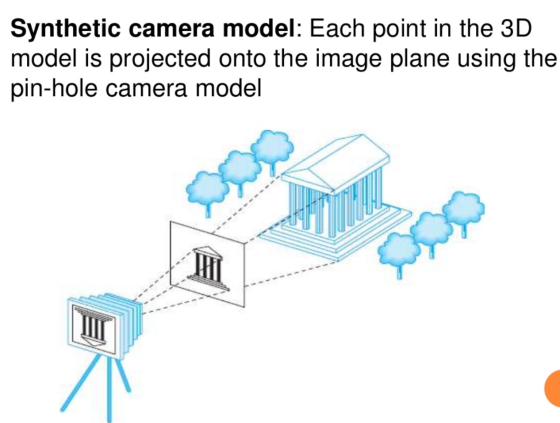
Ans 2: Synthetic Camera Model-
- In Computer Graphics, we use a synthetic camera model to mimic the behaviour of real camera.
- In this model, we avoid the inversion by placing the film plane, called the projection plane, in front of the lens.
- The clipping rectangle or clipping window determines the size of the image.
Synthetic camera model vs natural viewing system(eye)-
- Absolute versus subjective measuring of light: Simply speaking, the human eye is a subjective device. This means that your eyes work in harmony with your brain to create the images you perceive: Your eyes are adjusting the focus (by bending the light through the lens in your eyeballs) and translating photons (light) into an electrical impulse your brain can process. From there onwards, it’s all about your brain: It is continuously readjusting its colour balance according to the lighting context. In other words, our eyes know what must be seen as red or white or black etc.
- A camera, on the other hand, is an absolute measurement
device — It is measuring the light that hits a series of
sensor, but the sensor is ‘dumb’, and the signals recorded need to
be adjusted to suit the color temperature of the light illuminating
the scene, for example
-
Lens focus: In camera, the lens moves closer/further from the film to focus. In your eyes, the lens changes shape to focus: The muscles in your eyes change the actual shape of the lens inside your eyes.
-
Sensitivity to light: A film in a camera is uniformly sensitive to light. The human retina is not. Therefore, with respect to quality of image and capturing power, our eyes have a greater sensitivity in dark locations than a typical camera.
There are lighting situations that a current digital cameras cannot capture easily: The photos will come out blurry, or in a barrage of digital noise. As an example, when observing a fluorescence image of cells under a microscope, the image you can see with your eyes would be nigh-on impossible to capture for an ordinary camera. This is mainly because of the fact that the amount of light entering the camera (and your eyes) is so low.
-
Ans 3: Answer in the image.
Ans 4: Object Space or Local
space
Local space is the coordinate space that is local to your
object, i.e. where your object begins in. Imagine that you've
created your cube in a modeling software package (like Blender).
The origin of your cube is probably at (0,0,0) even
though your cube might end up at a different location in your final
application. Probably all the models you've created all have
(0,0,0) as their initial position. All the vertices of
your model are therefore in local space: they are all
local to your object.
The vertices of the container we've been using were specified as
coordinates between -0.5 and 0.5 with
0.0 as its origin. These are local coordinates.
Ans 5: World space
If we would import all our objects directly in the application
they would probably all be somewhere positioned inside each other
at the world's origin of (0,0,0) which is not what we
want. We want to define a position for each object to position them
inside a larger world. The coordinates in world space are exactly
what they sound like: the coordinates of all your vertices relative
to a (game) world. This is the coordinate space where you want your
objects transformed to in such a way that they're all scattered
around the place (preferably in a realistic fashion). The
coordinates of your object are transformed from local to world
space; this is accomplished with the model matrix.
Ans 6: Answer in image.
Ans 7: (Further adding to Ans 5)
: The model matrix is a transformation matrix that
translates, scales and/or rotates your object to place it in the
world at a location/orientation they belong to. Think of it as
transforming a house by scaling it down (it was a bit too large in
local space), translating it to a suburbia town and rotating it a
bit to the left on the y-axis so that it neatly fits with the
neighboring houses. You could think of the matrix in the previous
chapter to position the container all over the scene as a sort of
model matrix as well; we transformed the local coordinates of the
container to some different place in the scene/world.
Ans 8: Projection & it's types: It is the
process of converting a 3D object into a 2D object. It is also
defined as mapping or transformation of the object in projection
plane or view plane. The view plane is displayed surface.
(Types in the image).
Ans 9: Orthographic vs
Perspective Projection:
Orthographic projections are parallel projections. Each line that
is originally parallel will be parallel after this transformation.
The orthographic projection can be represented by a affine
transformation.
In contrast a perspective projection is not a parallel
projection and originally parallel lines will no longer be parallel
after this operation. Thus perspective projection can not be done
by a affine transform.
Ans 10: Look-At 
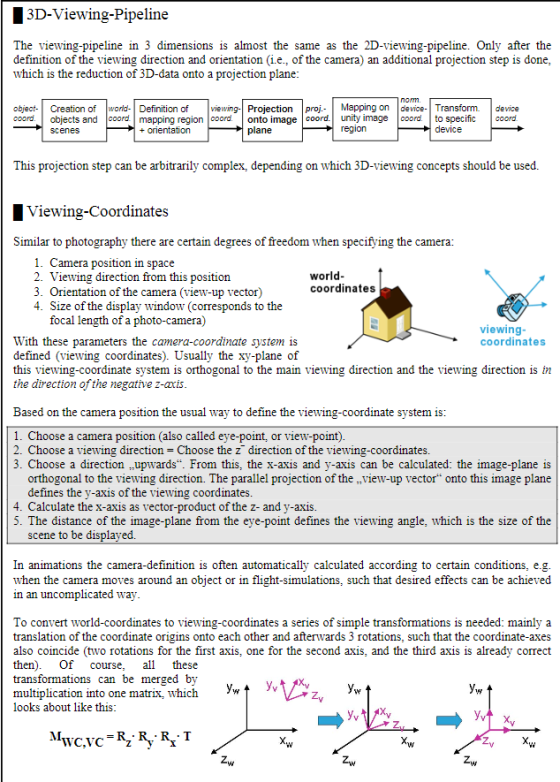

 The idea of the method is simple. In order to set a camera position
and orientation, all you really need is a point to set the camera
position in space which we will refer to as the
from point, and a point that defines what the
camera is looking at. We will refer to this point as the
to point.
The idea of the method is simple. In order to set a camera position
and orientation, all you really need is a point to set the camera
position in space which we will refer to as the
from point, and a point that defines what the
camera is looking at. We will refer to this point as the
to point.
Add Answer to:
Question 1: Illustrate the Rendering pipeline of the graphic systems. Answer: Question 2: Discuss the Synthetic...
** Please read the case study below to answer question 1, 2 and 3 Starbuck Community....
 ** Please read the case study below to answer question 1, 2 and 3 Starbuck Community. Connection. Caring. Committed. Coffee. Five Cs that describe the essence of Starbucks Corporation, what it stands for and what it wants to be as a business. With more than 19,000 stores in 62 countries, Starbucks is the world's number one specialty coffee retailer. The company also owns Seattle's Best Coffee, Tsavana. Taze, Starbucks VIA, Starbucks Refreshers, Evolution Fresh, LaBoulange, and Verismo brands. It's a...
 ** Please read the case study below to answer question 1, 2 and 3 Starbuck Community. Connection. Caring. Committed. Coffee. Five Cs that describe the essence of Starbucks Corporation, what it stands for and what it wants to be as a business. With more than 19,000 stores in 62 countries, Starbucks is the world's number one specialty coffee retailer. The company also owns Seattle's Best Coffee, Tsavana. Taze, Starbucks VIA, Starbucks Refreshers, Evolution Fresh, LaBoulange, and Verismo brands. It's a...
Most questions answered within 3 hours.
-
Where is the error in this code sequence?
String s1 = "Hello";
String s2 = "ello";...
asked 11 months ago -
Financial data for Joel de Paris, Inc., for last year
follow:
Joel de Paris, Inc.
Balance...
asked 11 months ago -
Consider this reaction:
Al2(SO4)3 (aq)+ BaCl3
(aq) Al2Cl6 (aq)- +
3BaSO4(s) . What is the...
asked 11 months ago -
Suppose that Savneet is considering increasing her
recent random sample from 20 car rentals to 40...
asked 11 months ago -
Trucks arrive at an unloading terminal at an average rate of 120
per hour.
Trucks arrive...
asked 11 months ago -
Why are methanol and ethanol completely soluble in water while
octanol is not very little soluble....
asked 11 months ago -
A facilities manager at a university reads in a research report
that the mean amount of...
asked 11 months ago -
When the CuSO4 is rehydrated by adding water to the anhydrous
compound, is this an endothermic...
asked 11 months ago -
A ray of sunlight is passing from diamond into crown glass; the
angle of incidence is...
asked 11 months ago -
A block of mass 0.249 kg is placed on top of a light, vertical
spring of...
asked 11 months ago -
how do the kidneys compensate in the presences of acidosis
a) trigger hyperventilate
b) reserve acid...
asked 11 months ago -
Question 501 pts
The rental rate of capital to the firm increases. Which of the
following...
asked 11 months ago