engneering
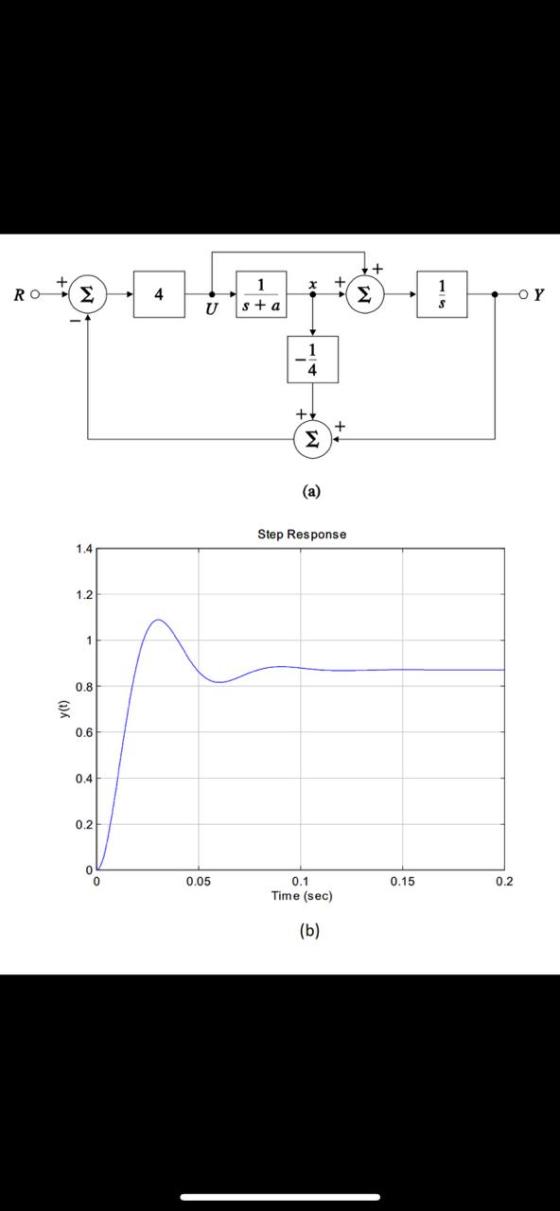
Q1) For the system in figure (a), find the equivalent transfer function Y(s)/R(s).
Q2) The figure (b) represents the step response of a linear system.
i) Find the order of the system.
ii) Find the damping factor of the system.
Note: Q1 and Q2 are independent.
Homework Answers
Request Answer!
We need at least 9 more requests to produce the answer.
1 / 10 have requested this problem solution
The more requests, the faster the answer.
Q2 (a) Consider the control system shown in Figure Q1 (a). Obtain the closed-loop transfer function...
 Q2 (a) Consider the control system shown in Figure Q1 (a). Obtain the closed-loop transfer function of this system and by using MATLAB obtain the unit step response of this closed loop system - R(S) c(s) 36+1) (s + 1) Figure Q2 (a) (b) A sampler and a zero-order hold element were inserted into the system in Figure Q1(a) as shown in Figure Q1(b). Obtain the closed-loop pulse transfer function of this system and by using MATLAB or otherwise, obtain...
Q1. Show analytically that the Root Locus for the unity feedback system with open loop transfer f...
 Q1. Show analytically that the Root Locus for the unity feedback system with open loop transfer function: (a) [10 marks] K(s 4) (s + 2) is a circle, and find the centre and the radius. Determine the minimum value of the damping ratio and the corresponding value of K (b) The root locus of the open loop transfer function: [10 marks] s(s26s +15) is depicted in Figure Q1(b). Find the minimum value of gain K that will render the system...
A chemical process unit exhibits an underdamped second order behavior as given by the transfer function:...
 A chemical process unit exhibits an underdamped second order behavior as given by the transfer function: Y(s) U(s) 18 s2 + 3s + 9 Calculate the process gain, natural period of oscillation and damping factor for the system. (3m) b. If a step change in the input with the magnitude of 3 is introduced, i. Determine the step response (5m) ii. Estimate the new steady-state value of y. (2m)
Question three The figure below shows a unit step response of a second order system. From...
 Question three The figure below shows a unit step response of a second order system. From the graph of response find: 1- The rise timet, 2- The peak timet, 3- The maximum overshoot Mp 4- The damped natural frequency w 5. The transfer function. Hence find the damping ratio ζ and the natural frequency ah-Find also the transfer function of the system. r 4 02 15 25 35 45 Question Four For the control system shown in the figure below,...
Wis) R(s u(s) 14 Gl(s) H(s) Given a system as in the diagram above, where K is an adjustable pa...
 Wis) R(s u(s) 14 Gl(s) H(s) Given a system as in the diagram above, where K is an adjustable parameter pl(s) Dal(sKp+ g) Assuming W-0, find the transfer function Y(s)/R(s) h) Assuming R-0, find the transfer function Y(s)/W(s) i) What is the type of the system (with respect to steady-state error)? j) What is the steady-state error when rt)u(t) (unit-step) and w(t)-0 k) What is the s.s. error when r(t) t u(t) and w(t)-0 ) Assume r(t)-0, what is the...
Higher Colleges of Technology Faculty of Electronic Engineering Class Assignment 4 Second Order Systems EEC 4043:...
 Higher Colleges of Technology Faculty of Electronic Engineering Class Assignment 4 Second Order Systems EEC 4043: Control Systems Score from 5 Student Name Student ID # You are required to analyze a DC motor speed control system shown in Figure I and 2 below. Figure 1 shows the equivalent circuit diagram of the DC motor control system, while Figure 2 shows the block diagram of the system feedback control G(s) drmanvee Motor Figare 2: The System Feedhack syacm daprams Figue...
answer true or false for all the questions given. om the controlled variable 9. The transfer...
 answer true or false for all the questions given.
om the controlled variable 9. The transfer function of a LTI system is the Laplace Transform of its time to 10. If a system has 2 real and equal characteristic rootspoles). It is described as having to damping 11. In a closed-loop system, feedback is the measurement path. 12. For a second order system with damping <1, the roots of the characteristic equation are complex conjugates. 13. Time constant is the...
answer true or false for all the questions given.
om the controlled variable 9. The transfer function of a LTI system is the Laplace Transform of its time to 10. If a system has 2 real and equal characteristic rootspoles). It is described as having to damping 11. In a closed-loop system, feedback is the measurement path. 12. For a second order system with damping <1, the roots of the characteristic equation are complex conjugates. 13. Time constant is the...
C(8) for the system shown in Figure 1. R(S Find the equivalent transfer function, Geg (s)...
 C(8) for the system shown in Figure 1. R(S Find the equivalent transfer function, Geg (s) 1 Cix) Figure 1. Block diagram 2s+1 s(5s+6Ge(s) = and Figure 2 shows a closed-loop transfer function, where G(s) 2. proper H(s) K+s. Find the overall closed-loop transfer function and express is as rational function. C(s) Ea (s) Controller R(s) +/ Plant G(s) Ge (s) Feedback H(s) Figure 2. Closed loop transfer function Construct the actuation Error Transfer Function associated with the system shown...
Need help with 1a and 1b. Please show all work I (a) The unit step response...
 Need help with 1a and 1b. Please show all work
I (a) The unit step response of a linear control system is shown below: 1.35 1.0 0 0.1 (sec) Find the transfer function of the second-order prototype system to model the system (b) The block diagram of a unity feedback control system is shown below. Find the step-, ramp-, and parabolic-error constants. The error signal is defined to be e(t). Find the steady-state errors in terms of K and Kt...
Need help with 1a and 1b. Please show all work
I (a) The unit step response of a linear control system is shown below: 1.35 1.0 0 0.1 (sec) Find the transfer function of the second-order prototype system to model the system (b) The block diagram of a unity feedback control system is shown below. Find the step-, ramp-, and parabolic-error constants. The error signal is defined to be e(t). Find the steady-state errors in terms of K and Kt...
Explain the effect of an increasing damping ratio to the dynamic response of a second a)...
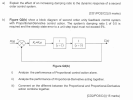 Explain the effect of an increasing damping ratio to the dynamic response of a second a) order control system. [CO1/PO2/C2] (5 marks) b) Figure Q2(b) show a block diagram of second order unity feedback control system with Proportional-Derivative control action. The system's damping ratio E of 0.5 is required and the steady state error to a unit step input must not exceed 5% C(s) 1 1 R(s) Kp+Kas (s+1) (s+5) Figure Q2(b) Analyze the performance of Proportional control action alone....
 Q2 (a) Consider the control system shown in Figure Q1 (a). Obtain the closed-loop transfer function of this system and by using MATLAB obtain the unit step response of this closed loop system - R(S) c(s) 36+1) (s + 1) Figure Q2 (a) (b) A sampler and a zero-order hold element were inserted into the system in Figure Q1(a) as shown in Figure Q1(b). Obtain the closed-loop pulse transfer function of this system and by using MATLAB or otherwise, obtain...
 Q1. Show analytically that the Root Locus for the unity feedback system with open loop transfer function: (a) [10 marks] K(s 4) (s + 2) is a circle, and find the centre and the radius. Determine the minimum value of the damping ratio and the corresponding value of K (b) The root locus of the open loop transfer function: [10 marks] s(s26s +15) is depicted in Figure Q1(b). Find the minimum value of gain K that will render the system...
 A chemical process unit exhibits an underdamped second order behavior as given by the transfer function: Y(s) U(s) 18 s2 + 3s + 9 Calculate the process gain, natural period of oscillation and damping factor for the system. (3m) b. If a step change in the input with the magnitude of 3 is introduced, i. Determine the step response (5m) ii. Estimate the new steady-state value of y. (2m)
 Question three The figure below shows a unit step response of a second order system. From the graph of response find: 1- The rise timet, 2- The peak timet, 3- The maximum overshoot Mp 4- The damped natural frequency w 5. The transfer function. Hence find the damping ratio ζ and the natural frequency ah-Find also the transfer function of the system. r 4 02 15 25 35 45 Question Four For the control system shown in the figure below,...
 Wis) R(s u(s) 14 Gl(s) H(s) Given a system as in the diagram above, where K is an adjustable parameter pl(s) Dal(sKp+ g) Assuming W-0, find the transfer function Y(s)/R(s) h) Assuming R-0, find the transfer function Y(s)/W(s) i) What is the type of the system (with respect to steady-state error)? j) What is the steady-state error when rt)u(t) (unit-step) and w(t)-0 k) What is the s.s. error when r(t) t u(t) and w(t)-0 ) Assume r(t)-0, what is the...
 Higher Colleges of Technology Faculty of Electronic Engineering Class Assignment 4 Second Order Systems EEC 4043: Control Systems Score from 5 Student Name Student ID # You are required to analyze a DC motor speed control system shown in Figure I and 2 below. Figure 1 shows the equivalent circuit diagram of the DC motor control system, while Figure 2 shows the block diagram of the system feedback control G(s) drmanvee Motor Figare 2: The System Feedhack syacm daprams Figue...
 answer true or false for all the questions given.
om the controlled variable 9. The transfer function of a LTI system is the Laplace Transform of its time to 10. If a system has 2 real and equal characteristic rootspoles). It is described as having to damping 11. In a closed-loop system, feedback is the measurement path. 12. For a second order system with damping <1, the roots of the characteristic equation are complex conjugates. 13. Time constant is the...
answer true or false for all the questions given.
om the controlled variable 9. The transfer function of a LTI system is the Laplace Transform of its time to 10. If a system has 2 real and equal characteristic rootspoles). It is described as having to damping 11. In a closed-loop system, feedback is the measurement path. 12. For a second order system with damping <1, the roots of the characteristic equation are complex conjugates. 13. Time constant is the...
 C(8) for the system shown in Figure 1. R(S Find the equivalent transfer function, Geg (s) 1 Cix) Figure 1. Block diagram 2s+1 s(5s+6Ge(s) = and Figure 2 shows a closed-loop transfer function, where G(s) 2. proper H(s) K+s. Find the overall closed-loop transfer function and express is as rational function. C(s) Ea (s) Controller R(s) +/ Plant G(s) Ge (s) Feedback H(s) Figure 2. Closed loop transfer function Construct the actuation Error Transfer Function associated with the system shown...
 Need help with 1a and 1b. Please show all work
I (a) The unit step response of a linear control system is shown below: 1.35 1.0 0 0.1 (sec) Find the transfer function of the second-order prototype system to model the system (b) The block diagram of a unity feedback control system is shown below. Find the step-, ramp-, and parabolic-error constants. The error signal is defined to be e(t). Find the steady-state errors in terms of K and Kt...
Need help with 1a and 1b. Please show all work
I (a) The unit step response of a linear control system is shown below: 1.35 1.0 0 0.1 (sec) Find the transfer function of the second-order prototype system to model the system (b) The block diagram of a unity feedback control system is shown below. Find the step-, ramp-, and parabolic-error constants. The error signal is defined to be e(t). Find the steady-state errors in terms of K and Kt...
 Explain the effect of an increasing damping ratio to the dynamic response of a second a) order control system. [CO1/PO2/C2] (5 marks) b) Figure Q2(b) show a block diagram of second order unity feedback control system with Proportional-Derivative control action. The system's damping ratio E of 0.5 is required and the steady state error to a unit step input must not exceed 5% C(s) 1 1 R(s) Kp+Kas (s+1) (s+5) Figure Q2(b) Analyze the performance of Proportional control action alone....
Most questions answered within 3 hours.
-
Where is the error in this code sequence?
String s1 = "Hello";
String s2 = "ello";...
asked 10 months ago -
Financial data for Joel de Paris, Inc., for last year
follow:
Joel de Paris, Inc.
Balance...
asked 10 months ago -
Consider this reaction:
Al2(SO4)3 (aq)+ BaCl3
(aq) Al2Cl6 (aq)- +
3BaSO4(s) . What is the...
asked 10 months ago -
Suppose that Savneet is considering increasing her
recent random sample from 20 car rentals to 40...
asked 10 months ago -
Trucks arrive at an unloading terminal at an average rate of 120
per hour.
Trucks arrive...
asked 10 months ago -
Why are methanol and ethanol completely soluble in water while
octanol is not very little soluble....
asked 10 months ago -
A facilities manager at a university reads in a research report
that the mean amount of...
asked 10 months ago -
When the CuSO4 is rehydrated by adding water to the anhydrous
compound, is this an endothermic...
asked 10 months ago -
A ray of sunlight is passing from diamond into crown glass; the
angle of incidence is...
asked 10 months ago -
A block of mass 0.249 kg is placed on top of a light, vertical
spring of...
asked 10 months ago -
how do the kidneys compensate in the presences of acidosis
a) trigger hyperventilate
b) reserve acid...
asked 10 months ago -
Question 501 pts
The rental rate of capital to the firm increases. Which of the
following...
asked 10 months ago