Measurement errors
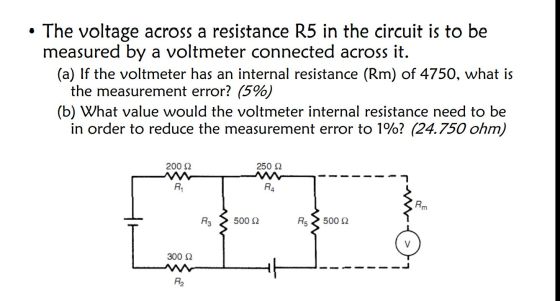
The voltage across a resistance R5 in the circuit is to be
measured by a voltmeter connected across it.
(a) If the voltmeter has an internal resistance (Rm) of 4750, what is
the measurement error? (5%)
(b) What value would the voltmeter internal resistance need to be
in order to reduce the measurement error to 1%? (24.750 ohm)
Homework Answers
(a)
The circuit in which the voltage across the resistance R5 is measured is:

In Figure 1, the resistance Rm acts like a shunt resistance to R5 and hence, decreases the resistance between the terminals AB. So, the voltage Em measured by the voltmeter V is not equal to the voltage value E0.
Thevenin’s theorem is used to find the voltage E0 in which the circuit in Figure 1 is replaced by the equivalent circuit with a single voltage source Es and an equivalent resistance RAB. For this purpose, all the voltage sources E1 and E2 are short-circuited.
Draw the circuit in which all the voltage sources are short-circuited for finding the Thevenin equivalent resistance as shown in Figure 2.

Draw the Thevenin equivalent network for the circuit of Figure 1 as shown in Figure 3.

In Figure 2, resistances R1 and R2 are in series to each other and the pair of series resistances R1 and R2 is in parallel to R3 across the terminal CD.

 …… (1)
Substitute 200Ω for R1, 300Ω for R2 and 500Ω for R3 in equation (1).

In Figure 2, resistances RCD and R4 are series to each other and the pair of series resistances RCD and R4 is parallel to R5 across the terminal AB.

 …… (2)
Substitute 250Ω for RCD, 250Ω for R4 and 500Ω for R5 in equation (2).

From Figure 3, it is found that the current I flowing through the circuit is:
 …… (3)
The voltage measured by the voltmeter Em is:
 …… (4)
Substitute  for I in equation (4).

 …… (5)
The measurement error of the voltmeter is defined by the term E0 - Em
Equation (5) can be rewritten as follows to find the measurement error of the voltmeter.


 …… (6)
Substitute 4750Ω for Rm and 250Ω for RAB in equation (6).

Hence, the measurement error of the voltmeter V is 5%.
(b)
Since the measurement error of the voltmeter is 1%.
Therefore,
E0 - Em=0.01E0
Substitute 0.01E0 for E0 - Em and 250 ? for RAB in equation (6).


250 + Rm = 25000
Rm = 25000 - 250 = 24.75kΩ
Hence, the internal resistance of the voltmeter with a measurement error of 1% is 24.75kΩ.
2. The voltage across a resistance Rs in the following circuit is to be measured by...
 2. The voltage across a resistance Rs in the following circuit is to be measured by a voltmeter connected across it. (a) If the voltmeter has infinity internal resistance (Rm), what is the measurement error? (b) If the voltmeter has an internal resistance (Rm) of 9500 W, what is the measurement error? (c) What value would the voltmeter internal resistance need to be in order to reduce the measurement error to 1%? R4 Circuit Parameters Vs1 12 V R1-400 Ω...
2.5 Loading effects. The ratings of a piezoelectric sensor indicate that at a certain stimulus the...
2.5 Loading effects. The ratings of a piezoelectric sensor indicate that at a certain stimulus the sensor provides an output of 150 V at no load. The short-circuit current of the sensor is measured and found to be 10 micro(A) (this is done by shorting the output through a current meter). To measure the output voltage of the sensor, a voltmeter with an internal impedance of 10 Mega(ohm) is connected across the sensor. a. Calculate the actual reading of the...
Imagine that you connect a 10 ohm resistor and a 1 megaohm resistor in series to...
Imagine that you connect a 10 ohm resistor and a 1 megaohm resistor in series to a battery. If you use a voltmeter that has a 1 megaohm internal resistance to measure the voltage across each resistor. Which measurement will affected most by the internal resistance of the ohm meter? the voltage across the 10 ohm resistor. the voltage across the 1 megaohm resistor. both measurement will be affected the same.
A 6.0 V battery is connected to two 7.70 kilo-Ohm resistors in series. An ammeter of...
A 6.0 V battery is connected to two 7.70 kilo-Ohm resistors in series. An ammeter of internal resistance 0.570 Ohm measures the current and at the same time a voltmeter with internal resistance 15.2 kilo-Ohm measures the voltage across one of the 7.70 kilo-Ohm resistors in the circuit. What does the ammeter read? What does the voltmeter read?
can you sovle this problem, also I need the code for part d. thanks Problem #5 Ri Vy= Probe I R- 1502 o VOLTMETER IN...
 can you sovle this problem, also I need the code for part d.
thanks
Problem #5 Ri Vy= Probe I R- 1502 o VOLTMETER INPUT CIRCUIT Probe 2 Express resistance in ohms (2) and voltage in volts (V) Requirements-Part 1 (voltmeter not attached yet) a) Suppose you want to produce a voltage of 1 V across resistor R2 (i.e. Vor 1 V) Use the voltage divider equation to find the value of Ri that is needed to do this. b)...
can you sovle this problem, also I need the code for part d.
thanks
Problem #5 Ri Vy= Probe I R- 1502 o VOLTMETER INPUT CIRCUIT Probe 2 Express resistance in ohms (2) and voltage in volts (V) Requirements-Part 1 (voltmeter not attached yet) a) Suppose you want to produce a voltage of 1 V across resistor R2 (i.e. Vor 1 V) Use the voltage divider equation to find the value of Ri that is needed to do this. b)...
In the circuit shown in the following figure, the voltage across the R1 = 5.50 Ohm...
 In the circuit shown in the following figure, the voltage across the R1 = 5.50 Ohm resistor is 27.0 V. what are the emf of the battery and the current through the 6.00-Ohm resistor? (Let R2 = 1.00 Ohm) Epsilon = _____ V I = __________ A A capacitor is charged to a potential of 13.0 V and is connected to a voltmeter having an internal resistance of 3.45 Mohm. After a time of 3.50 s the voltmeter reads 3.0...
Internal resistance problem. Suppose that in Figure 3.3, Vo=10VVo=10V, R1=175kΩR1=175kΩ, R2=400kΩR2=400kΩ, and Ri=1MΩRi=1MΩ. Initially, the voltmeter...
 Internal resistance problem. Suppose that in Figure 3.3,
Vo=10VVo=10V, R1=175kΩR1=175kΩ, R2=400kΩR2=400kΩ, and Ri=1MΩRi=1MΩ.
Initially, the voltmeter is disconnected.
EXAMPLES:
What is the voltage across R2R2? [Answer: 6.95652173913043
V.]
What is the voltage across R2R2 with the meter connected? [Answer:
6.2015503875969 V.]
QUESTION:
If the internal resistance of the meter were 14 M ΩΩ, what is the
voltage across R2R2?
Thanks ahead
Voltmeter Figure 3.3: Circuit used to observe the effect of test equipment on a measurement.
Internal resistance problem. Suppose that in Figure 3.3,
Vo=10VVo=10V, R1=175kΩR1=175kΩ, R2=400kΩR2=400kΩ, and Ri=1MΩRi=1MΩ.
Initially, the voltmeter is disconnected.
EXAMPLES:
What is the voltage across R2R2? [Answer: 6.95652173913043
V.]
What is the voltage across R2R2 with the meter connected? [Answer:
6.2015503875969 V.]
QUESTION:
If the internal resistance of the meter were 14 M ΩΩ, what is the
voltage across R2R2?
Thanks ahead
Voltmeter Figure 3.3: Circuit used to observe the effect of test equipment on a measurement.
A battery with E = 12.0 V and internal resistance r=1.2Ω is connected to two 8.5-kΩ...
A battery with E = 12.0 V and internal resistance r=1.2Ω is connected to two 8.5-kΩ resistors in series. An ammeter of internal resistance 0.30 Ωmeasures the current, and at the same time a voltmeter with internal resistance 17 kΩ measures the voltage across one of the 8.5-kΩ resistors in the circuit. What does the ammeter read? What does the voltmeter read? What is the % "error" from the current without meters? What is the % "error" from the voltage...
Please show full work of the following, thanks Voltmeter Vo 0 Figure 3.3: Circuit used to...
 Please show full work of the following, thanks
Voltmeter Vo 0 Figure 3.3: Circuit used to observe the effect of test equipment on a measurement. Internal resistance problem. Suppose that in Figure 3.3, Vo-13V, Ri 250kS2, R2 -375k2, and R1.3MS2. Initially, the voltmeter is disconnected. EXAMPLES: What is the voltage across R2? [Answer: 7.8 V] What is the voltage across R2 with the meter connected? [Answer: 6.99310344827586 V.] QUESTION: If the internal resistance of the meter were 13 M Ω,...
Please show full work of the following, thanks
Voltmeter Vo 0 Figure 3.3: Circuit used to observe the effect of test equipment on a measurement. Internal resistance problem. Suppose that in Figure 3.3, Vo-13V, Ri 250kS2, R2 -375k2, and R1.3MS2. Initially, the voltmeter is disconnected. EXAMPLES: What is the voltage across R2? [Answer: 7.8 V] What is the voltage across R2 with the meter connected? [Answer: 6.99310344827586 V.] QUESTION: If the internal resistance of the meter were 13 M Ω,...
When you connect a standalone battery to a voltmeter the voltmeter reads 5 V. (a) Assuming...
When you connect a standalone battery to a voltmeter the voltmeter reads 5 V. (a) Assuming the voltmeter has a very high resistance, what is the approximate elec- tromotive force in the battery? (b) When you hook the same battery up to a circuit with a 15 Ohm resistor, you hook up the voltmeter to read the terminal voltage across the battery and it now reads 4.688 V instead of 5 V. What is the internal resistance of the battery?
 2. The voltage across a resistance Rs in the following circuit is to be measured by a voltmeter connected across it. (a) If the voltmeter has infinity internal resistance (Rm), what is the measurement error? (b) If the voltmeter has an internal resistance (Rm) of 9500 W, what is the measurement error? (c) What value would the voltmeter internal resistance need to be in order to reduce the measurement error to 1%? R4 Circuit Parameters Vs1 12 V R1-400 Ω...
 can you sovle this problem, also I need the code for part d.
thanks
Problem #5 Ri Vy= Probe I R- 1502 o VOLTMETER INPUT CIRCUIT Probe 2 Express resistance in ohms (2) and voltage in volts (V) Requirements-Part 1 (voltmeter not attached yet) a) Suppose you want to produce a voltage of 1 V across resistor R2 (i.e. Vor 1 V) Use the voltage divider equation to find the value of Ri that is needed to do this. b)...
can you sovle this problem, also I need the code for part d.
thanks
Problem #5 Ri Vy= Probe I R- 1502 o VOLTMETER INPUT CIRCUIT Probe 2 Express resistance in ohms (2) and voltage in volts (V) Requirements-Part 1 (voltmeter not attached yet) a) Suppose you want to produce a voltage of 1 V across resistor R2 (i.e. Vor 1 V) Use the voltage divider equation to find the value of Ri that is needed to do this. b)...
 In the circuit shown in the following figure, the voltage across the R1 = 5.50 Ohm resistor is 27.0 V. what are the emf of the battery and the current through the 6.00-Ohm resistor? (Let R2 = 1.00 Ohm) Epsilon = _____ V I = __________ A A capacitor is charged to a potential of 13.0 V and is connected to a voltmeter having an internal resistance of 3.45 Mohm. After a time of 3.50 s the voltmeter reads 3.0...
 Internal resistance problem. Suppose that in Figure 3.3,
Vo=10VVo=10V, R1=175kΩR1=175kΩ, R2=400kΩR2=400kΩ, and Ri=1MΩRi=1MΩ.
Initially, the voltmeter is disconnected.
EXAMPLES:
What is the voltage across R2R2? [Answer: 6.95652173913043
V.]
What is the voltage across R2R2 with the meter connected? [Answer:
6.2015503875969 V.]
QUESTION:
If the internal resistance of the meter were 14 M ΩΩ, what is the
voltage across R2R2?
Thanks ahead
Voltmeter Figure 3.3: Circuit used to observe the effect of test equipment on a measurement.
Internal resistance problem. Suppose that in Figure 3.3,
Vo=10VVo=10V, R1=175kΩR1=175kΩ, R2=400kΩR2=400kΩ, and Ri=1MΩRi=1MΩ.
Initially, the voltmeter is disconnected.
EXAMPLES:
What is the voltage across R2R2? [Answer: 6.95652173913043
V.]
What is the voltage across R2R2 with the meter connected? [Answer:
6.2015503875969 V.]
QUESTION:
If the internal resistance of the meter were 14 M ΩΩ, what is the
voltage across R2R2?
Thanks ahead
Voltmeter Figure 3.3: Circuit used to observe the effect of test equipment on a measurement.
 Please show full work of the following, thanks
Voltmeter Vo 0 Figure 3.3: Circuit used to observe the effect of test equipment on a measurement. Internal resistance problem. Suppose that in Figure 3.3, Vo-13V, Ri 250kS2, R2 -375k2, and R1.3MS2. Initially, the voltmeter is disconnected. EXAMPLES: What is the voltage across R2? [Answer: 7.8 V] What is the voltage across R2 with the meter connected? [Answer: 6.99310344827586 V.] QUESTION: If the internal resistance of the meter were 13 M Ω,...
Please show full work of the following, thanks
Voltmeter Vo 0 Figure 3.3: Circuit used to observe the effect of test equipment on a measurement. Internal resistance problem. Suppose that in Figure 3.3, Vo-13V, Ri 250kS2, R2 -375k2, and R1.3MS2. Initially, the voltmeter is disconnected. EXAMPLES: What is the voltage across R2? [Answer: 7.8 V] What is the voltage across R2 with the meter connected? [Answer: 6.99310344827586 V.] QUESTION: If the internal resistance of the meter were 13 M Ω,...
Most questions answered within 3 hours.
-
Where is the error in this code sequence?
String s1 = "Hello";
String s2 = "ello";...
asked 10 months ago -
Financial data for Joel de Paris, Inc., for last year
follow:
Joel de Paris, Inc.
Balance...
asked 10 months ago -
Consider this reaction:
Al2(SO4)3 (aq)+ BaCl3
(aq) Al2Cl6 (aq)- +
3BaSO4(s) . What is the...
asked 10 months ago -
Suppose that Savneet is considering increasing her
recent random sample from 20 car rentals to 40...
asked 10 months ago -
Trucks arrive at an unloading terminal at an average rate of 120
per hour.
Trucks arrive...
asked 10 months ago -
Why are methanol and ethanol completely soluble in water while
octanol is not very little soluble....
asked 10 months ago -
A facilities manager at a university reads in a research report
that the mean amount of...
asked 10 months ago -
When the CuSO4 is rehydrated by adding water to the anhydrous
compound, is this an endothermic...
asked 10 months ago -
A ray of sunlight is passing from diamond into crown glass; the
angle of incidence is...
asked 10 months ago -
A block of mass 0.249 kg is placed on top of a light, vertical
spring of...
asked 10 months ago -
how do the kidneys compensate in the presences of acidosis
a) trigger hyperventilate
b) reserve acid...
asked 10 months ago -
Question 501 pts
The rental rate of capital to the firm increases. Which of the
following...
asked 10 months ago