
Homework Answers

Add Answer to:
Which is a pair of the most likely mechanisms for the C-I bond formations in the...
What substitution reaction mechanism is most likely for the following conversion? S_N1 S_N2 Either S_N1 or...
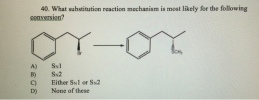 What substitution reaction mechanism is most likely for the following conversion? S_N1 S_N2 Either S_N1 or S_N2 None of these
Which of the following ring formations must involve a suprafacial bond formation?
Which of the following ring formations must involve a suprafacial bond formation?
Draw the products in the following reaction. Part 1 Identify which mechanism(s) the reaction will undergo....
 Draw the products in the following reaction. Part 1 Identify which mechanism(s) the reaction will undergo. A. S_N1 B. S_N2 C. EI D. E2 Part 2 The number of S_N1 product(s): The number of E1 product(s):
For each pair of atoms below, decide what type of bond is most likely to form...
For each pair of atoms below, decide what type of bond is most likely to form between them. C and H Be and C S and Cl
2. Which of the following is most likely a polar covalent bond? Na-C b. Н—Н d....
 2. Which of the following is most likely a polar covalent bond? Na-C b. Н—Н d. KF а. Са—О е. С—N с.
a = Proton transfer b = Lewis acid/base c = Radical chain substitution d = Radical...
 a = Proton transfer b = Lewis acid/base c = Radical chain substitution d = Radical chain addition e = Electrophilic addition f = E1 Elimination g = E2 Elimination h = S_N1 Nucleophilic substitution i = S_N2 Nucleophilic substitution j = Electrophilic aromatic substitution Identify the mechanism by which each of the reactions above proceeds from among the mechanisms listed. Use the letters a - j for your answers.
Aluminum reacts with oxygen to form Al2O3. Which pair of elements would most likely yield a...
Aluminum reacts with oxygen to form Al2O3. Which pair of elements would most likely yield a compound with a similar formula? a. In and S b. B and F c. Si and O d. Zn and N
Which of the following is the most likely noncovalent interaction observed between a carboxylic acid and...
Which of the following is the most likely noncovalent interaction observed between a carboxylic acid and an alcohol? A) charge-charge interaction B) charge-dipole interaction C) dipole-dipole interaction D) dipole-induced dipole interaction E) formation of an ester bond Please answer the question with explanation and draw the molecules to show the bond between them. Thank you so much
(SNI,5Na, EI, E2) 5. Draw all possible products after determining which mechanisms are most likely. oclcs)...
 (SNI,5Na, EI, E2) 5. Draw all possible products after determining which mechanisms are most likely. oclcs) a Br Br b. CHe CH OH For the following E1 reaction, 6. Draw the two steps Draw the transition state for each step
1. Which one of the following is most likely to be an ionic compound? A) CaCl2...
1. Which one of the following is most likely to be an ionic compound? A) CaCl2 B) CO2 C) CS2 D) SO2 E) OF2 2. Which one of the following ionic solids would have the largest lattice energy? A) NaCl B) NaF C) CaBr2 D) CsI E) CaCl2 3. Calculate the energy change for the reaction K(g) + I(g) → K+(g) + I – (g) given the following ionization energy (IE) and electron affinity (EA) values. IE K: 419 kJ/mol...
 What substitution reaction mechanism is most likely for the following conversion? S_N1 S_N2 Either S_N1 or S_N2 None of these
 Draw the products in the following reaction. Part 1 Identify which mechanism(s) the reaction will undergo. A. S_N1 B. S_N2 C. EI D. E2 Part 2 The number of S_N1 product(s): The number of E1 product(s):
 2. Which of the following is most likely a polar covalent bond? Na-C b. Н—Н d. KF а. Са—О е. С—N с.
 a = Proton transfer b = Lewis acid/base c = Radical chain substitution d = Radical chain addition e = Electrophilic addition f = E1 Elimination g = E2 Elimination h = S_N1 Nucleophilic substitution i = S_N2 Nucleophilic substitution j = Electrophilic aromatic substitution Identify the mechanism by which each of the reactions above proceeds from among the mechanisms listed. Use the letters a - j for your answers.
 (SNI,5Na, EI, E2) 5. Draw all possible products after determining which mechanisms are most likely. oclcs) a Br Br b. CHe CH OH For the following E1 reaction, 6. Draw the two steps Draw the transition state for each step
Most questions answered within 3 hours.
-
Where is the error in this code sequence?
String s1 = "Hello";
String s2 = "ello";...
asked 11 months ago -
Financial data for Joel de Paris, Inc., for last year
follow:
Joel de Paris, Inc.
Balance...
asked 11 months ago -
Consider this reaction:
Al2(SO4)3 (aq)+ BaCl3
(aq) Al2Cl6 (aq)- +
3BaSO4(s) . What is the...
asked 11 months ago -
Suppose that Savneet is considering increasing her
recent random sample from 20 car rentals to 40...
asked 11 months ago -
Trucks arrive at an unloading terminal at an average rate of 120
per hour.
Trucks arrive...
asked 11 months ago -
Why are methanol and ethanol completely soluble in water while
octanol is not very little soluble....
asked 11 months ago -
A facilities manager at a university reads in a research report
that the mean amount of...
asked 11 months ago -
When the CuSO4 is rehydrated by adding water to the anhydrous
compound, is this an endothermic...
asked 11 months ago -
A ray of sunlight is passing from diamond into crown glass; the
angle of incidence is...
asked 11 months ago -
A block of mass 0.249 kg is placed on top of a light, vertical
spring of...
asked 11 months ago -
how do the kidneys compensate in the presences of acidosis
a) trigger hyperventilate
b) reserve acid...
asked 11 months ago -
Question 501 pts
The rental rate of capital to the firm increases. Which of the
following...
asked 11 months ago