Which of the following ring formations must involve a suprafacial bond formation?
Which of the following ring formations must involve a suprafacial bond formation?
Homework Answers
Must provide the ring formations for answer.
Repeat the question with proper details.
Add Answer to:
Which of the following ring formations must involve a
suprafacial bond formation?
Which is a pair of the most likely mechanisms for the C-I bond formations in the...
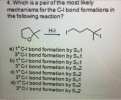 Which is a pair of the most likely mechanisms for the C-I bond formations in the following reaction? a) 1 degree C-I bond formation by S_N1 3 degree C-I bond formation by S_N1 b) 1 degree C-I bond formation by S_N1 3 degree C-I bond formation by S_N2 c) 1 degree C-I bond formation by S_N2 3 degree C-I bond formation by S_N1 d) 1 degree C-I bond formation by S_N2 3 degree C-I bond formation by S_N2
The rate-limiting step for the nitration of a benzene ring is _____________. formation of the electrophile...
The rate-limiting step for the nitration of a benzene ring is _____________. formation of the electrophile re-aromatization of the ring system the step in which C-N bond formation occurs C-H bond deprotonation none of these answers are correct
22) Proteins must be complex set of mol bond formation eins must bend and fold as...
 22) Proteins must be complex set of mol bond formation eins must bend and fold as they are synthesized with a x set of molecules assisting in this process. Disulfide formation helps to guide and stabilize this protein folding. What type of reaction is disulfide bond formation? a) oxidation-reduction b) acid-base c) isomerization d) splitting ("lysis") e) high energy bond transfer SH HS s-s Cys, free cysteines disulfide bor 23) Which of the following has a hydrophobic side chain? a)...
A national park is famous for its beautiful desert landscape and its many natural rock formations. The following...
A national park is famous for its beautiful desert landscape and its many natural rock formations. The following table is based on information gathered by a park ranger of all rock formations of at least 3 feet. The height of the rock formation is rounded to the nearest foot. Height of rock formation, feet 3
give the products for the following reactions; propose a mechanism to explain the formations of each...
 give the products for the following reactions; propose a mechanism
to explain the formations of each
1. Give the products for the following reactions, propose a mechanism to explain the formation of each: HCI ? (а) HCI ? но ? (b) (c) HB: ? HB ? HBF ?
give the products for the following reactions; propose a mechanism
to explain the formations of each
1. Give the products for the following reactions, propose a mechanism to explain the formation of each: HCI ? (а) HCI ? но ? (b) (c) HB: ? HB ? HBF ?
Pyridine, C5H5N, is a 6-membered ring containing the C atoms and the N atom. Aniline, [C6H5(NH2)]...
Pyridine, C5H5N, is a 6-membered ring containing the C atoms and the N atom. Aniline, [C6H5(NH2)] , is a hexagonal ring of 6 C atoms with a NH2 group attached to one of the C atoms in the ring (1) For each of the above molecules, draw (the) equivalent resonance structure(s) AND resonance structures that involve (introduce) a +1 and a -1 formal charge. (2) These molecules are Bronsted-Lowry bases – molecules containing at least one atom with a nonbonding...
Which of the following statements describes a correct step in the formation of an ionic bond...
Which of the following statements describes a correct step in the formation of an ionic bond between sodium and chlorine? 1. Removing an electron from sodium (ionization energy) will provide energy for ionic bond formation 2. Adding an electron to chlorine (electron affinity) will require energy 3. The Coulombic potential between the ions (lattice energy) will release energy 4. The Coulombic potential between the ions (lattice energy) will require energy
Although ring closing is favored over ring opening, if like in the formation of Vitamin D3...
Although ring closing is favored over ring opening, if like in the formation of Vitamin D3 we excite the closed product to open photolytically (with light), what would be the major product of the following reactions?
Which of the following is true of the mechanism for Glycosidic bond formation? 1. The hydroxyl...
Which of the following is true of the mechanism for Glycosidic bond formation? 1. The hydroxyl on C1 of the sugar is protonated 2. Electrons from oxygen stabilize the carbocation formed by the leaving water molecule 3. A Nitrogen from either a purine or a pyramidine attacks C1 of the sugar molecule 4. All of the above statements are true
using valence bond theory, determine which orbitals overlap in the formation on of the H-Br bond...
using valence bond theory, determine which orbitals overlap in the formation on of the H-Br bond in the molecule HBr?
 Which is a pair of the most likely mechanisms for the C-I bond formations in the following reaction? a) 1 degree C-I bond formation by S_N1 3 degree C-I bond formation by S_N1 b) 1 degree C-I bond formation by S_N1 3 degree C-I bond formation by S_N2 c) 1 degree C-I bond formation by S_N2 3 degree C-I bond formation by S_N1 d) 1 degree C-I bond formation by S_N2 3 degree C-I bond formation by S_N2
 22) Proteins must be complex set of mol bond formation eins must bend and fold as they are synthesized with a x set of molecules assisting in this process. Disulfide formation helps to guide and stabilize this protein folding. What type of reaction is disulfide bond formation? a) oxidation-reduction b) acid-base c) isomerization d) splitting ("lysis") e) high energy bond transfer SH HS s-s Cys, free cysteines disulfide bor 23) Which of the following has a hydrophobic side chain? a)...
 give the products for the following reactions; propose a mechanism
to explain the formations of each
1. Give the products for the following reactions, propose a mechanism to explain the formation of each: HCI ? (а) HCI ? но ? (b) (c) HB: ? HB ? HBF ?
give the products for the following reactions; propose a mechanism
to explain the formations of each
1. Give the products for the following reactions, propose a mechanism to explain the formation of each: HCI ? (а) HCI ? но ? (b) (c) HB: ? HB ? HBF ?
Most questions answered within 3 hours.
-
Where is the error in this code sequence?
String s1 = "Hello";
String s2 = "ello";...
asked 10 months ago -
Financial data for Joel de Paris, Inc., for last year
follow:
Joel de Paris, Inc.
Balance...
asked 10 months ago -
Consider this reaction:
Al2(SO4)3 (aq)+ BaCl3
(aq) Al2Cl6 (aq)- +
3BaSO4(s) . What is the...
asked 10 months ago -
Suppose that Savneet is considering increasing her
recent random sample from 20 car rentals to 40...
asked 10 months ago -
Trucks arrive at an unloading terminal at an average rate of 120
per hour.
Trucks arrive...
asked 10 months ago -
Why are methanol and ethanol completely soluble in water while
octanol is not very little soluble....
asked 10 months ago -
A facilities manager at a university reads in a research report
that the mean amount of...
asked 10 months ago -
When the CuSO4 is rehydrated by adding water to the anhydrous
compound, is this an endothermic...
asked 10 months ago -
A ray of sunlight is passing from diamond into crown glass; the
angle of incidence is...
asked 10 months ago -
A block of mass 0.249 kg is placed on top of a light, vertical
spring of...
asked 10 months ago -
how do the kidneys compensate in the presences of acidosis
a) trigger hyperventilate
b) reserve acid...
asked 10 months ago -
Question 501 pts
The rental rate of capital to the firm increases. Which of the
following...
asked 10 months ago