Theorems Regarding Right Angle Triangles
Summarize Euclid's approach to proving proposition 1.47 and 1.48.
1.47: In right-angled triangles, the square on the side subtending the right angle is equal to the squares on the sides containing the right angle.
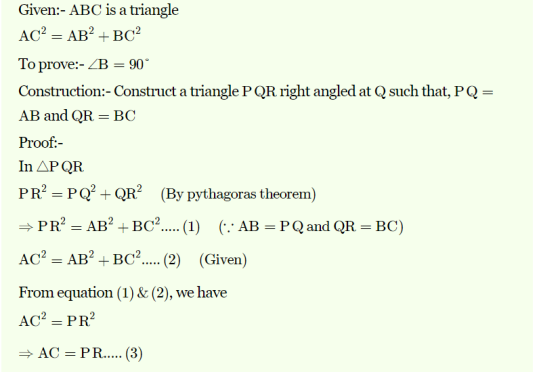
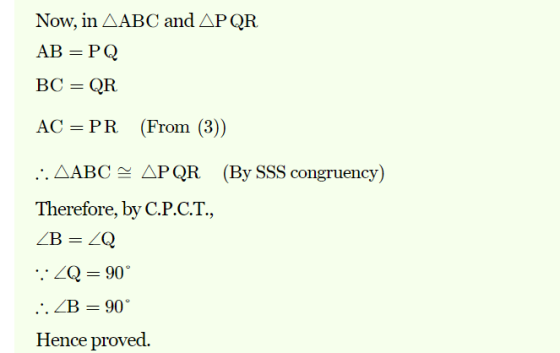
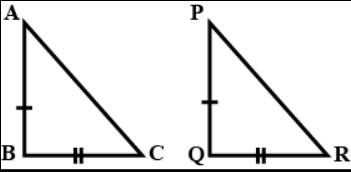
1.48: If In a triangle the square on one of the sides be equal to the squares on the remaining two sides of the triangle, the angle contained by the remaining two sides of the triangle is right.
Homework Answers
PROOF OF PROPOSITION 1.47:
THEOREM : 6.7 :


Hence in this way we can prove Pythagoras Theorem as : AB2 + BC2 = AC2 .
PROOF OF PROPOSITION 1.48:
In a right triangle, the square of the length of one side is equal to the...
In a right triangle, the square of the length of one side is equal to the sum of the squares of the lengths of the other two sides. Write a program that prompts the user to enter the lengths of three sides of a triangle and then outputs a message indicating whether the triangle is a right triangle. If the triangle is a right triangle, output It is a right-angled triangle If the triangle is not a right triangle, output...
C++ Can somebody help me with this 2 integer right triangles There are right-angled triangles (i.e.,...
C++ Can somebody help me with this 2 integer right triangles There are right-angled triangles (i.e., triangles, for which the theorem of Pythagoras applies), whose side lengths are all integers are. Write a program that finds all these triangles in the form of the lengths of their three sides and these three Output page lengths for each triangle found. This should only page lengths not greater than 500 are taken into account. In addition, specify the number of...
c++ The length of the hypotenuse of a right-angled triangle is the square root of the...
c++ The length of the hypotenuse of a right-angled triangle is the square root of the sum of the squares of the other two sides. Write a function calcH that accept two doubles as function arguments and returns a double. Prompt the user for the length of base and the perpendicular side of the triangle. Use the pow and sqrt functions from cmath to perform the calculations
//////// ONLY JAVA **** //////// ONLY JAVA **** 5. In a right triangle, the square of...
 //////// ONLY JAVA ****
5. In a right triangle, the square of the length of one side is equal to the sum of the squares of the lengths of the other two sides. Write a program that prompts the user to enter the lengths of three sides of a triangle and then outputs a message indicating whether the triangle is a right triangle. (Have the user enter the lengths 3, 4, and 5).
//////// ONLY JAVA ****
//////// ONLY JAVA ****
5. In a right triangle, the square of the length of one side is equal to the sum of the squares of the lengths of the other two sides. Write a program that prompts the user to enter the lengths of three sides of a triangle and then outputs a message indicating whether the triangle is a right triangle. (Have the user enter the lengths 3, 4, and 5).
Two sides and an angle (SSA) of a triangle are given. Determine whether the given measurements produce one triangle, two triangles, or no triangle at all Solve each triangle that results
Two sides and an angle (SSA) of a triangle are given. Determine whether the given measurements produce one triangle, two triangles, or no triangle at all Solve each triangle that results. a=15, c=18, A=53° Select the correct choice below and, if necessary, to in the answer boxes to complete your choice (Round side lengths to the nearest tenth and angle measurements to the nearest degree as needed.) A. There is only one possible solution for the triangle The measurements for the remaining side b...
Prove that if two right triangles have hypotenuses of equal length and an acute angle of...
Prove that if two right triangles have hypotenuses of equal length and an acute angle of one is equal to an acute angle of the other, then they are congruent.
To use trigonometric functions to find sides and angles of right triangles.
 Learning Goal:To use trigonometric functions to find sides and angles of right triangles.The functions sine, cosine, and tangent are called trigonometric functions (often shortened to "trig functions"). Trigonometric just means "measuring triangles." These functions are called trigonometric because they are used to find the lengths of sides or the measures of angles for right triangles. They can be used, with some effort, to find measures of any triangle, but in this problem we will focus on right triangles. Right triangles...
To. D In Exercises 17-32, two sides and an angle (SSAI given. Determine whether the given measure...
 To. D In Exercises 17-32, two sides and an angle (SSAI given. Determine whether the given measurements triangle, two triangles, or no triangle at all. Solve results Round to the nearest tenth and the neat a and angles, respectively of a triangle 259 produce one 29 each trian rest degree for side gle ka 238 To. D In Exercises 17-32, two sides and an angle (SSAI given. Determine whether the given measurements triangle, two triangles, or no triangle at all....
The length of the base of an isosceles triangle is 41.69 inches. Each base angle is...
The length of the base of an isosceles triangle is 41.69 inches. Each base angle is 29.24°. Find the length of each of the two equal sides of the triangle. (Hint: Divide the triangle into two right triangles.)
I need help doing a doing two column for these two propositions. Book 1 Proposition 7:...
 I need help doing a doing two column for these two
propositions.
Book 1 Proposition 7:
Given two straight lines constructed from the ends of a straight
line and meeting in a point, there cannot be constructed from the
ends of the same straight line, and on the same side of it, two
other straight lines meeting in another point and equal to the
former two respectively, namely each equal to that from the same
end.
Book 3 Proposition 14:...
I need help doing a doing two column for these two
propositions.
Book 1 Proposition 7:
Given two straight lines constructed from the ends of a straight
line and meeting in a point, there cannot be constructed from the
ends of the same straight line, and on the same side of it, two
other straight lines meeting in another point and equal to the
former two respectively, namely each equal to that from the same
end.
Book 3 Proposition 14:...
 //////// ONLY JAVA ****
5. In a right triangle, the square of the length of one side is equal to the sum of the squares of the lengths of the other two sides. Write a program that prompts the user to enter the lengths of three sides of a triangle and then outputs a message indicating whether the triangle is a right triangle. (Have the user enter the lengths 3, 4, and 5).
//////// ONLY JAVA ****
//////// ONLY JAVA ****
5. In a right triangle, the square of the length of one side is equal to the sum of the squares of the lengths of the other two sides. Write a program that prompts the user to enter the lengths of three sides of a triangle and then outputs a message indicating whether the triangle is a right triangle. (Have the user enter the lengths 3, 4, and 5).
 To. D In Exercises 17-32, two sides and an angle (SSAI given. Determine whether the given measurements triangle, two triangles, or no triangle at all. Solve results Round to the nearest tenth and the neat a and angles, respectively of a triangle 259 produce one 29 each trian rest degree for side gle ka 238 To. D In Exercises 17-32, two sides and an angle (SSAI given. Determine whether the given measurements triangle, two triangles, or no triangle at all....
 I need help doing a doing two column for these two
propositions.
Book 1 Proposition 7:
Given two straight lines constructed from the ends of a straight
line and meeting in a point, there cannot be constructed from the
ends of the same straight line, and on the same side of it, two
other straight lines meeting in another point and equal to the
former two respectively, namely each equal to that from the same
end.
Book 3 Proposition 14:...
I need help doing a doing two column for these two
propositions.
Book 1 Proposition 7:
Given two straight lines constructed from the ends of a straight
line and meeting in a point, there cannot be constructed from the
ends of the same straight line, and on the same side of it, two
other straight lines meeting in another point and equal to the
former two respectively, namely each equal to that from the same
end.
Book 3 Proposition 14:...
Most questions answered within 3 hours.
-
Where is the error in this code sequence?
String s1 = "Hello";
String s2 = "ello";...
asked 11 months ago -
Financial data for Joel de Paris, Inc., for last year
follow:
Joel de Paris, Inc.
Balance...
asked 11 months ago -
Consider this reaction:
Al2(SO4)3 (aq)+ BaCl3
(aq) Al2Cl6 (aq)- +
3BaSO4(s) . What is the...
asked 11 months ago -
Suppose that Savneet is considering increasing her
recent random sample from 20 car rentals to 40...
asked 11 months ago -
Trucks arrive at an unloading terminal at an average rate of 120
per hour.
Trucks arrive...
asked 11 months ago -
Why are methanol and ethanol completely soluble in water while
octanol is not very little soluble....
asked 11 months ago -
A facilities manager at a university reads in a research report
that the mean amount of...
asked 11 months ago -
When the CuSO4 is rehydrated by adding water to the anhydrous
compound, is this an endothermic...
asked 11 months ago -
A ray of sunlight is passing from diamond into crown glass; the
angle of incidence is...
asked 11 months ago -
A block of mass 0.249 kg is placed on top of a light, vertical
spring of...
asked 11 months ago -
how do the kidneys compensate in the presences of acidosis
a) trigger hyperventilate
b) reserve acid...
asked 11 months ago -
Question 501 pts
The rental rate of capital to the firm increases. Which of the
following...
asked 11 months ago