Matrices Diagonalization with Phase Portrait in the Application of Differential Equations
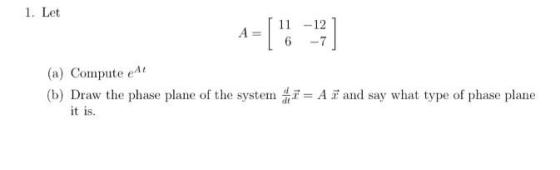
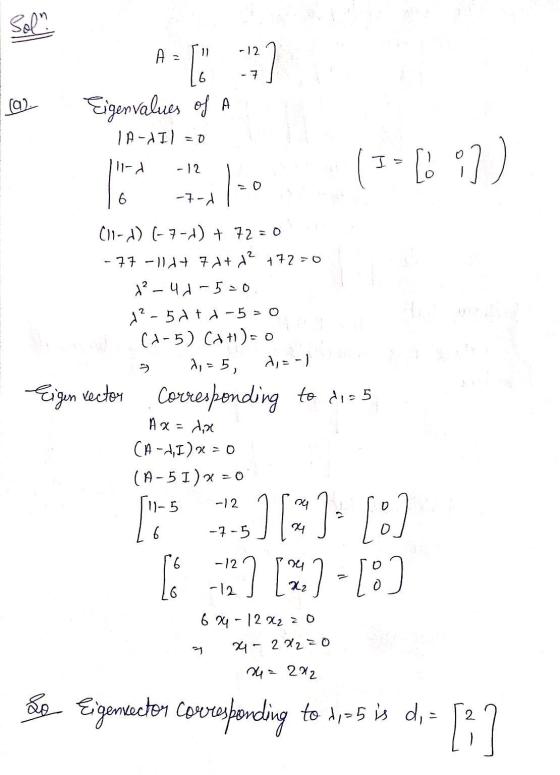
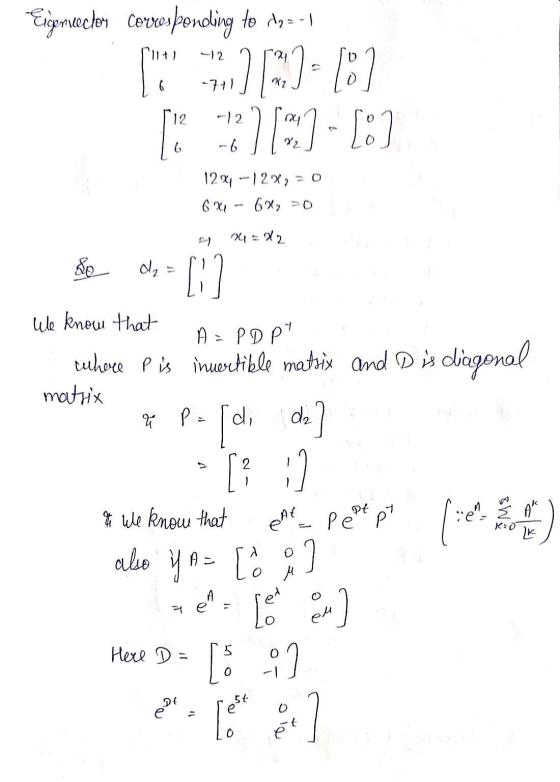
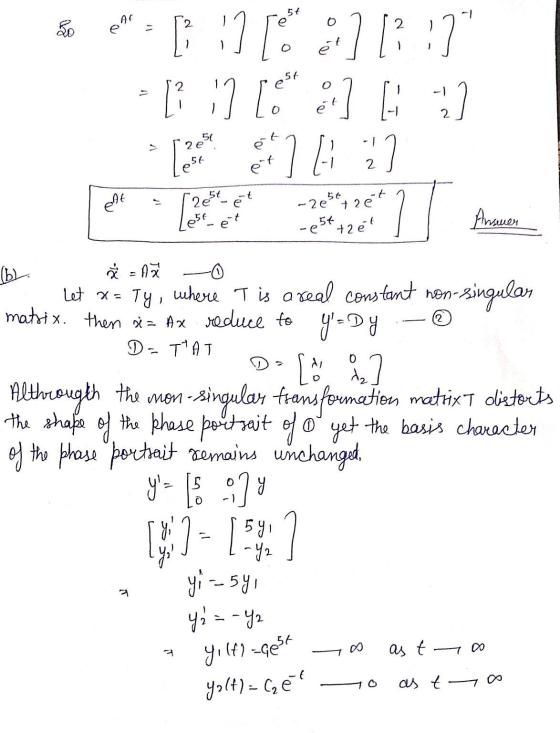
Please solve these 2 Matrices Diagonalization with Phase Portrait in the Application of Differential Equations questions in step-by-step manner..
Homework Answers
Add Answer to:
Matrices Diagonalization with Phase Portrait in the Application of Differential Equations
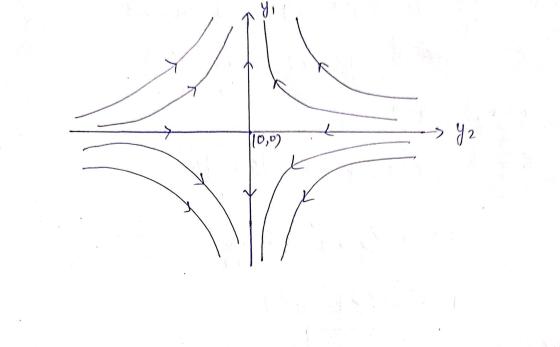
9-Sketch the phase plane portrait (phase portrait) for the given system of differential equations. Include all...
 9-Sketch the phase plane portrait (phase portrait) for the given system of differential equations. Include all your calculations (phase portrait without proper calculations wont be accepted). (5 Points) X' - x + 3y ly - 2x - 4y
Consider the following autonomous first-order differential equation. Find the critical points and phase portrait of...
 Consider the following autonomous first-order differential equation. Find the critical points and phase portrait of the given differential equation. 0
Consider the following autonomous first-order differential equation. Find the critical points and phase portrait of the given differential equation. 0
Consider the following autonomous first-order differential equation. Find the critical points and phase portrait of the given differential equation. 0
Diagonalization of 2 X 2 Hermitian matrices. Usually we are in need of diagonalizing 2 X...
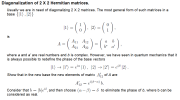 Diagonalization of 2 X 2 Hermitian matrices. Usually we are in need of diagonalizing 2 X 2 matrices. The most general form of such matrices in a base { 1), 2)} is 11) = ( 6 ). 12) = (i). A = ( Aust) -(8%). where a and a' are real numbers and b is complex. However, we have seen in quantum mechanics that it is always possible to redefine the phase of the base vectors 11) + |1') =...
This is a differential equations problem 2. Given the system of differential equations 0.2 0.005ry, --0.5y+0.01ry, w...
 This is a differential equations problem
2. Given the system of differential equations 0.2 0.005ry, --0.5y+0.01ry, which models the rates of changes of two interacting species populations, describe the type of z- and y-populations involved (exponential or logistic) and the nature of their interaction (competition, cooperation, or predation). Then find and characterize the system's critical points (type and stability). Determine what nonzero r- and y-populations can coexist. Ther construct a phase plane portrait that enables you to describe the long...
This is a differential equations problem
2. Given the system of differential equations 0.2 0.005ry, --0.5y+0.01ry, which models the rates of changes of two interacting species populations, describe the type of z- and y-populations involved (exponential or logistic) and the nature of their interaction (competition, cooperation, or predation). Then find and characterize the system's critical points (type and stability). Determine what nonzero r- and y-populations can coexist. Ther construct a phase plane portrait that enables you to describe the long...
Consider the linear system of first order differential equations x' = Ax, where x = x(t),...
 Consider the linear system of first order differential equations x' = Ax, where x = x(t), t > 0, and A has the eigenvalues and eigenvectors below. Sketch the phase portrait. Please label your axes. 11 = 5, V1 = 12 = 2, V2 = ()
Here is the phase portrait of a homogeneous linear system of differential tions. 4. equa- (a) Cla...
 Here is the phase portrait of a homogeneous linear system of differential tions. 4. equa- (a) Classify the equilibrium (b) If λί is the eigenvalue with corresponding eigenvector (1,1) and A2 is the eigenvalue with corresponding eigenvector (-1,3), place the three numbers 0, λ, and λ2 in order frorn least to greatest. (c) If ((t), y(t) is the solution satisfying the initial condition (x(0),y(0)- (-2,2). Find i. lim r(t) i. lim rlt) ii. lim y(t) iv. lim y(t)
Here is...
Here is the phase portrait of a homogeneous linear system of differential tions. 4. equa- (a) Classify the equilibrium (b) If λί is the eigenvalue with corresponding eigenvector (1,1) and A2 is the eigenvalue with corresponding eigenvector (-1,3), place the three numbers 0, λ, and λ2 in order frorn least to greatest. (c) If ((t), y(t) is the solution satisfying the initial condition (x(0),y(0)- (-2,2). Find i. lim r(t) i. lim rlt) ii. lim y(t) iv. lim y(t)
Here is...
For the equation (dp/dt)=(P+2)(P^2-6P+5) find the equilibrium points and make a phase portrait of the differential...
For the equation (dp/dt)=(P+2)(P^2-6P+5) find the equilibrium points and make a phase portrait of the differential equation. Classify each equilibrium point as asymptotically stable, unstable or semi-stable. Sketch typical solution curves determined by the graphs of equilibrium solutions.
Consider the system of differential equations ; 1) Find the fixed points of the system , 2) Eval...
consider the system of differential equations ; 1) Find the fixed points of the system , 2) Evaluate the Jacobian Matrix at each fixed point, 3) Classify stability of each fixed point, 4) Sketch the graph of the phase portrait,
Solve for a, b and c. Please write clearly. Thanks 9. (20%) System Differential Equations X...
 Solve for a, b and c. Please write clearly.
Thanks
9. (20%) System Differential Equations X = [X1 ; X2] Initial condition X1(0)=1, X2(0) = 1 find the solutions X by (a) Laplace transform method (6%) (b) Diagonalization transform method (7%) (c) Elimination method (7%)
Solve for a, b and c. Please write clearly.
Thanks
9. (20%) System Differential Equations X = [X1 ; X2] Initial condition X1(0)=1, X2(0) = 1 find the solutions X by (a) Laplace transform method (6%) (b) Diagonalization transform method (7%) (c) Elimination method (7%)
1. (20 marks) This question is about the system of differential equations dY (3 1 (a) Consider the case k 0 i. Dete...
 1. (20 marks) This question is about the system of differential equations dY (3 1 (a) Consider the case k 0 i. Determine the type of equilibrium at (0,0) (e.g., sink, spiral source). i. Write down the general solution. ili Sketch a phase portrait for the system. (b) Now consider the case k -3. (-1+iv ) i. In this case, the matrix has an eigenvalue 2+i/2 with eigenvector and an eigenvalue 2-W2 with eigenvector Determine the type of equilibrium at...
 9-Sketch the phase plane portrait (phase portrait) for the given system of differential equations. Include all your calculations (phase portrait without proper calculations wont be accepted). (5 Points) X' - x + 3y ly - 2x - 4y
 Consider the following autonomous first-order differential equation. Find the critical points and phase portrait of the given differential equation. 0
Consider the following autonomous first-order differential equation. Find the critical points and phase portrait of the given differential equation. 0
Consider the following autonomous first-order differential equation. Find the critical points and phase portrait of the given differential equation. 0
 Diagonalization of 2 X 2 Hermitian matrices. Usually we are in need of diagonalizing 2 X 2 matrices. The most general form of such matrices in a base { 1), 2)} is 11) = ( 6 ). 12) = (i). A = ( Aust) -(8%). where a and a' are real numbers and b is complex. However, we have seen in quantum mechanics that it is always possible to redefine the phase of the base vectors 11) + |1') =...
 This is a differential equations problem
2. Given the system of differential equations 0.2 0.005ry, --0.5y+0.01ry, which models the rates of changes of two interacting species populations, describe the type of z- and y-populations involved (exponential or logistic) and the nature of their interaction (competition, cooperation, or predation). Then find and characterize the system's critical points (type and stability). Determine what nonzero r- and y-populations can coexist. Ther construct a phase plane portrait that enables you to describe the long...
This is a differential equations problem
2. Given the system of differential equations 0.2 0.005ry, --0.5y+0.01ry, which models the rates of changes of two interacting species populations, describe the type of z- and y-populations involved (exponential or logistic) and the nature of their interaction (competition, cooperation, or predation). Then find and characterize the system's critical points (type and stability). Determine what nonzero r- and y-populations can coexist. Ther construct a phase plane portrait that enables you to describe the long...
 Consider the linear system of first order differential equations x' = Ax, where x = x(t), t > 0, and A has the eigenvalues and eigenvectors below. Sketch the phase portrait. Please label your axes. 11 = 5, V1 = 12 = 2, V2 = ()
 Here is the phase portrait of a homogeneous linear system of differential tions. 4. equa- (a) Classify the equilibrium (b) If λί is the eigenvalue with corresponding eigenvector (1,1) and A2 is the eigenvalue with corresponding eigenvector (-1,3), place the three numbers 0, λ, and λ2 in order frorn least to greatest. (c) If ((t), y(t) is the solution satisfying the initial condition (x(0),y(0)- (-2,2). Find i. lim r(t) i. lim rlt) ii. lim y(t) iv. lim y(t)
Here is...
Here is the phase portrait of a homogeneous linear system of differential tions. 4. equa- (a) Classify the equilibrium (b) If λί is the eigenvalue with corresponding eigenvector (1,1) and A2 is the eigenvalue with corresponding eigenvector (-1,3), place the three numbers 0, λ, and λ2 in order frorn least to greatest. (c) If ((t), y(t) is the solution satisfying the initial condition (x(0),y(0)- (-2,2). Find i. lim r(t) i. lim rlt) ii. lim y(t) iv. lim y(t)
Here is...
 Solve for a, b and c. Please write clearly.
Thanks
9. (20%) System Differential Equations X = [X1 ; X2] Initial condition X1(0)=1, X2(0) = 1 find the solutions X by (a) Laplace transform method (6%) (b) Diagonalization transform method (7%) (c) Elimination method (7%)
Solve for a, b and c. Please write clearly.
Thanks
9. (20%) System Differential Equations X = [X1 ; X2] Initial condition X1(0)=1, X2(0) = 1 find the solutions X by (a) Laplace transform method (6%) (b) Diagonalization transform method (7%) (c) Elimination method (7%)
 1. (20 marks) This question is about the system of differential equations dY (3 1 (a) Consider the case k 0 i. Determine the type of equilibrium at (0,0) (e.g., sink, spiral source). i. Write down the general solution. ili Sketch a phase portrait for the system. (b) Now consider the case k -3. (-1+iv ) i. In this case, the matrix has an eigenvalue 2+i/2 with eigenvector and an eigenvalue 2-W2 with eigenvector Determine the type of equilibrium at...
Most questions answered within 3 hours.
-
Where is the error in this code sequence?
String s1 = "Hello";
String s2 = "ello";...
asked 11 months ago -
Financial data for Joel de Paris, Inc., for last year
follow:
Joel de Paris, Inc.
Balance...
asked 11 months ago -
Consider this reaction:
Al2(SO4)3 (aq)+ BaCl3
(aq) Al2Cl6 (aq)- +
3BaSO4(s) . What is the...
asked 11 months ago -
Suppose that Savneet is considering increasing her
recent random sample from 20 car rentals to 40...
asked 11 months ago -
Trucks arrive at an unloading terminal at an average rate of 120
per hour.
Trucks arrive...
asked 11 months ago -
Why are methanol and ethanol completely soluble in water while
octanol is not very little soluble....
asked 11 months ago -
A facilities manager at a university reads in a research report
that the mean amount of...
asked 11 months ago -
When the CuSO4 is rehydrated by adding water to the anhydrous
compound, is this an endothermic...
asked 11 months ago -
A ray of sunlight is passing from diamond into crown glass; the
angle of incidence is...
asked 11 months ago -
A block of mass 0.249 kg is placed on top of a light, vertical
spring of...
asked 11 months ago -
how do the kidneys compensate in the presences of acidosis
a) trigger hyperventilate
b) reserve acid...
asked 11 months ago -
Question 501 pts
The rental rate of capital to the firm increases. Which of the
following...
asked 11 months ago