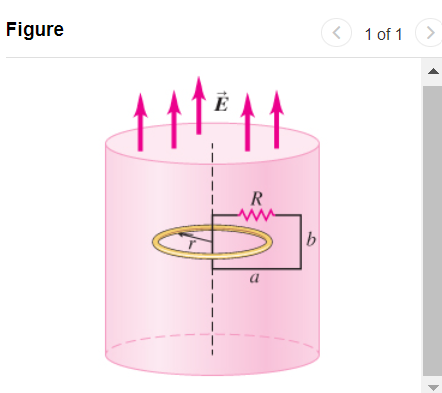
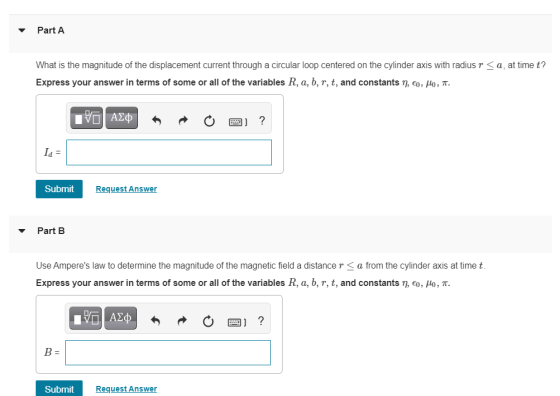
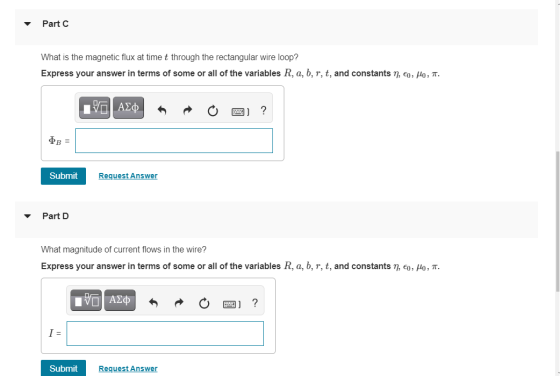
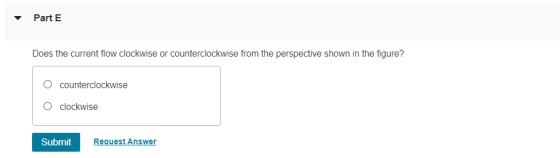
A uniform electric field is directed axially in a cylindrical region that includes a rectangular loop of wire with total resistance R.
A uniform electric field is directed axially in a cylindrical region that includes a rectangular loop of wire with total resistance
Homework Answers
Request Answer!
We need at least 9 more requests to produce the answer.
1 / 10 have requested this problem solution
The more requests, the faster the answer.
Add Answer to:
A uniform electric field is directed axially in a cylindrical region that includes a rectangular loop of wire with total resistance R.
A rectangular loop of wire is pushed into a region of uniform magnetic field. Given the...
 A rectangular loop of wire is pushed into a region of uniform magnetic field. Given the data in the figure, what is the magnitude of the emf induced in the one-turn loop? B into page B=0.60 T 0.20 m 10 ms ® 0.50 m 3.00 V 0.120 V 1.20 V 0.300 V 6.00 V
A rectangular loop of wire is pushed into a region of uniform magnetic field. Given the...
 A rectangular loop of wire is pushed into a region of uniform magnetic field. Given the data in the figure, what is the magnitude of the emf induced in the one-turn loop? page 80601 0.20m 10m's 0.50 m 1.20 V 100V 6.00 V 0.120 V 0..300 V
The figure below shows a circular loop of wire of resistance R = 0.500Ω and radius r = 9.30 cm in the presence of a uniform magnetic field B out directed out of the page
 The figure below shows a circular loop of wire of resistance R = 0.500Ω and radius r = 9.30 cm in the presence of a uniform magnetic field B out directed out of the page. A clockwise current of I = 3.30 mA is induced in the loop.(a) Which of the following best describes the magnitude of Bout It is increasing with time. It is decreasing with time. It remains constant. (b) Find the rate at which the field is changing with time (in...
24 A circular loop of wire is in a region of spatially uniform magnetic field directed...
 24 A circular loop of wire is in a region of spatially uniform magnetic field directed into the page. Determine the direction of the induced current (as viewed from above) when the magnitude of the magnetic field is increasing. a. Clockwise b. Counterclockwise c. No current flows. 25 An electron enters a region where the uniform magnetic field strength is 4.0 T at a velocity of 4.88 x 10^m/s perpendicular to the field. Determine the radius of gyration of the...
2. A cylindrical bar magnet has magnetization M(r), a general function of r directed (a) axially,...
 2. A cylindrical bar magnet has magnetization M(r), a general function of r directed (a) axially, (b) azimuthally or (c) radially (here with M(0)- 0). In each case find Br). In (a) also find the magnetization current encircled by a rectangle of axial length i, extending from radial distance r inside the cylinder to the outsidemrim ma wontoor dall % in (b) find the current encircled by a circle of radius r.
Motional EMF A single rectangular loop is pulled out of a region of uniform magnetic field...
 Motional EMF A single rectangular loop is pulled out of a region of uniform magnetic field at a con- stant speed v. Suppose that the loop has a mass m and a resistance R. Its cross- sectional width is L, as shown. 1. Find the induced EMF in the loop. Express your FINAL answer in terms of B, L, and v only 2. Find the induced current, including direction. Express your FINAL answer in terms of B L, v, and...
A rectangular loop of wire with dimensions 2.12 cm by 8 50 cm and resistance 0.576 Ω is being pulled to the right out of a region
A rectangular loop of wire with dimensions 2.12 cm by 8 50 cm and resistance 0.576 Ω is being pulled to the right out of a region of uniform magnetic field. The magnetic field has magnitude 3.27 T and is directed into the plane of the following figure(Figure 1) Part A At the instant when the speed of the loop is 3.00 m/s and it is still partially in the field region, what is the magnitude of the force the magnetic field...
A rectangular loop of wire lays flat on a table in a uniform magnetic field of...
A rectangular loop of wire lays flat on a table in a uniform magnetic field of 4.0x10^-2 T. The length of the rectangle is 2.5x10^-2 m, and the width is stretched smoothly from 5.0x10^-2 m to 7.5x10^-2 m in 0.3 seconds. How much emf is induced in the loop?
A rectangular loop of wire with dimensions 2.43 cm by 8.38 cm and resistance 0.593 Ω
A rectangular loop of wire with dimensions 2.43 cm by 8.38 cm and resistance 0.593 Ω is being pulled to the right out of a region of uniform magnetic field. The magnetic field has magnitude 3.01 T and is directed into the plane of the following figure(Figure 1). Part A At the instant when the speed of the loop is 3.09 m/s and it is still partially in the field region, what is the magnitude of the force the magnetic field exert...
A circular loop of wire with radius r= 0.0480m and reistance R = 0.160 Ω is in a region of spatially uniform magnetic field
 A circular loop of wire with radius r= 0.0480m and reistance R = 0.160 Ω is in a region of spatially uniform magnetic field, as shown in the figure. The magnetic field is directed out of the plane of the figure. The magnetic field has an initial value of 8.00 T and is decreasing dB/ dt = -0.680 T a) Is the induced current in the loop clockwise or counterclockwise? b) What is the rate at which electrical energy is being dissipated...
 A rectangular loop of wire is pushed into a region of uniform magnetic field. Given the data in the figure, what is the magnitude of the emf induced in the one-turn loop? B into page B=0.60 T 0.20 m 10 ms ® 0.50 m 3.00 V 0.120 V 1.20 V 0.300 V 6.00 V
 A rectangular loop of wire is pushed into a region of uniform magnetic field. Given the data in the figure, what is the magnitude of the emf induced in the one-turn loop? page 80601 0.20m 10m's 0.50 m 1.20 V 100V 6.00 V 0.120 V 0..300 V
 24 A circular loop of wire is in a region of spatially uniform magnetic field directed into the page. Determine the direction of the induced current (as viewed from above) when the magnitude of the magnetic field is increasing. a. Clockwise b. Counterclockwise c. No current flows. 25 An electron enters a region where the uniform magnetic field strength is 4.0 T at a velocity of 4.88 x 10^m/s perpendicular to the field. Determine the radius of gyration of the...
 2. A cylindrical bar magnet has magnetization M(r), a general function of r directed (a) axially, (b) azimuthally or (c) radially (here with M(0)- 0). In each case find Br). In (a) also find the magnetization current encircled by a rectangle of axial length i, extending from radial distance r inside the cylinder to the outsidemrim ma wontoor dall % in (b) find the current encircled by a circle of radius r.
 Motional EMF A single rectangular loop is pulled out of a region of uniform magnetic field at a con- stant speed v. Suppose that the loop has a mass m and a resistance R. Its cross- sectional width is L, as shown. 1. Find the induced EMF in the loop. Express your FINAL answer in terms of B, L, and v only 2. Find the induced current, including direction. Express your FINAL answer in terms of B L, v, and...
Most questions answered within 3 hours.
-
Where is the error in this code sequence?
String s1 = "Hello";
String s2 = "ello";...
asked 10 months ago -
Financial data for Joel de Paris, Inc., for last year
follow:
Joel de Paris, Inc.
Balance...
asked 10 months ago -
Consider this reaction:
Al2(SO4)3 (aq)+ BaCl3
(aq) Al2Cl6 (aq)- +
3BaSO4(s) . What is the...
asked 10 months ago -
Suppose that Savneet is considering increasing her
recent random sample from 20 car rentals to 40...
asked 10 months ago -
Trucks arrive at an unloading terminal at an average rate of 120
per hour.
Trucks arrive...
asked 10 months ago -
Why are methanol and ethanol completely soluble in water while
octanol is not very little soluble....
asked 10 months ago -
A facilities manager at a university reads in a research report
that the mean amount of...
asked 10 months ago -
When the CuSO4 is rehydrated by adding water to the anhydrous
compound, is this an endothermic...
asked 10 months ago -
A ray of sunlight is passing from diamond into crown glass; the
angle of incidence is...
asked 10 months ago -
A block of mass 0.249 kg is placed on top of a light, vertical
spring of...
asked 10 months ago -
how do the kidneys compensate in the presences of acidosis
a) trigger hyperventilate
b) reserve acid...
asked 10 months ago -
Question 501 pts
The rental rate of capital to the firm increases. Which of the
following...
asked 10 months ago