
Homework Answers

Add Answer to:
I need help for organic chemistry
Acid Catalyzed Dimerization of 2-Methylpropene
I need help with a 2-part organic chemistry lab. The main topic is esterification of fatty...
I need help with a 2-part organic chemistry lab. The main topic is esterification of fatty acids. In the reaction, I mix acetic acid, ethanol, and diethyl ether (solvent) together and then add the reagent (H2SO4) to the flask. The final product of this reaction is ethyl acetate. Ethyl acetate is then extracted in a separatory funnel using NaOH. For this reaction, I need help with 2 things. I need help with the overall reaction mechanism, and in identifying the...
Need help with this organic chemistry problem please. Need help with this organic chemistry problem please....
 Need help with this organic chemistry problem please.
 What s the driving force that leads to the observed product rather than the molecule below?
Need help with this organic chemistry problem please.
Need help with this organic chemistry problem please. What s the driving force that leads to the observed product rather than the molecule below?
Organic chemistry 2 question I need help with problems #1 and #2, please showed works and...
 Organic chemistry 2 question
I need help with problems #1 and #2, please showed works and neat
writing, thank you
Organic chemistry 2 question
I need help with problems #1 and #2, please showed works and neat
writing, thank you
i started this problem but i need help! Acid catalyzed hydrolysis (12 pts)
 i started this problem but i need help!
Acid catalyzed hydrolysis (12 pts)
i started this problem but i need help!
Acid catalyzed hydrolysis (12 pts)
Organic Chemistry Question: Please show the arrows! Terpin, prepared commercially by the acid-catalyzed hydration of limonene,...
 Organic Chemistry Question: Please show the arrows!
Terpin, prepared commercially by the acid-catalyzed hydration of limonene, is used medicinally as an expectorant for coughs. Draw curved arrows to show the movement of electrons in this step of the reaction mechanism.
Organic Chemistry Question: Please show the arrows!
Terpin, prepared commercially by the acid-catalyzed hydration of limonene, is used medicinally as an expectorant for coughs. Draw curved arrows to show the movement of electrons in this step of the reaction mechanism.
I need help with an organic chemistry lab. The main topic is Ester Hydrolysis. I start...
I need help with an organic chemistry lab. The main topic is Ester Hydrolysis. I start with 1,7-Dimethylhaptanedioate and water (solvent), and add the catalyst H2SO4. The reaction mixture is extracted with water. The final product is heptanedioic acid. I need to know the steps of the reaction mechanism, as well as the role of each component in the reaction. I also need to know why the reaction mixture is extracted with water, and what the water does. Why water...
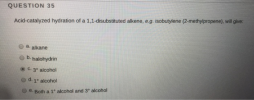
please help:) QUESTION 35 Acid-catalyzed hydration of a 1,1-disubstituted alkene, e.g. isobutylene (2-methylpropene), will give! a....
 please help:)
QUESTION 35 Acid-catalyzed hydration of a 1,1-disubstituted alkene, e.g. isobutylene (2-methylpropene), will give! a. alkane b. halohydrin OC. 3° alcohol e d. 1° alcohol O e. Both a 1° alcohol and 3° alcohol QUESTION 30 To favor the product side of the equilibrium, isopentyl alcohol was the limiting reagent. Therefore, the theoretical yield of isopentyl acetate (MW 130.19 g-moll) is calculated to be if 1600. microl, of isopentyl alcohol and 3000, microL of acetic acid were used: (C5H120...
please help:)
QUESTION 35 Acid-catalyzed hydration of a 1,1-disubstituted alkene, e.g. isobutylene (2-methylpropene), will give! a. alkane b. halohydrin OC. 3° alcohol e d. 1° alcohol O e. Both a 1° alcohol and 3° alcohol QUESTION 30 To favor the product side of the equilibrium, isopentyl alcohol was the limiting reagent. Therefore, the theoretical yield of isopentyl acetate (MW 130.19 g-moll) is calculated to be if 1600. microl, of isopentyl alcohol and 3000, microL of acetic acid were used: (C5H120...
Hello all, I need an expert in organic chemistry to help with this practice question. Please...
 Hello all, I need an expert in organic chemistry to help with
this practice question. Please give answer the question below.
Please explain your answers for each drug separately. Please I need
your honest answer to this question. Thank you. The question is as
stated below;
Hello all, I need an expert in organic chemistry to help with this practice question. Please give answer the question below. Please explain your answers for each drug separately. Please I need your honest...
Hello all, I need an expert in organic chemistry to help with
this practice question. Please give answer the question below.
Please explain your answers for each drug separately. Please I need
your honest answer to this question. Thank you. The question is as
stated below;
Hello all, I need an expert in organic chemistry to help with this practice question. Please give answer the question below. Please explain your answers for each drug separately. Please I need your honest...
Hi, I need help with somthing in my organic chemistry lab. We are supposed to prepare...
Hi, I need help with somthing in my organic chemistry lab. We are supposed to prepare a .15M copper acetate acetic acid solution (.12 equiv) and ammonium nitrate (1.5 equiv). we have to make this based off our benzoin, which is 1.0 equiv and .942 mmol. Would you please be able to show all the work!
I need help in Organic Chemistry! I am having trouble with these problems, please help!! I...
 I need help in Organic Chemistry! I am having trouble with these
problems, please help!! I appreciate you!
4. For each of the following sets of material and products propose a synthesis using reactions from Chapters 1-11 of the textbook. Remember to consider stereochemistry where appropriate. Show the product of each step you propose. There are more than one solution for each You do NOT need mechanism, only conditions. a. H-CEC-H
I need help in Organic Chemistry! I am having trouble with these
problems, please help!! I appreciate you!
4. For each of the following sets of material and products propose a synthesis using reactions from Chapters 1-11 of the textbook. Remember to consider stereochemistry where appropriate. Show the product of each step you propose. There are more than one solution for each You do NOT need mechanism, only conditions. a. H-CEC-H
 Need help with this organic chemistry problem please.
 What s the driving force that leads to the observed product rather than the molecule below?
Need help with this organic chemistry problem please.
Need help with this organic chemistry problem please. What s the driving force that leads to the observed product rather than the molecule below?
 Organic chemistry 2 question
I need help with problems #1 and #2, please showed works and neat
writing, thank you
Organic chemistry 2 question
I need help with problems #1 and #2, please showed works and neat
writing, thank you
 i started this problem but i need help!
Acid catalyzed hydrolysis (12 pts)
i started this problem but i need help!
Acid catalyzed hydrolysis (12 pts)
 Organic Chemistry Question: Please show the arrows!
Terpin, prepared commercially by the acid-catalyzed hydration of limonene, is used medicinally as an expectorant for coughs. Draw curved arrows to show the movement of electrons in this step of the reaction mechanism.
Organic Chemistry Question: Please show the arrows!
Terpin, prepared commercially by the acid-catalyzed hydration of limonene, is used medicinally as an expectorant for coughs. Draw curved arrows to show the movement of electrons in this step of the reaction mechanism.
 please help:)
QUESTION 35 Acid-catalyzed hydration of a 1,1-disubstituted alkene, e.g. isobutylene (2-methylpropene), will give! a. alkane b. halohydrin OC. 3° alcohol e d. 1° alcohol O e. Both a 1° alcohol and 3° alcohol QUESTION 30 To favor the product side of the equilibrium, isopentyl alcohol was the limiting reagent. Therefore, the theoretical yield of isopentyl acetate (MW 130.19 g-moll) is calculated to be if 1600. microl, of isopentyl alcohol and 3000, microL of acetic acid were used: (C5H120...
please help:)
QUESTION 35 Acid-catalyzed hydration of a 1,1-disubstituted alkene, e.g. isobutylene (2-methylpropene), will give! a. alkane b. halohydrin OC. 3° alcohol e d. 1° alcohol O e. Both a 1° alcohol and 3° alcohol QUESTION 30 To favor the product side of the equilibrium, isopentyl alcohol was the limiting reagent. Therefore, the theoretical yield of isopentyl acetate (MW 130.19 g-moll) is calculated to be if 1600. microl, of isopentyl alcohol and 3000, microL of acetic acid were used: (C5H120...
 Hello all, I need an expert in organic chemistry to help with
this practice question. Please give answer the question below.
Please explain your answers for each drug separately. Please I need
your honest answer to this question. Thank you. The question is as
stated below;
Hello all, I need an expert in organic chemistry to help with this practice question. Please give answer the question below. Please explain your answers for each drug separately. Please I need your honest...
Hello all, I need an expert in organic chemistry to help with
this practice question. Please give answer the question below.
Please explain your answers for each drug separately. Please I need
your honest answer to this question. Thank you. The question is as
stated below;
Hello all, I need an expert in organic chemistry to help with this practice question. Please give answer the question below. Please explain your answers for each drug separately. Please I need your honest...
 I need help in Organic Chemistry! I am having trouble with these
problems, please help!! I appreciate you!
4. For each of the following sets of material and products propose a synthesis using reactions from Chapters 1-11 of the textbook. Remember to consider stereochemistry where appropriate. Show the product of each step you propose. There are more than one solution for each You do NOT need mechanism, only conditions. a. H-CEC-H
I need help in Organic Chemistry! I am having trouble with these
problems, please help!! I appreciate you!
4. For each of the following sets of material and products propose a synthesis using reactions from Chapters 1-11 of the textbook. Remember to consider stereochemistry where appropriate. Show the product of each step you propose. There are more than one solution for each You do NOT need mechanism, only conditions. a. H-CEC-H
Most questions answered within 3 hours.
-
Where is the error in this code sequence?
String s1 = "Hello";
String s2 = "ello";...
asked 10 months ago -
Financial data for Joel de Paris, Inc., for last year
follow:
Joel de Paris, Inc.
Balance...
asked 10 months ago -
Consider this reaction:
Al2(SO4)3 (aq)+ BaCl3
(aq) Al2Cl6 (aq)- +
3BaSO4(s) . What is the...
asked 10 months ago -
Suppose that Savneet is considering increasing her
recent random sample from 20 car rentals to 40...
asked 10 months ago -
Trucks arrive at an unloading terminal at an average rate of 120
per hour.
Trucks arrive...
asked 10 months ago -
Why are methanol and ethanol completely soluble in water while
octanol is not very little soluble....
asked 10 months ago -
A facilities manager at a university reads in a research report
that the mean amount of...
asked 10 months ago -
When the CuSO4 is rehydrated by adding water to the anhydrous
compound, is this an endothermic...
asked 10 months ago -
A ray of sunlight is passing from diamond into crown glass; the
angle of incidence is...
asked 10 months ago -
A block of mass 0.249 kg is placed on top of a light, vertical
spring of...
asked 10 months ago -
how do the kidneys compensate in the presences of acidosis
a) trigger hyperventilate
b) reserve acid...
asked 10 months ago -
Question 501 pts
The rental rate of capital to the firm increases. Which of the
following...
asked 10 months ago