
Homework Answers
Add Answer to:
chapter 6 e16 not in the app?
122 Chapter 6 Energy and Oscillations point A. What...
4. A roller-coaster car with a mass of 250 kg carries a 75 kg passenger and...
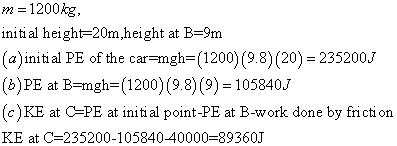
 4. A roller-coaster car with a mass of 250 kg carries a 75 kg passenger and starts from rest from a point 20 m above the ground. At point C, it is 15 m above the ground. A. What is the initial potential energy of the car (in kJ) at point A? - 75 kg 250. kg B. What is the potential energy at point B? C. If the initial kinetic energy was zero and the work done against friction...
1). the roller coaster car with a mass of 250 kg starts with an initial speed v0...
1). the roller coaster car with a mass of 250 kg starts with an initial speed v0 = 5.6 m/s at the top of the track . What is its speed (in m/s) at the lowest point of the track (which is 25m below the start point)? Keep 2 decimal places. 1 b) Recall what you learned in vertical circular motion. If the lowest part of the track is approximated as circular with a radius of 6.20 m, What is the...
A block with a mass of 4 kg is sliding across a horizontal surface with an...
A block with a mass of 4 kg is sliding across a horizontal surface with an initial speed of 5 m/s. Because of kinetic friction, the energy of this system will decrease linearly with the distance travelled by the block. a. What is the magnitude of the force of kinetic friction (in N) acting on the block if the block moves 4 m before coming to a stop? b. What is the average power (in W) supplied by the force...
Recitation Work - 5 In order to get full credit, you need to show all your...
 Recitation Work - 5 In order to get full credit, you need to
show all your work.
question 1.
A force Fx = cx^3 (c = 3.0 N/m^3) acts on an object with mass 40
kg that is sliding along a rough horizontal floor (x-axis) with
coefficient of kinetic friction of 0.2. A) What is the work done by
the force Fx on this object as it slides from x1 = 0.0 m to x2 =
6.0 m?
B) What...
Recitation Work - 5 In order to get full credit, you need to
show all your work.
question 1.
A force Fx = cx^3 (c = 3.0 N/m^3) acts on an object with mass 40
kg that is sliding along a rough horizontal floor (x-axis) with
coefficient of kinetic friction of 0.2. A) What is the work done by
the force Fx on this object as it slides from x1 = 0.0 m to x2 =
6.0 m?
B) What...
A hand pushes a 2 kg block along a table from point A to point C...
 A hand pushes a 2 kg block along a table from point A to point C as shown in the figure below. The table has been prepared so that the left half of the table (from A to B) is frictionless. The right half (from B to C) has a non-zero coefficient of friction equal to . The hand pushes the block the full distance from A to C using a constant force of 5 N. The block starts off...
A roller coaster car of mass 800 kg when released from rest at point A (height...
 A roller coaster car of mass 800 kg when released from rest at
point A (height h above the ground) slides along the track and
inside the loop of radius 16.0 m. The car never loses contact with
the track.
A) Draw below a free body diagram for the car the car at the top
of the loop.
B) If the normal force acting on the car at the top is 1500 N,
what is the speed of the car...
A roller coaster car of mass 800 kg when released from rest at
point A (height h above the ground) slides along the track and
inside the loop of radius 16.0 m. The car never loses contact with
the track.
A) Draw below a free body diagram for the car the car at the top
of the loop.
B) If the normal force acting on the car at the top is 1500 N,
what is the speed of the car...
A roller coaster (404 kg) moves from A (3.13 m above the ground) to B (21.6...
A roller coaster (404 kg) moves from A (3.13 m above the ground) to B (21.6 m above the ground). Two non-conservative forces are present: friction does -2.37 x 10⁴ J of work on the car, and a chain mechanism does +5.76 x 10⁴ J of work to help the car up a long climb. What is the change in the car's kinetic energy KEf - KEo from A to B?
A roller coaster (390 kg) moves from A (4.96 m above the ground) to B (20.9...
A roller coaster (390 kg) moves from A (4.96 m above the ground) to B (20.9 m above the ground). Two non-conservative forces are present: friction does -1.86 x 10⁴ J of work on the car, and a chain mechanism does +5.66 x 10⁴ J of work to help the car up a long climb. What is the change in the car's kinetic energy KEf - KEo from A to B?
I need help with problem 39 parts b,c,d Unit 7. Work and Energy In Class Packet...
 I need help with problem 39 parts b,c,d
Unit 7. Work and Energy In Class Packet Name: 36. A 2.45 kg rock is dropped from the top of a 15.5 m vertical cliff a. What is the potential energy of the rock relative to the base of the cliff before it is dropped? b. What is the kinetic energy of the rock just before it hits the ground below? c. What is the velocity of the rock at a point...
I need help with problem 39 parts b,c,d
Unit 7. Work and Energy In Class Packet Name: 36. A 2.45 kg rock is dropped from the top of a 15.5 m vertical cliff a. What is the potential energy of the rock relative to the base of the cliff before it is dropped? b. What is the kinetic energy of the rock just before it hits the ground below? c. What is the velocity of the rock at a point...
You are testing a new roller coaster ride in which a car of mass m moves...
You are testing a new roller coaster ride in which a car of mass m moves around a vertical circle of radius R. In one test, the car starts at the bottom of the circle (point A) with initial kinetic energy Ki. When the car reaches the top of the circle (point B), its kinetic energy is Ki/4, and its gravitational potential energy has increased by Ki/2. What was the speed of the car at point A, in terms of...
 4. A roller-coaster car with a mass of 250 kg carries a 75 kg passenger and starts from rest from a point 20 m above the ground. At point C, it is 15 m above the ground. A. What is the initial potential energy of the car (in kJ) at point A? - 75 kg 250. kg B. What is the potential energy at point B? C. If the initial kinetic energy was zero and the work done against friction...
 Recitation Work - 5 In order to get full credit, you need to
show all your work.
question 1.
A force Fx = cx^3 (c = 3.0 N/m^3) acts on an object with mass 40
kg that is sliding along a rough horizontal floor (x-axis) with
coefficient of kinetic friction of 0.2. A) What is the work done by
the force Fx on this object as it slides from x1 = 0.0 m to x2 =
6.0 m?
B) What...
Recitation Work - 5 In order to get full credit, you need to
show all your work.
question 1.
A force Fx = cx^3 (c = 3.0 N/m^3) acts on an object with mass 40
kg that is sliding along a rough horizontal floor (x-axis) with
coefficient of kinetic friction of 0.2. A) What is the work done by
the force Fx on this object as it slides from x1 = 0.0 m to x2 =
6.0 m?
B) What...
 A hand pushes a 2 kg block along a table from point A to point C as shown in the figure below. The table has been prepared so that the left half of the table (from A to B) is frictionless. The right half (from B to C) has a non-zero coefficient of friction equal to . The hand pushes the block the full distance from A to C using a constant force of 5 N. The block starts off...
 A roller coaster car of mass 800 kg when released from rest at
point A (height h above the ground) slides along the track and
inside the loop of radius 16.0 m. The car never loses contact with
the track.
A) Draw below a free body diagram for the car the car at the top
of the loop.
B) If the normal force acting on the car at the top is 1500 N,
what is the speed of the car...
A roller coaster car of mass 800 kg when released from rest at
point A (height h above the ground) slides along the track and
inside the loop of radius 16.0 m. The car never loses contact with
the track.
A) Draw below a free body diagram for the car the car at the top
of the loop.
B) If the normal force acting on the car at the top is 1500 N,
what is the speed of the car...
 I need help with problem 39 parts b,c,d
Unit 7. Work and Energy In Class Packet Name: 36. A 2.45 kg rock is dropped from the top of a 15.5 m vertical cliff a. What is the potential energy of the rock relative to the base of the cliff before it is dropped? b. What is the kinetic energy of the rock just before it hits the ground below? c. What is the velocity of the rock at a point...
I need help with problem 39 parts b,c,d
Unit 7. Work and Energy In Class Packet Name: 36. A 2.45 kg rock is dropped from the top of a 15.5 m vertical cliff a. What is the potential energy of the rock relative to the base of the cliff before it is dropped? b. What is the kinetic energy of the rock just before it hits the ground below? c. What is the velocity of the rock at a point...
Most questions answered within 3 hours.
-
Where is the error in this code sequence?
String s1 = "Hello";
String s2 = "ello";...
asked 10 months ago -
Financial data for Joel de Paris, Inc., for last year
follow:
Joel de Paris, Inc.
Balance...
asked 10 months ago -
Consider this reaction:
Al2(SO4)3 (aq)+ BaCl3
(aq) Al2Cl6 (aq)- +
3BaSO4(s) . What is the...
asked 10 months ago -
Suppose that Savneet is considering increasing her
recent random sample from 20 car rentals to 40...
asked 10 months ago -
Trucks arrive at an unloading terminal at an average rate of 120
per hour.
Trucks arrive...
asked 10 months ago -
Why are methanol and ethanol completely soluble in water while
octanol is not very little soluble....
asked 10 months ago -
A facilities manager at a university reads in a research report
that the mean amount of...
asked 10 months ago -
When the CuSO4 is rehydrated by adding water to the anhydrous
compound, is this an endothermic...
asked 10 months ago -
A ray of sunlight is passing from diamond into crown glass; the
angle of incidence is...
asked 10 months ago -
A block of mass 0.249 kg is placed on top of a light, vertical
spring of...
asked 10 months ago -
how do the kidneys compensate in the presences of acidosis
a) trigger hyperventilate
b) reserve acid...
asked 10 months ago -
Question 501 pts
The rental rate of capital to the firm increases. Which of the
following...
asked 10 months ago