
Homework Answers

Add Answer to:
Question 6 The critical Reynolds # for tube flow dependent upon fluid viscosity is 500,000 dependent...
Poiseuille Flow: Consider a pressure-driven (gradient DeltaP/L = (P_in -P_out)/L) flow of a fluid of viscosity...
 Poiseuille Flow: Consider a pressure-driven (gradient DeltaP/L = (P_in -P_out)/L) flow of a fluid of viscosity mu in a tube of circular cross-section with radius R and length L. Starting from the NSE, show for fully-developed, steady flow, that the volumetric flow rate is:[10] Show that the magnitude of the shear stress T_rz at the wall is: Using your answer from parts (a) and (b), obtain an expression for the friction factor f in terms of the Reynolds number Re...
Recall that the Reynolds number is a dimensionless number that we use to discuss the flow...
 Recall that the Reynolds number is a dimensionless number that we use to discuss the flow charecteristics of moving fluids. Generally speaking it is the ratio of momentum forces to viscous forces, and it depends on the diameter of the pipe, the density of the fluid, the velocity of the moving fluid, and the viscosity of the moving fluid. It is normally given by Re Where Re - Reynolds number [dimensionless) p- fuid density v- fud velocity D- pipe diameter...
3. A Newtonian fluid with a dynamic or absolute viscosity of 0.38 Ns/m” and a Density...
 3. A Newtonian fluid with a dynamic or absolute viscosity of 0.38 Ns/m” and a Density of 910 kg/m flows through a 25 mm diameter pipe with a velocity of 2.6 m/s. Find out Reynolds number of the fluid. Is the fluid flow lamina, transient, or turbulent?
Question 2 2A. Define Reynolds number. 2B. What is the range of Reynolds number where the...
 Question 2 2A. Define Reynolds number. 2B. What is the range of Reynolds number where the Darcy's Law is applicable? 2C. How should you ensure you are in the valid range of Reynolds number to apply the Darcy's Law correctly? 2D. Consider a porous medium with the following rock properties • Porosity, Ø = 20% • Permeability, k = 200 mD The fluid being injected into the medium at a Darcian velocity, u = 5 cm/s, has the following properties...
3 x 10⁻⁶ m2/s, estimate the i) (1 pes.) The kinematic viscosity Reynolds number for the...
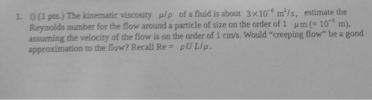 3 x 10⁻⁶ m2/s, estimate the i) (1 pes.) The kinematic viscosity Reynolds number for the flow around a particle of size on the order of 1 μ m (= 10° m), assuming the velocity of the flow is on the order of 1 cm/s. Would "creeping flow" be a good approximation to the flow? Recall Re pULIp. し μ/ρ of a fluid is about
the mass flow rate, m, flow through duct with a rectangular cross-section a*b. The fluid properties such as density, p,...
the mass flow rate, m, flow through duct with a rectangular cross-section a*b. The fluid properties such as density, p, and kinematic viscosity, v, are given determine: (1) Hydraulic, Dh, (2)average velocity, V (3)Mass flux, G, (4) Reynolds number, Re
Calculate the Reynolds number, Re- (2rpv)/ n, for the following situations and decide whether the flow...
 Calculate the Reynolds number, Re- (2rpv)/ n, for the following situations and decide whether the flow of fluid around them is laminar or turbulent. Then calculate the frag force using the appropriate formula. For the radius, use r 2(Area/perimeter) which, for a circle, gives the radius. Densities and viscosities are in the table on page 2. Also, to keep things uniform, we will use the boundaries for laminar and turbulent flow from Engineer's Toolbox, also on pg. 2 [1] A...
8. Which of the following flow regimes are dependent on the Reynolds number in order to...
 8. Which of the following flow regimes are dependent on the Reynolds number in order to determine the friction factor? a) laminar flow b) critical flow c) turbulent flow (smooth pipe) d) turbulent flow (transition zone) e) turbulent flow (supercritical turbulence, rough pipes 9. Which of the following methods can be used to determine friction loss in pipelines? a) Darcy-Weisbach b) Manning c) Hazen-Williams d) a, b, and c e) a and b only 10. Solution of the classical 3-reservoir...
Assuming both non-circular cylinders are experiencing the same external fluid flow (identical density, viscosity, fluid velocity),...
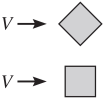 Assuming both non-circular cylinders are experiencing the same
external fluid flow (identical density, viscosity, fluid velocity),
which orientation would experience a higher convective heat
transfer coefficient? What is the ratio of Nusselt numbers for the
flat cross-section over the angled cross-section? Please show work,
and explain conceptually if possible. Thank you!
V- V —
Assuming both non-circular cylinders are experiencing the same
external fluid flow (identical density, viscosity, fluid velocity),
which orientation would experience a higher convective heat
transfer coefficient? What is the ratio of Nusselt numbers for the
flat cross-section over the angled cross-section? Please show work,
and explain conceptually if possible. Thank you!
V- V —
Write the solution of the maximum Reynolds number of the flow passing over the tube bundle...
 Write the solution of the maximum Reynolds number of the flow
passing over the tube bundle here.
(b) Estimate the average Nusselt number of the flow passing over
the tube bundle. (choose the closest answer)
Write the solution of the average Nusselt number of the flow
passing over the tube bundle here
(c) Estimate the number of required transverse rows. (choose the
closest answer)
Write the solution of the number of required transverse rows
here.
Question 13 (5 points) We...
Write the solution of the maximum Reynolds number of the flow
passing over the tube bundle here.
(b) Estimate the average Nusselt number of the flow passing over
the tube bundle. (choose the closest answer)
Write the solution of the average Nusselt number of the flow
passing over the tube bundle here
(c) Estimate the number of required transverse rows. (choose the
closest answer)
Write the solution of the number of required transverse rows
here.
Question 13 (5 points) We...
 Poiseuille Flow: Consider a pressure-driven (gradient DeltaP/L = (P_in -P_out)/L) flow of a fluid of viscosity mu in a tube of circular cross-section with radius R and length L. Starting from the NSE, show for fully-developed, steady flow, that the volumetric flow rate is:[10] Show that the magnitude of the shear stress T_rz at the wall is: Using your answer from parts (a) and (b), obtain an expression for the friction factor f in terms of the Reynolds number Re...
 Recall that the Reynolds number is a dimensionless number that we use to discuss the flow charecteristics of moving fluids. Generally speaking it is the ratio of momentum forces to viscous forces, and it depends on the diameter of the pipe, the density of the fluid, the velocity of the moving fluid, and the viscosity of the moving fluid. It is normally given by Re Where Re - Reynolds number [dimensionless) p- fuid density v- fud velocity D- pipe diameter...
 3. A Newtonian fluid with a dynamic or absolute viscosity of 0.38 Ns/m” and a Density of 910 kg/m flows through a 25 mm diameter pipe with a velocity of 2.6 m/s. Find out Reynolds number of the fluid. Is the fluid flow lamina, transient, or turbulent?
 Question 2 2A. Define Reynolds number. 2B. What is the range of Reynolds number where the Darcy's Law is applicable? 2C. How should you ensure you are in the valid range of Reynolds number to apply the Darcy's Law correctly? 2D. Consider a porous medium with the following rock properties • Porosity, Ø = 20% • Permeability, k = 200 mD The fluid being injected into the medium at a Darcian velocity, u = 5 cm/s, has the following properties...
 3 x 10⁻⁶ m2/s, estimate the i) (1 pes.) The kinematic viscosity Reynolds number for the flow around a particle of size on the order of 1 μ m (= 10° m), assuming the velocity of the flow is on the order of 1 cm/s. Would "creeping flow" be a good approximation to the flow? Recall Re pULIp. し μ/ρ of a fluid is about
 Calculate the Reynolds number, Re- (2rpv)/ n, for the following situations and decide whether the flow of fluid around them is laminar or turbulent. Then calculate the frag force using the appropriate formula. For the radius, use r 2(Area/perimeter) which, for a circle, gives the radius. Densities and viscosities are in the table on page 2. Also, to keep things uniform, we will use the boundaries for laminar and turbulent flow from Engineer's Toolbox, also on pg. 2 [1] A...
 8. Which of the following flow regimes are dependent on the Reynolds number in order to determine the friction factor? a) laminar flow b) critical flow c) turbulent flow (smooth pipe) d) turbulent flow (transition zone) e) turbulent flow (supercritical turbulence, rough pipes 9. Which of the following methods can be used to determine friction loss in pipelines? a) Darcy-Weisbach b) Manning c) Hazen-Williams d) a, b, and c e) a and b only 10. Solution of the classical 3-reservoir...
 Assuming both non-circular cylinders are experiencing the same
external fluid flow (identical density, viscosity, fluid velocity),
which orientation would experience a higher convective heat
transfer coefficient? What is the ratio of Nusselt numbers for the
flat cross-section over the angled cross-section? Please show work,
and explain conceptually if possible. Thank you!
V- V —
Assuming both non-circular cylinders are experiencing the same
external fluid flow (identical density, viscosity, fluid velocity),
which orientation would experience a higher convective heat
transfer coefficient? What is the ratio of Nusselt numbers for the
flat cross-section over the angled cross-section? Please show work,
and explain conceptually if possible. Thank you!
V- V —
 Write the solution of the maximum Reynolds number of the flow
passing over the tube bundle here.
(b) Estimate the average Nusselt number of the flow passing over
the tube bundle. (choose the closest answer)
Write the solution of the average Nusselt number of the flow
passing over the tube bundle here
(c) Estimate the number of required transverse rows. (choose the
closest answer)
Write the solution of the number of required transverse rows
here.
Question 13 (5 points) We...
Write the solution of the maximum Reynolds number of the flow
passing over the tube bundle here.
(b) Estimate the average Nusselt number of the flow passing over
the tube bundle. (choose the closest answer)
Write the solution of the average Nusselt number of the flow
passing over the tube bundle here
(c) Estimate the number of required transverse rows. (choose the
closest answer)
Write the solution of the number of required transverse rows
here.
Question 13 (5 points) We...
Most questions answered within 3 hours.
-
Where is the error in this code sequence?
String s1 = "Hello";
String s2 = "ello";...
asked 10 months ago -
Financial data for Joel de Paris, Inc., for last year
follow:
Joel de Paris, Inc.
Balance...
asked 10 months ago -
Consider this reaction:
Al2(SO4)3 (aq)+ BaCl3
(aq) Al2Cl6 (aq)- +
3BaSO4(s) . What is the...
asked 10 months ago -
Suppose that Savneet is considering increasing her
recent random sample from 20 car rentals to 40...
asked 10 months ago -
Trucks arrive at an unloading terminal at an average rate of 120
per hour.
Trucks arrive...
asked 10 months ago -
Why are methanol and ethanol completely soluble in water while
octanol is not very little soluble....
asked 10 months ago -
A facilities manager at a university reads in a research report
that the mean amount of...
asked 10 months ago -
When the CuSO4 is rehydrated by adding water to the anhydrous
compound, is this an endothermic...
asked 10 months ago -
A ray of sunlight is passing from diamond into crown glass; the
angle of incidence is...
asked 10 months ago -
A block of mass 0.249 kg is placed on top of a light, vertical
spring of...
asked 10 months ago -
how do the kidneys compensate in the presences of acidosis
a) trigger hyperventilate
b) reserve acid...
asked 10 months ago -
Question 501 pts
The rental rate of capital to the firm increases. Which of the
following...
asked 10 months ago