please help
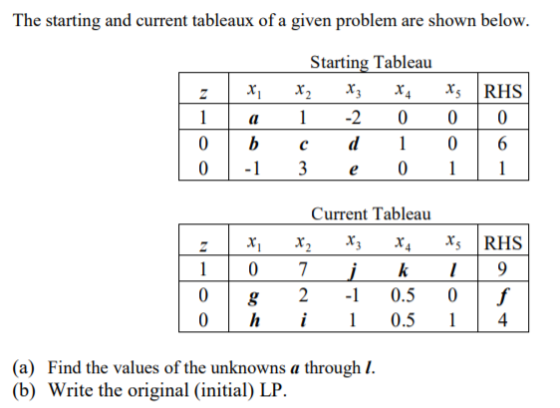
The starting and current tableaux of a given problem are shown below. Starting Tableau z 1 x 2 x 3 x 4 x 5 x RHS 1 a 1 -2 0 0 0 0 b c d 1 0 6 0 -1 3 e 0 1 1 Current Tableau z 1 x 2 x 3 x 4 x 5 x RHS 1 0 7 j k l 9 0 g 2 -1 0.5 0 f 0 h i 1 0.5 1 4 (a) Find the values of the unknowns a through l. (b) Write the original (initial) LP.
Homework Answers
Request Answer!
We need at least 9 more requests to produce the answer.
1 / 10 have requested this problem solution
The more requests, the faster the answer.
1) Consider the simplex tableau obtained after a few iterations: RHS Basic 1 1/4 5/8 57/4 57/4 0 ...
 1) Consider the simplex tableau obtained after a few iterations: RHS Basic 1 1/4 5/8 57/4 57/4 0 01/4 1 1/8 /2 14 3/2 1/4 1/8 5/8 0 a) (10pts) We do not know the original problem, but is given that x and xs are the slack variables for the first and second constraints respectively. The initial basis was constructed as хв=fu xs] and after several simplex tableau iter tions the optimal basis is determined as x [x, x]. From...
4) (20 pts) Consider the following optimal Simplex Tableau of an LP problem: 11 12 13...
 4) (20 pts) Consider the following optimal Simplex Tableau of an LP problem: 11 12 13 0 0 0 14 -4 1 RHS -2-40 0 1 1 1 It is known that 14 and 15 are the slack variables in the first and the second constraints of the original problem. The constraints are stype. Write the original problem.
please Solve This!! Consider a maximization problem with the optimal tableau in Table 73. The optimal...
 please Solve This!!
Consider a maximization problem with the optimal tableau in Table 73. The optimal solution to this LP is z = 10, x3 = 3, x4 = 5, x1 = x2 = 0. Determine the second-best bfs to this LP. (Hint: Show that the second-best solution must be a bfs that is one pivot away from the optimal solution.) TABLE 73 z X1 X2 X3 X4 rhs 1 2 10 10 10 0 3 2 1 0 3...
please Solve This!!
Consider a maximization problem with the optimal tableau in Table 73. The optimal solution to this LP is z = 10, x3 = 3, x4 = 5, x1 = x2 = 0. Determine the second-best bfs to this LP. (Hint: Show that the second-best solution must be a bfs that is one pivot away from the optimal solution.) TABLE 73 z X1 X2 X3 X4 rhs 1 2 10 10 10 0 3 2 1 0 3...
Q4. (Sensitivity Analysis: Adding a new constraint) (3 marks) Consider the following LP max z= 6x1+x2 s.t.xi + x2 S5 2x1 + x2 s6 with the following final optimal Simplex tableau basis x1 r2 S2 rhs 0...
 Q4. (Sensitivity Analysis: Adding a new constraint) (3 marks) Consider the following LP max z= 6x1+x2 s.t.xi + x2 S5 2x1 + x2 s6 with the following final optimal Simplex tableau basis x1 r2 S2 rhs 0 0 18 0.5 0.5 0.5 0.5 x1 where sı and s2 are the slack variables in the first and second constraints, respectively (a) Please find the optimal solution if we add the new constraint 3x1 + x2 S 10 into the LP (b)...
2. Consider the linear programm (a) Fill in the initial tableau below in order to start...
 2. Consider the linear programm (a) Fill in the initial tableau below in order to start the Big-M Method tableau by performing one pivot operation. (6) The first tableau below is the tableau just before the optimal tableau, and the second one oorresponds to the optimal tableau. Fill in the missing entries for the second one. 1 7 56 M15 25 01 3/2 2 0 0 1/2 0 15/2 #310 0 5/2-1 o 1-1/2 0133/2 a1 a rhs (i) Exhibit...
#16.2 Consider the following standard form LP problem: minimize 2xi -x2-^3 subject to 3x1+x2+エ4-4 a. Write down the A,...
 #16.2 Consider the following standard form LP problem: minimize 2xi -x2-^3 subject to 3x1+x2+エ4-4 a. Write down the A, b, and c matrices/vectors for the problem. b. Consider the basis consisting of the third and fourth columns of A, or- dered according to [a4, as]. Compute the canonical tableau correspond ing to this basis c. Write down the basic feasible solution corresponding to the basis above, and its objective function value. d. Write down the values of the reduced cost...
In Exercises 3 and 4 we give the original objective function of a linear program- ming problem an...
 In Exercises 3 and 4 we give the original objective function of a linear program- ming problem and the final tableau at the end of Phase 1. Find the initial tableau for Phase 2 and solve the resulting linear programming problem. 4. Maximize z = 3x 1 + x2 + 3x3. Ху 0 0 0-1 010 0 x1 -2 0
In Exercises 3 and 4 we give the original objective function of a linear program- ming problem and the final...
In Exercises 3 and 4 we give the original objective function of a linear program- ming problem and the final tableau at the end of Phase 1. Find the initial tableau for Phase 2 and solve the resulting linear programming problem. 4. Maximize z = 3x 1 + x2 + 3x3. Ху 0 0 0-1 010 0 x1 -2 0
In Exercises 3 and 4 we give the original objective function of a linear program- ming problem and the final...
please answer all the question and explain clearly! THANKS! Exercise 6 Consider the LP problem subject to 1 1/2 T2 S1 2 2. 1, 0. After applying the Simplex method, the last simplex tableau is the fol...
 please answer all the question and explain clearly! THANKS!
Exercise 6 Consider the LP problem subject to 1 1/2 T2 S1 2 2. 1, 0. After applying the Simplex method, the last simplex tableau is the follow- ng: z x1 x2 81 82 83|RHS -1 0 0 0 0 1-2 1 0 1 0 1 01/2 82 0 2 10 r20 0 1 201 Explain if the problem has one solution, infinitely many, or none. If it has infinitely many...
please answer all the question and explain clearly! THANKS!
Exercise 6 Consider the LP problem subject to 1 1/2 T2 S1 2 2. 1, 0. After applying the Simplex method, the last simplex tableau is the follow- ng: z x1 x2 81 82 83|RHS -1 0 0 0 0 1-2 1 0 1 0 1 01/2 82 0 2 10 r20 0 1 201 Explain if the problem has one solution, infinitely many, or none. If it has infinitely many...
This is question 5.3-5 from Introduction to Operations Research (Hillier). Relevant text: Consider the following problem....
 This is question 5.3-5 from Introduction to Operations Research
(Hillier). Relevant text:
Consider the following problem. Maximize Z= cixi + c2x2 + C3X3 subject to x1 + 2x2 + x3 = b 2x1 + x2 + 3x3 = 2b and x 20, X220, X2 > 0. Note that values have not been assigned to the coefficients in the objective function (C1, C2, C3). and that the only specification for the right-hand side of the functional constraints is that the second...
This is question 5.3-5 from Introduction to Operations Research
(Hillier). Relevant text:
Consider the following problem. Maximize Z= cixi + c2x2 + C3X3 subject to x1 + 2x2 + x3 = b 2x1 + x2 + 3x3 = 2b and x 20, X220, X2 > 0. Note that values have not been assigned to the coefficients in the objective function (C1, C2, C3). and that the only specification for the right-hand side of the functional constraints is that the second...
SOLVE STEP BY STEP! 4. Consider the following LP: Minimize z = x; +3x2 - X3...
 SOLVE STEP BY STEP!
4. Consider the following LP: Minimize z = x; +3x2 - X3 Subject to x + x2 + x2 > 3 -x + 2xz > 2 -x + 3x2 + x3 34 X1 X2,43 20 (a) Using the two-phase method, find the optimal solution to the primal problem above. (b) Write directly the dual of the primal problem, without using the method of transformation. (c) Determine the optimal values of the dual variables from the optimal...
SOLVE STEP BY STEP!
4. Consider the following LP: Minimize z = x; +3x2 - X3 Subject to x + x2 + x2 > 3 -x + 2xz > 2 -x + 3x2 + x3 34 X1 X2,43 20 (a) Using the two-phase method, find the optimal solution to the primal problem above. (b) Write directly the dual of the primal problem, without using the method of transformation. (c) Determine the optimal values of the dual variables from the optimal...
 1) Consider the simplex tableau obtained after a few iterations: RHS Basic 1 1/4 5/8 57/4 57/4 0 01/4 1 1/8 /2 14 3/2 1/4 1/8 5/8 0 a) (10pts) We do not know the original problem, but is given that x and xs are the slack variables for the first and second constraints respectively. The initial basis was constructed as хв=fu xs] and after several simplex tableau iter tions the optimal basis is determined as x [x, x]. From...
 4) (20 pts) Consider the following optimal Simplex Tableau of an LP problem: 11 12 13 0 0 0 14 -4 1 RHS -2-40 0 1 1 1 It is known that 14 and 15 are the slack variables in the first and the second constraints of the original problem. The constraints are stype. Write the original problem.
 please Solve This!!
Consider a maximization problem with the optimal tableau in Table 73. The optimal solution to this LP is z = 10, x3 = 3, x4 = 5, x1 = x2 = 0. Determine the second-best bfs to this LP. (Hint: Show that the second-best solution must be a bfs that is one pivot away from the optimal solution.) TABLE 73 z X1 X2 X3 X4 rhs 1 2 10 10 10 0 3 2 1 0 3...
please Solve This!!
Consider a maximization problem with the optimal tableau in Table 73. The optimal solution to this LP is z = 10, x3 = 3, x4 = 5, x1 = x2 = 0. Determine the second-best bfs to this LP. (Hint: Show that the second-best solution must be a bfs that is one pivot away from the optimal solution.) TABLE 73 z X1 X2 X3 X4 rhs 1 2 10 10 10 0 3 2 1 0 3...
 Q4. (Sensitivity Analysis: Adding a new constraint) (3 marks) Consider the following LP max z= 6x1+x2 s.t.xi + x2 S5 2x1 + x2 s6 with the following final optimal Simplex tableau basis x1 r2 S2 rhs 0 0 18 0.5 0.5 0.5 0.5 x1 where sı and s2 are the slack variables in the first and second constraints, respectively (a) Please find the optimal solution if we add the new constraint 3x1 + x2 S 10 into the LP (b)...
 2. Consider the linear programm (a) Fill in the initial tableau below in order to start the Big-M Method tableau by performing one pivot operation. (6) The first tableau below is the tableau just before the optimal tableau, and the second one oorresponds to the optimal tableau. Fill in the missing entries for the second one. 1 7 56 M15 25 01 3/2 2 0 0 1/2 0 15/2 #310 0 5/2-1 o 1-1/2 0133/2 a1 a rhs (i) Exhibit...
 #16.2 Consider the following standard form LP problem: minimize 2xi -x2-^3 subject to 3x1+x2+エ4-4 a. Write down the A, b, and c matrices/vectors for the problem. b. Consider the basis consisting of the third and fourth columns of A, or- dered according to [a4, as]. Compute the canonical tableau correspond ing to this basis c. Write down the basic feasible solution corresponding to the basis above, and its objective function value. d. Write down the values of the reduced cost...
 In Exercises 3 and 4 we give the original objective function of a linear program- ming problem and the final tableau at the end of Phase 1. Find the initial tableau for Phase 2 and solve the resulting linear programming problem. 4. Maximize z = 3x 1 + x2 + 3x3. Ху 0 0 0-1 010 0 x1 -2 0
In Exercises 3 and 4 we give the original objective function of a linear program- ming problem and the final...
In Exercises 3 and 4 we give the original objective function of a linear program- ming problem and the final tableau at the end of Phase 1. Find the initial tableau for Phase 2 and solve the resulting linear programming problem. 4. Maximize z = 3x 1 + x2 + 3x3. Ху 0 0 0-1 010 0 x1 -2 0
In Exercises 3 and 4 we give the original objective function of a linear program- ming problem and the final...
 please answer all the question and explain clearly! THANKS!
Exercise 6 Consider the LP problem subject to 1 1/2 T2 S1 2 2. 1, 0. After applying the Simplex method, the last simplex tableau is the follow- ng: z x1 x2 81 82 83|RHS -1 0 0 0 0 1-2 1 0 1 0 1 01/2 82 0 2 10 r20 0 1 201 Explain if the problem has one solution, infinitely many, or none. If it has infinitely many...
please answer all the question and explain clearly! THANKS!
Exercise 6 Consider the LP problem subject to 1 1/2 T2 S1 2 2. 1, 0. After applying the Simplex method, the last simplex tableau is the follow- ng: z x1 x2 81 82 83|RHS -1 0 0 0 0 1-2 1 0 1 0 1 01/2 82 0 2 10 r20 0 1 201 Explain if the problem has one solution, infinitely many, or none. If it has infinitely many...
 This is question 5.3-5 from Introduction to Operations Research
(Hillier). Relevant text:
Consider the following problem. Maximize Z= cixi + c2x2 + C3X3 subject to x1 + 2x2 + x3 = b 2x1 + x2 + 3x3 = 2b and x 20, X220, X2 > 0. Note that values have not been assigned to the coefficients in the objective function (C1, C2, C3). and that the only specification for the right-hand side of the functional constraints is that the second...
This is question 5.3-5 from Introduction to Operations Research
(Hillier). Relevant text:
Consider the following problem. Maximize Z= cixi + c2x2 + C3X3 subject to x1 + 2x2 + x3 = b 2x1 + x2 + 3x3 = 2b and x 20, X220, X2 > 0. Note that values have not been assigned to the coefficients in the objective function (C1, C2, C3). and that the only specification for the right-hand side of the functional constraints is that the second...
 SOLVE STEP BY STEP!
4. Consider the following LP: Minimize z = x; +3x2 - X3 Subject to x + x2 + x2 > 3 -x + 2xz > 2 -x + 3x2 + x3 34 X1 X2,43 20 (a) Using the two-phase method, find the optimal solution to the primal problem above. (b) Write directly the dual of the primal problem, without using the method of transformation. (c) Determine the optimal values of the dual variables from the optimal...
SOLVE STEP BY STEP!
4. Consider the following LP: Minimize z = x; +3x2 - X3 Subject to x + x2 + x2 > 3 -x + 2xz > 2 -x + 3x2 + x3 34 X1 X2,43 20 (a) Using the two-phase method, find the optimal solution to the primal problem above. (b) Write directly the dual of the primal problem, without using the method of transformation. (c) Determine the optimal values of the dual variables from the optimal...
Most questions answered within 3 hours.
-
Where is the error in this code sequence?
String s1 = "Hello";
String s2 = "ello";...
asked 10 months ago -
Financial data for Joel de Paris, Inc., for last year
follow:
Joel de Paris, Inc.
Balance...
asked 10 months ago -
Consider this reaction:
Al2(SO4)3 (aq)+ BaCl3
(aq) Al2Cl6 (aq)- +
3BaSO4(s) . What is the...
asked 10 months ago -
Suppose that Savneet is considering increasing her
recent random sample from 20 car rentals to 40...
asked 10 months ago -
Trucks arrive at an unloading terminal at an average rate of 120
per hour.
Trucks arrive...
asked 10 months ago -
Why are methanol and ethanol completely soluble in water while
octanol is not very little soluble....
asked 10 months ago -
A facilities manager at a university reads in a research report
that the mean amount of...
asked 10 months ago -
When the CuSO4 is rehydrated by adding water to the anhydrous
compound, is this an endothermic...
asked 10 months ago -
A ray of sunlight is passing from diamond into crown glass; the
angle of incidence is...
asked 10 months ago -
A block of mass 0.249 kg is placed on top of a light, vertical
spring of...
asked 10 months ago -
how do the kidneys compensate in the presences of acidosis
a) trigger hyperventilate
b) reserve acid...
asked 10 months ago -
Question 501 pts
The rental rate of capital to the firm increases. Which of the
following...
asked 10 months ago