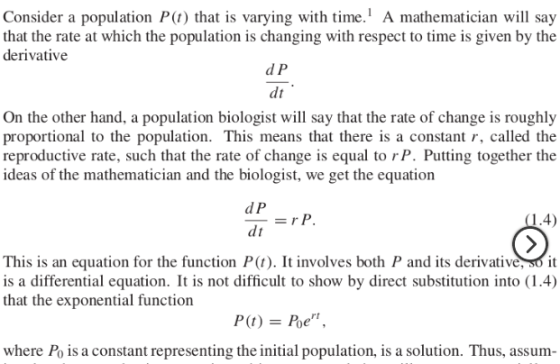
Can someone show step by step how to get P0e^rt from equation (1.4)?
Homework Answers
![dP top 1] dt t dP to dt [. Integrating ] TT dP s li f to at 7 en =botte [ro= constant] (where, e = integral constant pt te 7](http://img.homeworklib.com/questions/33df5f30-4c0e-11ec-b11b-bdf33e87c167.png?x-oss-process=image/resize,w_560)
Add Answer to:
Can someone show step by step how to get P0e^rt from equation
(1.4)?
Consider a population...
Use the solution you found in Part 1f to show that the Gompertz model can be...
 Use the solution you found in
Part 1f to show that the Gompertz model can be rewritten as
dP/dt=−λe^(−rt)P, where λ is a positive constant.
j) Consider grouping the factors in the equation like this:
dP/dt=-(λe^(-rt))P. Make an interpretation of this equation. In
other words, what assumption about tumour growth would lead us to
write down such an equation?
k) Now consider grouping the factors in the equation like this:
dP/dt=−λ(e^(-rt)P). Again, explain what assumption about tumour
growth would lead...
Use the solution you found in
Part 1f to show that the Gompertz model can be rewritten as
dP/dt=−λe^(−rt)P, where λ is a positive constant.
j) Consider grouping the factors in the equation like this:
dP/dt=-(λe^(-rt))P. Make an interpretation of this equation. In
other words, what assumption about tumour growth would lead us to
write down such an equation?
k) Now consider grouping the factors in the equation like this:
dP/dt=−λ(e^(-rt)P). Again, explain what assumption about tumour
growth would lead...
step by step please 4. Suppose that the logistic equation dt Pla -bP) models a population of fish in a lake after t months during which no fishing occurs. What is the limiting population for this...
 step by step please
4. Suppose that the logistic equation dt Pla -bP) models a population of fish in a lake after t months during which no fishing occurs. What is the limiting population for this fish population? suppose that, because of fishing, fish are removed from the lake at a rate proportional to the existing fish population. i. Write a differential equation that describes this situation. ii. Show that if the constant of proportionality for the harvest of fish,...
step by step please
4. Suppose that the logistic equation dt Pla -bP) models a population of fish in a lake after t months during which no fishing occurs. What is the limiting population for this fish population? suppose that, because of fishing, fish are removed from the lake at a rate proportional to the existing fish population. i. Write a differential equation that describes this situation. ii. Show that if the constant of proportionality for the harvest of fish,...
- ap-bp? This equation is known as the logistic law of population growth and the numbers...
 - ap-bp? This equation is known as the logistic law of population growth and the numbers a, b are called the vital coefficients of the population. It was first introduced in 1837 by the Dutch mathematical-biologist Verhulst. Now, the constant b, in general, will be very small compared to a, so that if p is not too large then the term - bp will be negligible compared to ap and the population will grow exponentially. However, when p is very...
Exercises 1. Verify equation (3) 2. Use the techniques of Section 13.7 and the fact that...
 Exercises 1. Verify equation (3) 2. Use the techniques of Section 13.7 and the fact that P(0) = 10 to solve equation (5). 3. The carrying capacity of Atlantic harp seals has been estimated to be C = 10 million seals. Let 1 = 0 correspond to the year 1980 when this seal population was estimated to be about 2 mil- lion. (Data from: Fisheries and Oceans Canada.) (a) Use a logistic growth model = kP(C - P) with k...
I need Summary of this Paper i dont need long summary i need What methodology they used , what is the purpose of this p...
 I need Summary of this Paper i dont need long summary i need
What methodology they used , what is the purpose of this paper and
some conclusions and contributes of this paper. I need this for my
Finishing Project so i need this ASAP please ( IN 1-2-3 HOURS
PLEASE !!!)
Budgetary Policy and Economic Growth Errol D'Souza The share of capital expenditures in government expenditures has been slipping and the tax reforms have not yet improved the income...
I need Summary of this Paper i dont need long summary i need
What methodology they used , what is the purpose of this paper and
some conclusions and contributes of this paper. I need this for my
Finishing Project so i need this ASAP please ( IN 1-2-3 HOURS
PLEASE !!!)
Budgetary Policy and Economic Growth Errol D'Souza The share of capital expenditures in government expenditures has been slipping and the tax reforms have not yet improved the income...
 Use the solution you found in
Part 1f to show that the Gompertz model can be rewritten as
dP/dt=−λe^(−rt)P, where λ is a positive constant.
j) Consider grouping the factors in the equation like this:
dP/dt=-(λe^(-rt))P. Make an interpretation of this equation. In
other words, what assumption about tumour growth would lead us to
write down such an equation?
k) Now consider grouping the factors in the equation like this:
dP/dt=−λ(e^(-rt)P). Again, explain what assumption about tumour
growth would lead...
Use the solution you found in
Part 1f to show that the Gompertz model can be rewritten as
dP/dt=−λe^(−rt)P, where λ is a positive constant.
j) Consider grouping the factors in the equation like this:
dP/dt=-(λe^(-rt))P. Make an interpretation of this equation. In
other words, what assumption about tumour growth would lead us to
write down such an equation?
k) Now consider grouping the factors in the equation like this:
dP/dt=−λ(e^(-rt)P). Again, explain what assumption about tumour
growth would lead...
 step by step please
4. Suppose that the logistic equation dt Pla -bP) models a population of fish in a lake after t months during which no fishing occurs. What is the limiting population for this fish population? suppose that, because of fishing, fish are removed from the lake at a rate proportional to the existing fish population. i. Write a differential equation that describes this situation. ii. Show that if the constant of proportionality for the harvest of fish,...
step by step please
4. Suppose that the logistic equation dt Pla -bP) models a population of fish in a lake after t months during which no fishing occurs. What is the limiting population for this fish population? suppose that, because of fishing, fish are removed from the lake at a rate proportional to the existing fish population. i. Write a differential equation that describes this situation. ii. Show that if the constant of proportionality for the harvest of fish,...
 - ap-bp? This equation is known as the logistic law of population growth and the numbers a, b are called the vital coefficients of the population. It was first introduced in 1837 by the Dutch mathematical-biologist Verhulst. Now, the constant b, in general, will be very small compared to a, so that if p is not too large then the term - bp will be negligible compared to ap and the population will grow exponentially. However, when p is very...
 Exercises 1. Verify equation (3) 2. Use the techniques of Section 13.7 and the fact that P(0) = 10 to solve equation (5). 3. The carrying capacity of Atlantic harp seals has been estimated to be C = 10 million seals. Let 1 = 0 correspond to the year 1980 when this seal population was estimated to be about 2 mil- lion. (Data from: Fisheries and Oceans Canada.) (a) Use a logistic growth model = kP(C - P) with k...
 I need Summary of this Paper i dont need long summary i need
What methodology they used , what is the purpose of this paper and
some conclusions and contributes of this paper. I need this for my
Finishing Project so i need this ASAP please ( IN 1-2-3 HOURS
PLEASE !!!)
Budgetary Policy and Economic Growth Errol D'Souza The share of capital expenditures in government expenditures has been slipping and the tax reforms have not yet improved the income...
I need Summary of this Paper i dont need long summary i need
What methodology they used , what is the purpose of this paper and
some conclusions and contributes of this paper. I need this for my
Finishing Project so i need this ASAP please ( IN 1-2-3 HOURS
PLEASE !!!)
Budgetary Policy and Economic Growth Errol D'Souza The share of capital expenditures in government expenditures has been slipping and the tax reforms have not yet improved the income...
Most questions answered within 3 hours.
-
Where is the error in this code sequence?
String s1 = "Hello";
String s2 = "ello";...
asked 10 months ago -
Financial data for Joel de Paris, Inc., for last year
follow:
Joel de Paris, Inc.
Balance...
asked 10 months ago -
Consider this reaction:
Al2(SO4)3 (aq)+ BaCl3
(aq) Al2Cl6 (aq)- +
3BaSO4(s) . What is the...
asked 10 months ago -
Suppose that Savneet is considering increasing her
recent random sample from 20 car rentals to 40...
asked 10 months ago -
Trucks arrive at an unloading terminal at an average rate of 120
per hour.
Trucks arrive...
asked 10 months ago -
Why are methanol and ethanol completely soluble in water while
octanol is not very little soluble....
asked 10 months ago -
A facilities manager at a university reads in a research report
that the mean amount of...
asked 10 months ago -
When the CuSO4 is rehydrated by adding water to the anhydrous
compound, is this an endothermic...
asked 10 months ago -
A ray of sunlight is passing from diamond into crown glass; the
angle of incidence is...
asked 10 months ago -
A block of mass 0.249 kg is placed on top of a light, vertical
spring of...
asked 10 months ago -
how do the kidneys compensate in the presences of acidosis
a) trigger hyperventilate
b) reserve acid...
asked 10 months ago -
Question 501 pts
The rental rate of capital to the firm increases. Which of the
following...
asked 10 months ago