
Homework Answers
PDA for given language is given here.
 Here at state A :- push '[' on
to stack for each input string '[' . and pop one '[' for each input
string ']'.
Here at state A :- push '[' on
to stack for each input string '[' . and pop one '[' for each input
string ']'.
when end of string is reached, i.e $ found, and stack is empty accept the string at state B.
--> here symbol Z0 indicates empty stack.
----> Here is the parse tree and derivation for the given string []$ :
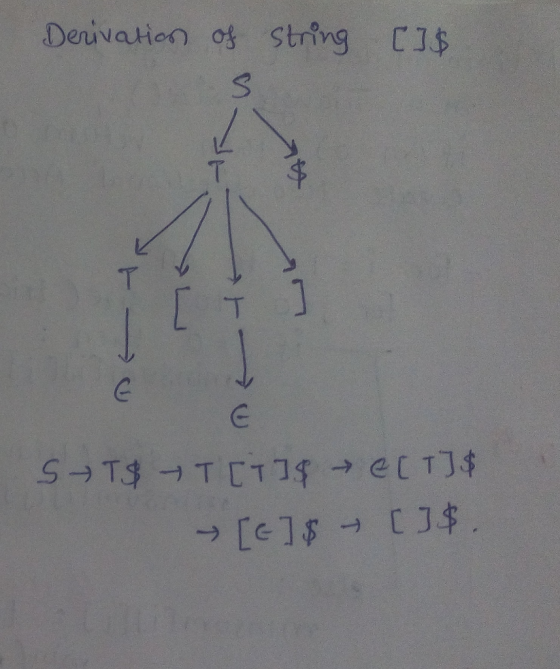
note : Here given language is left recursive, so there can be ambiguity in derivation.
If you have any doubts, you can ask in comment section.
Add Answer to:
Define a deterministic PDA (give table of moves) that accepts the language of balanced strings of...
4. Show that the pda constructed in Example 7.6 accepts the strings aabb and aaabbbb, and that bo...
 4. Show that the pda constructed in Example 7.6 accepts the strings aabb and aaabbbb, and that both strings are in the language generated by the given grammar. EXAMPLE 7.6 Construct a pda that accepts the language generated by a grammar with productions We first transform the grammar into Greibach normal form, changing the productions to A bB, The corresponding automaton will have three states (go, 91,92), with initial state go and final state q2. First, the start symbol S...
1. Consider the alphabet {a,b,c}. Construct a finite automaton that accepts the language described by the...
 1. Consider the alphabet {a,b,c}. Construct a finite automaton that accepts the language described by the following regular expression. 6* (ab U bc)(aa)* ccb* Which of the following strings are in the language: bccc, babbcaacc, cbcaaaaccbb, and bbbbaaaaccccbbb (Give reasons for why the string are or are not in the language). 2. Let G be a context free grammar in Chomsky normal form. Let w be a string produced by that grammar with W = n 1. Prove that the...
Please help me with the coding for LL(1)!! The given grammar was: P → PL |...
 Please help me with the coding for LL(1)!!
The given grammar was:
P → PL | L
L → N; | M; | C
N → print E
M → print "W"
W → TW | ε
C → if E {P} | if E {P} else {P}
E → (EOE) | V (note: this has a variable O)
O → + | - | * V → 0 | 1 | 2 | 3 (note: this has a terminal...
Please help me with the coding for LL(1)!!
The given grammar was:
P → PL | L
L → N; | M; | C
N → print E
M → print "W"
W → TW | ε
C → if E {P} | if E {P} else {P}
E → (EOE) | V (note: this has a variable O)
O → + | - | * V → 0 | 1 | 2 | 3 (note: this has a terminal...
Task The task for this assignment is to have the following user-defined data type: struct rgb...
Task The task for this assignment is to have the following user-defined data type: struct rgb { unsigned char red; unsigned char green; unsigned char blue; }; be able to be: read in from a stream (e.g., std::cin), i.e., write: std::istream& operator >>(std::istream& is, rgb& colour); (see below) written out to a stream (e.g., std::cout), i.e., write: std::ostream& operator <<(std::ostream& os, rgb const& colour); (see below) stored in a container, e.g., std::vector<rgb>, std::array<rgb,16>; (see below) processed via algorithms (and other...
 4. Show that the pda constructed in Example 7.6 accepts the strings aabb and aaabbbb, and that both strings are in the language generated by the given grammar. EXAMPLE 7.6 Construct a pda that accepts the language generated by a grammar with productions We first transform the grammar into Greibach normal form, changing the productions to A bB, The corresponding automaton will have three states (go, 91,92), with initial state go and final state q2. First, the start symbol S...
 1. Consider the alphabet {a,b,c}. Construct a finite automaton that accepts the language described by the following regular expression. 6* (ab U bc)(aa)* ccb* Which of the following strings are in the language: bccc, babbcaacc, cbcaaaaccbb, and bbbbaaaaccccbbb (Give reasons for why the string are or are not in the language). 2. Let G be a context free grammar in Chomsky normal form. Let w be a string produced by that grammar with W = n 1. Prove that the...
 Please help me with the coding for LL(1)!!
The given grammar was:
P → PL | L
L → N; | M; | C
N → print E
M → print "W"
W → TW | ε
C → if E {P} | if E {P} else {P}
E → (EOE) | V (note: this has a variable O)
O → + | - | * V → 0 | 1 | 2 | 3 (note: this has a terminal...
Please help me with the coding for LL(1)!!
The given grammar was:
P → PL | L
L → N; | M; | C
N → print E
M → print "W"
W → TW | ε
C → if E {P} | if E {P} else {P}
E → (EOE) | V (note: this has a variable O)
O → + | - | * V → 0 | 1 | 2 | 3 (note: this has a terminal...
Most questions answered within 3 hours.
-
Where is the error in this code sequence?
String s1 = "Hello";
String s2 = "ello";...
asked 10 months ago -
Financial data for Joel de Paris, Inc., for last year
follow:
Joel de Paris, Inc.
Balance...
asked 10 months ago -
Consider this reaction:
Al2(SO4)3 (aq)+ BaCl3
(aq) Al2Cl6 (aq)- +
3BaSO4(s) . What is the...
asked 10 months ago -
Suppose that Savneet is considering increasing her
recent random sample from 20 car rentals to 40...
asked 10 months ago -
Trucks arrive at an unloading terminal at an average rate of 120
per hour.
Trucks arrive...
asked 10 months ago -
Why are methanol and ethanol completely soluble in water while
octanol is not very little soluble....
asked 10 months ago -
A facilities manager at a university reads in a research report
that the mean amount of...
asked 10 months ago -
When the CuSO4 is rehydrated by adding water to the anhydrous
compound, is this an endothermic...
asked 10 months ago -
A ray of sunlight is passing from diamond into crown glass; the
angle of incidence is...
asked 10 months ago -
A block of mass 0.249 kg is placed on top of a light, vertical
spring of...
asked 10 months ago -
how do the kidneys compensate in the presences of acidosis
a) trigger hyperventilate
b) reserve acid...
asked 10 months ago -
Question 501 pts
The rental rate of capital to the firm increases. Which of the
following...
asked 10 months ago