NB! This task is required to be solved in matlab. this task also requires the use of the function displayDualSpectrum(); which i have pasted in the bottom. the tasks that i need help with are A), B) and C). this is a multi-part question. Task - Frequency mixing We use a basic signal that can be described mathematically as follows:with this We shall then make an amplitude modulated signal:
where fc is the carrier frequency. the code below specifies the parameters :
 with this We shall then make an amplitude modulated signal:
  where fc is the carrier frequency. the code below specifies the parameters :
clear;
close all;
%-------------------------------------------------------
% Parameters
%-------------------------------------------------------
Fs = 240; % sampling frequency
F1 = 8;
F2 = 12;
A0 = 0.48;
A1 = 0.31;
A2 = 0.19;
Fc = 50; % Carrier Frequency
T = 20; % signal duration in seconds
A) Complete the code in the field below so that we have two signals in the form of row vectors xt and yt as described by the formula above. We shall then get a plot of the frequency spectrum into one baseband signal and one frequency modulated signal.
code given by task:
%-------------------------------------------------------
% Signal generation
%-------------------------------------------------------
t = 0:1/Fs:(T-1/Fs); % Gives exactly Fs * T amount of samples.
%-------------------------------------------------------
% Plot of signal spectrum. ( i do not think this one needs to be
changed)
%-------------------------------------------------------
subplot(2,1,1);
displayDualSpectrum(xt,Fs);
title('BaseBand-signal x(t)');
subplot(2,1,2);
displayDualSpectrum(yt,Fs);
title('FrequencyMixed signal y(t)');
B)
Try adjusting the different signal parameters and answer the following control questions:

- Why do we have different amplitudes for the signals in subplot 1 and subplot 2.

- What determines the bandwidth of the signal y(t) ?

- Try to set the carrier frequency fc to 113 Hz or higher. what happens ?
C)
Adjust the code and use loops so that the signal x(t) can be given by a variable number of sine components depending on the following formula:
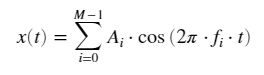
Where the parameters of Ai and fi are given by elements in the row vectors A and F, both with M amounts of elements.
displayDualSpectrum function below:
function displayDualSpectrum(xn,Fs)
L = length(xn);
Xk = fft(xn);
Fk = -Fs/2:Fs/L:(Fs/2-Fs/L);
Xk = [Xk(L/2+1:L) Xk(1:L/2)];
%figure();
%set(gcf, 'Visible', 'on');
%plot(Fk, abs(Xk)./(Fs*T), 'LineWidth', 2); axis([max(Fc
+F_min,-0.5) (Fc+F_max) 0 (A0+0.02)]);
plot(Fk, abs(Xk)./(L), 'LineWidth', 2);
xlim([-Fs/2 Fs/2]);
xlabel('Frequency (Hz)');
ylabel('Amplitude');
grid on;
end
Homework Answers

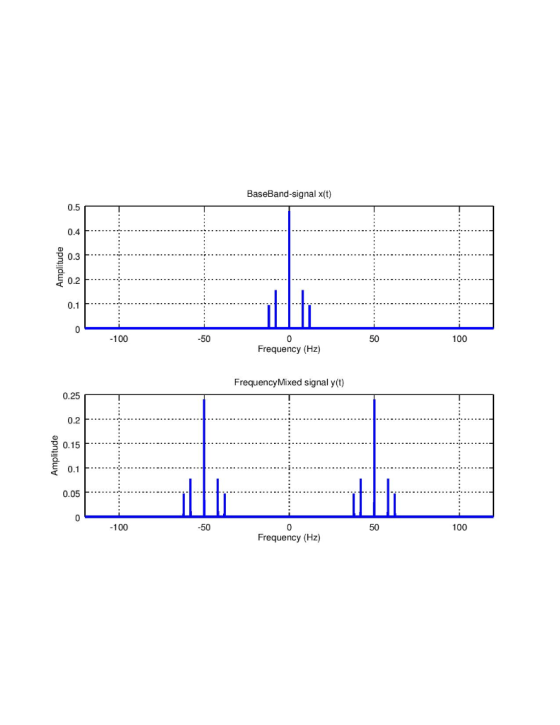
Part b solution figures
part 1

part b
2)
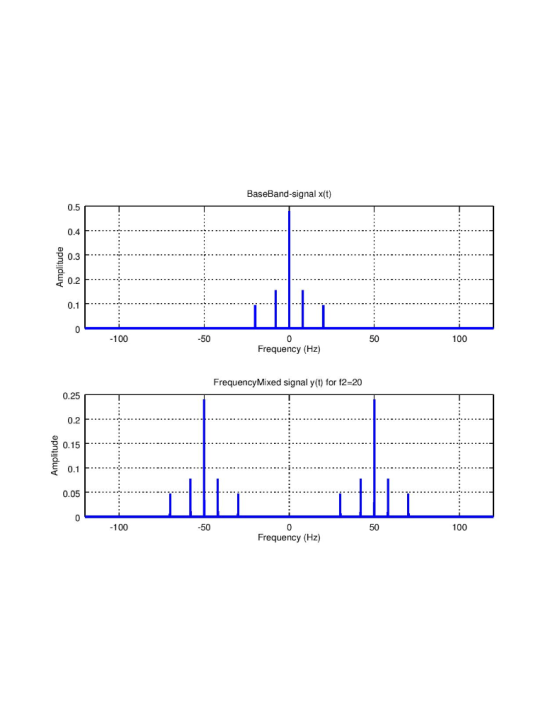
part b
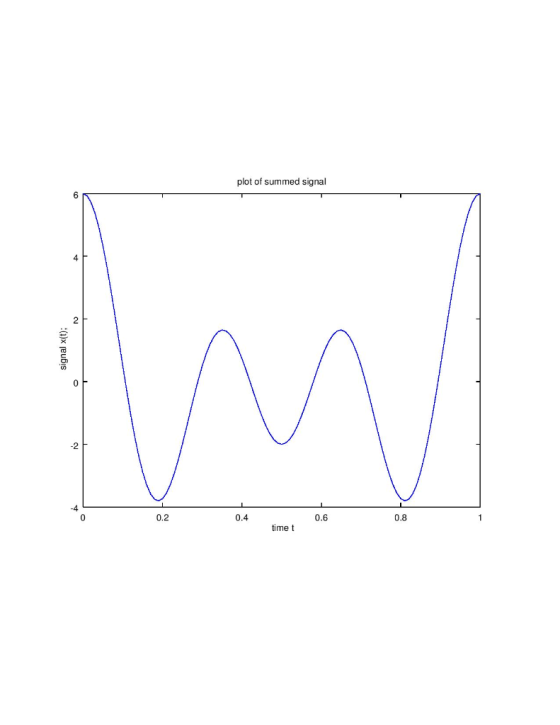
3)


Add Answer to:
NB! This task is required to be solved in matlab. this task also requires the use...
below is used to modulate a carrier to generate the AM signal yt) (Am()) cos(1000t) The periodic signal m() shown a) The power efficiency of the system is measured to be 1 () The type of AM modula...
 below is used to modulate a carrier to generate the AM signal yt) (Am()) cos(1000t) The periodic signal m() shown a) The power efficiency of the system is measured to be 1 () The type of AM modulation, i.e. SSB, DSBSC, (i) The constant A. (ili) The modulation index 1/13. Determine DSB with carrier enit -3 b) An angle modulated signal is given by d(t-2 cos (2n1061+ sin 2 1000). Find i) The carrier frequency. ii) The baseband signal bandwidth....
Below is the MATLAB code of low-cut shelving filter which can cut the low frequency of given music signal and low-boost...
Below is the MATLAB code of low-cut shelving filter which can cut the low frequency of given music signal and low-boost shelving filter which can boost the low frequency of given music signal. Design your low-boost shelving filter and low-cut shelving filter to have noticeablly different sound. Compare the sounds of two music signals after filtering, and explain the difference in sounds briefly. If there are any mistakes in code, correct them. Low-cut shelving filter code: close all, clear all,...
I got help with task 1 and 2 . can you help me with task 3 and 4 of this question. please help me...
 I got help with task 1 and 2 . can you help me with task 3 and 4
of this question. please help me step for step thanks.
A signal x[n] modulated by multiplying it by a carrier wave cos(2*p1"/cm) to form the signal z[n] = cos(2"p1"Vcm)x[n] ·The modulated signal z[n] multiplies with the same carrier wave to give the signal y[n]=cos(2*pi"Vcm)z[n] and filters with an LT-system to give x-hat [n] . all this are described by the picture below...
I got help with task 1 and 2 . can you help me with task 3 and 4
of this question. please help me step for step thanks.
A signal x[n] modulated by multiplying it by a carrier wave cos(2*p1"/cm) to form the signal z[n] = cos(2"p1"Vcm)x[n] ·The modulated signal z[n] multiplies with the same carrier wave to give the signal y[n]=cos(2*pi"Vcm)z[n] and filters with an LT-system to give x-hat [n] . all this are described by the picture below...
QUESTION 5Select the correct statement(s) regarding amplitude modulation (AM). a. If the AM Index is greater...
QUESTION 5Select the correct statement(s) regarding amplitude modulation (AM). a. If the AM Index is greater than 1 (i.e., µAM>1), then over modulation occurs leading to signal distortion b. With AM, the message is captured as amplitude changes to the carrier’s amplitude. c. The AM modulated signal bandwidth is dependent upon the highest frequency (fm), and frequency bandwidth, of the message d. All of the above are correct QUESTION 6 Amplitude Modulation (AM) describes a method where the baseband message...
1. Draw frequency domain representations (sketches of the real and imaginary parts of the Fourier transform)...
1. Draw frequency domain representations (sketches of the real and imaginary parts of the Fourier transform) for both cos(2*pi*fc*t) and sin(2*pi*fc*t), for a carrier waveform. ____________________ Now suppose we have a sinusoidal signal of frequency fi, where fi << fc. Let the signal be m(t)=cos(2*pi*fi*t) and the carrier be cos(2*pi*fc*t). Say we mix m(t) up to carrier frequency fc when we multiply m(t) by the carrier to create the modulated signal, s(t) = m(t) * cos(2*pi*fc*t). Draw the real part...
Consider the message signal m(t):
 Consider the message signal m(t):a. Sketch the AM signal u(t)=[ A + m(t) ] Cos(wct) for modulation indexes μ = 0.5 and μ = 2.0 by assuming the carrier frequency to be much higher than the bandwidth of m(t) b. Determine the efficiency percentage (η = ps/pt) for μ = 0.5. Herein, Ps and Pt are sideband and total powers respectively, and Pt= Ps + Pc , in which Pc is the carrier power. Hint : Take into account the Parseval's property. c. If the AM waveforms corresponding...
[MATLAB Scriptfile task] Design N-band tone vocoder with a given figure (below) in MATLAB implementing the...
 [MATLAB Scriptfile task]
Design N-band tone vocoder with a given figure (below) in MATLAB
implementing the given script file(bands_cutoff). This program
should be able to process any sound(.wav) file. Then, graph the
band-passed signals and amplitude envelopes extracted(after
rectification and low-pass filtering) and waveforms of the original
sound and vocoded sound. Additionally, using the output of the
script file, make spectrograms of the original sound and the
synthesized sound.
Bandpass filter Modulation Band-limiting Envelope detection BPF RECT LPF BPF sine...
[MATLAB Scriptfile task]
Design N-band tone vocoder with a given figure (below) in MATLAB
implementing the given script file(bands_cutoff). This program
should be able to process any sound(.wav) file. Then, graph the
band-passed signals and amplitude envelopes extracted(after
rectification and low-pass filtering) and waveforms of the original
sound and vocoded sound. Additionally, using the output of the
script file, make spectrograms of the original sound and the
synthesized sound.
Bandpass filter Modulation Band-limiting Envelope detection BPF RECT LPF BPF sine...
[MATLAB Scriptfile task] Design N-band tone vocoder with a given figure (below) in MATLAB implementing the...
 [MATLAB Scriptfile task]
Design N-band tone vocoder with a given figure (below) in MATLAB
implementing the given script file(bands_cutoff). This program
should be able to process any sound(.wav) file. Then, graph the
band-passed signals and amplitude envelopes extracted(after
rectification and low-pass filtering) and waveforms of the original
sound and vocoded sound. Additionally, using the output of the
script file, make spectrograms of the original sound and the
synthesized sound.
Bandpass filter Modulation Band-limiting Envelope detection BPF RECT LPF BPF sine...
[MATLAB Scriptfile task]
Design N-band tone vocoder with a given figure (below) in MATLAB
implementing the given script file(bands_cutoff). This program
should be able to process any sound(.wav) file. Then, graph the
band-passed signals and amplitude envelopes extracted(after
rectification and low-pass filtering) and waveforms of the original
sound and vocoded sound. Additionally, using the output of the
script file, make spectrograms of the original sound and the
synthesized sound.
Bandpass filter Modulation Band-limiting Envelope detection BPF RECT LPF BPF sine...
matlab is mathematics programing language.you have to write code of matlab, with your output screen shot...
 matlab is mathematics programing language.you have to
write code of matlab, with your output screen shot of waveform
Problem 6 Matlab: For a baseband message signal m(t) = 5cos(250t), and carrier signal c(t) = cos(2103t). Sketch the FM modulated signal in time domain in the interval (0, 0.1 seconds without using pmmod function in Matlab, for (a) kp = 7/2 rad/V (b) kp = 7/4 rad/V Verify and report your results using the MATLAB command pmmod, for different ky as...
matlab is mathematics programing language.you have to
write code of matlab, with your output screen shot of waveform
Problem 6 Matlab: For a baseband message signal m(t) = 5cos(250t), and carrier signal c(t) = cos(2103t). Sketch the FM modulated signal in time domain in the interval (0, 0.1 seconds without using pmmod function in Matlab, for (a) kp = 7/2 rad/V (b) kp = 7/4 rad/V Verify and report your results using the MATLAB command pmmod, for different ky as...
Please explain in detail and use MATLAB code. Thank you. Prob. 4-1 FM and PM are,...
 Please explain in detail and use MATLAB code. Thank you.
Prob. 4-1 FM and PM are, respectively, defined as FM: A cos ((t) PM: A cos (kpm(t)) The FM and PM coefficients. kf and kp are kf-100 and kp-2, respectively. The carrier frequency is 400 Hz (1) Plot both the time-domain and frequency-domain representation for two independent message signals, m1(t) and m2(t) using MATLAB. Figure 1 is, again, the illustration of the Rectangular pulse (a) Tn1(t) = 11(t _ 0.5)...
Please explain in detail and use MATLAB code. Thank you.
Prob. 4-1 FM and PM are, respectively, defined as FM: A cos ((t) PM: A cos (kpm(t)) The FM and PM coefficients. kf and kp are kf-100 and kp-2, respectively. The carrier frequency is 400 Hz (1) Plot both the time-domain and frequency-domain representation for two independent message signals, m1(t) and m2(t) using MATLAB. Figure 1 is, again, the illustration of the Rectangular pulse (a) Tn1(t) = 11(t _ 0.5)...
 below is used to modulate a carrier to generate the AM signal yt) (Am()) cos(1000t) The periodic signal m() shown a) The power efficiency of the system is measured to be 1 () The type of AM modulation, i.e. SSB, DSBSC, (i) The constant A. (ili) The modulation index 1/13. Determine DSB with carrier enit -3 b) An angle modulated signal is given by d(t-2 cos (2n1061+ sin 2 1000). Find i) The carrier frequency. ii) The baseband signal bandwidth....
 I got help with task 1 and 2 . can you help me with task 3 and 4
of this question. please help me step for step thanks.
A signal x[n] modulated by multiplying it by a carrier wave cos(2*p1"/cm) to form the signal z[n] = cos(2"p1"Vcm)x[n] ·The modulated signal z[n] multiplies with the same carrier wave to give the signal y[n]=cos(2*pi"Vcm)z[n] and filters with an LT-system to give x-hat [n] . all this are described by the picture below...
I got help with task 1 and 2 . can you help me with task 3 and 4
of this question. please help me step for step thanks.
A signal x[n] modulated by multiplying it by a carrier wave cos(2*p1"/cm) to form the signal z[n] = cos(2"p1"Vcm)x[n] ·The modulated signal z[n] multiplies with the same carrier wave to give the signal y[n]=cos(2*pi"Vcm)z[n] and filters with an LT-system to give x-hat [n] . all this are described by the picture below...
 [MATLAB Scriptfile task]
Design N-band tone vocoder with a given figure (below) in MATLAB
implementing the given script file(bands_cutoff). This program
should be able to process any sound(.wav) file. Then, graph the
band-passed signals and amplitude envelopes extracted(after
rectification and low-pass filtering) and waveforms of the original
sound and vocoded sound. Additionally, using the output of the
script file, make spectrograms of the original sound and the
synthesized sound.
Bandpass filter Modulation Band-limiting Envelope detection BPF RECT LPF BPF sine...
[MATLAB Scriptfile task]
Design N-band tone vocoder with a given figure (below) in MATLAB
implementing the given script file(bands_cutoff). This program
should be able to process any sound(.wav) file. Then, graph the
band-passed signals and amplitude envelopes extracted(after
rectification and low-pass filtering) and waveforms of the original
sound and vocoded sound. Additionally, using the output of the
script file, make spectrograms of the original sound and the
synthesized sound.
Bandpass filter Modulation Band-limiting Envelope detection BPF RECT LPF BPF sine...
 [MATLAB Scriptfile task]
Design N-band tone vocoder with a given figure (below) in MATLAB
implementing the given script file(bands_cutoff). This program
should be able to process any sound(.wav) file. Then, graph the
band-passed signals and amplitude envelopes extracted(after
rectification and low-pass filtering) and waveforms of the original
sound and vocoded sound. Additionally, using the output of the
script file, make spectrograms of the original sound and the
synthesized sound.
Bandpass filter Modulation Band-limiting Envelope detection BPF RECT LPF BPF sine...
[MATLAB Scriptfile task]
Design N-band tone vocoder with a given figure (below) in MATLAB
implementing the given script file(bands_cutoff). This program
should be able to process any sound(.wav) file. Then, graph the
band-passed signals and amplitude envelopes extracted(after
rectification and low-pass filtering) and waveforms of the original
sound and vocoded sound. Additionally, using the output of the
script file, make spectrograms of the original sound and the
synthesized sound.
Bandpass filter Modulation Band-limiting Envelope detection BPF RECT LPF BPF sine...
 matlab is mathematics programing language.you have to
write code of matlab, with your output screen shot of waveform
Problem 6 Matlab: For a baseband message signal m(t) = 5cos(250t), and carrier signal c(t) = cos(2103t). Sketch the FM modulated signal in time domain in the interval (0, 0.1 seconds without using pmmod function in Matlab, for (a) kp = 7/2 rad/V (b) kp = 7/4 rad/V Verify and report your results using the MATLAB command pmmod, for different ky as...
matlab is mathematics programing language.you have to
write code of matlab, with your output screen shot of waveform
Problem 6 Matlab: For a baseband message signal m(t) = 5cos(250t), and carrier signal c(t) = cos(2103t). Sketch the FM modulated signal in time domain in the interval (0, 0.1 seconds without using pmmod function in Matlab, for (a) kp = 7/2 rad/V (b) kp = 7/4 rad/V Verify and report your results using the MATLAB command pmmod, for different ky as...
 Please explain in detail and use MATLAB code. Thank you.
Prob. 4-1 FM and PM are, respectively, defined as FM: A cos ((t) PM: A cos (kpm(t)) The FM and PM coefficients. kf and kp are kf-100 and kp-2, respectively. The carrier frequency is 400 Hz (1) Plot both the time-domain and frequency-domain representation for two independent message signals, m1(t) and m2(t) using MATLAB. Figure 1 is, again, the illustration of the Rectangular pulse (a) Tn1(t) = 11(t _ 0.5)...
Please explain in detail and use MATLAB code. Thank you.
Prob. 4-1 FM and PM are, respectively, defined as FM: A cos ((t) PM: A cos (kpm(t)) The FM and PM coefficients. kf and kp are kf-100 and kp-2, respectively. The carrier frequency is 400 Hz (1) Plot both the time-domain and frequency-domain representation for two independent message signals, m1(t) and m2(t) using MATLAB. Figure 1 is, again, the illustration of the Rectangular pulse (a) Tn1(t) = 11(t _ 0.5)...
Most questions answered within 3 hours.
-
Where is the error in this code sequence?
String s1 = "Hello";
String s2 = "ello";...
asked 10 months ago -
Financial data for Joel de Paris, Inc., for last year
follow:
Joel de Paris, Inc.
Balance...
asked 10 months ago -
Consider this reaction:
Al2(SO4)3 (aq)+ BaCl3
(aq) Al2Cl6 (aq)- +
3BaSO4(s) . What is the...
asked 10 months ago -
Suppose that Savneet is considering increasing her
recent random sample from 20 car rentals to 40...
asked 10 months ago -
Trucks arrive at an unloading terminal at an average rate of 120
per hour.
Trucks arrive...
asked 10 months ago -
Why are methanol and ethanol completely soluble in water while
octanol is not very little soluble....
asked 10 months ago -
A facilities manager at a university reads in a research report
that the mean amount of...
asked 10 months ago -
When the CuSO4 is rehydrated by adding water to the anhydrous
compound, is this an endothermic...
asked 10 months ago -
A ray of sunlight is passing from diamond into crown glass; the
angle of incidence is...
asked 10 months ago -
A block of mass 0.249 kg is placed on top of a light, vertical
spring of...
asked 10 months ago -
how do the kidneys compensate in the presences of acidosis
a) trigger hyperventilate
b) reserve acid...
asked 10 months ago -
Question 501 pts
The rental rate of capital to the firm increases. Which of the
following...
asked 10 months ago