
Homework Answers

Add Answer to:
Problems 4, 5 & 6
15) A heat-conducting rod, 0.90 m long and wrapped in insulation,...
A heat conducting rod, is made of an aluminum section that is 0.10 m long, and...
A heat conducting rod, is made of an aluminum section that is 0.10 m long, and a copper section that is 0.80 m long. Both sections have cross-sectional areas of 0,0004 m2. The aluminum end is maintained at a temperature of 20°C and the copper end is at 121°C. The thermal conductivity of aluminum is 205 W/m∙K and of copper is 385 W/m∙K. Steady state has been reached, and no heat is lost through the well-insulated sides of the rod....
Before beginning a long trip on a hot day, a driver inflates an automobile tire to...
Before beginning a long trip on a hot day, a driver inflates an automobile tire to a gauge pressure of 1.57 atm at 300 K. At the end of the trip, the gauge pressure has increased to 1.97 atm. (a) Assuming the volume has remained constant, what is the temperature of the air inside the tire? K (b) What percentage of the original mass of air in the tire should be released so the pressure returns to its original value?...
Before beginning a long trip on a hot day, a driver inflates an automobile tire to...
 Before beginning a long trip on a hot day, a driver inflates an automobile tire to a gauge pressure of 2.70 atm at 300 K. At the end of the trip, the gauge pressure has increased to 3.20 atm. (a) Assuming the volume has remained constant, what is the temperature of the air inside the tire? 356 K (b) What percentage of the original mass of air in the tire should be released so the pressure returns to its original...
A long slender solid cylindrical rod made of copper is 2 cm in diameter. It is...
A long slender solid cylindrical rod made of copper is 2 cm in diameter. It is taken out of a liquid nitrogen bath at 77 K and exposed to a stream of warm air at a temperature of 50 C. Neglect internal temperature gradients find the time taken by the rod to heat up to a temperature of 10 C if the surface heat transfer coefficient is 20 W/m^2K. For copper, take k=330 W/mK and ?=95*10^-6 m^2/s.
How do I solve this? A copper rod is 0.450 m long. Heat is added to...
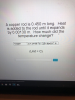 How do I solve this?
A copper rod is 0.450 m long. Heat is added to the rod until it expands by 0.00130 m. How much did the temperature change? la-17. 10-s ca l β-51-10-6 C-1] Copper (Unit C) 3003-201Coation All ights Reserved
How do I solve this?
A copper rod is 0.450 m long. Heat is added to the rod until it expands by 0.00130 m. How much did the temperature change? la-17. 10-s ca l β-51-10-6 C-1] Copper (Unit C) 3003-201Coation All ights Reserved
006 10.0 point:s Two concrete spans of a 230 m long bridge are placed end to...
 006 10.0 point:s Two concrete spans of a 230 m long bridge are placed end to end so that no room is allowed for expansion T 20 I y 230 m If the temperature increases by 20°C, what is the height to which the spans rise when they buckle? Assume the thermal coefficient of expansion is 1.2 x 10⁻⁵ (C)1 Answer in units of m. 007 10.0 points An automobile tire having a temperature of -4.3°C (a cold tire on...
Consider a 2 m long metal rod. The temperature u(z,t) at a point along the rod at any time t is found by solving the heat equation k where k is the material property. The left end of the rod ( 0) is...
 Consider a 2 m long metal rod. The temperature u(z,t) at a point along the rod at any time t is found by solving the heat equation k where k is the material property. The left end of the rod ( 0) is maintained at 20°C and the right end is suddenly dipped into snow (0°C). The initial temperature distribution in the rod is given by u(x,0)- (i) Use the substitution u(z,t) ta,t)+20-10z to reduce the above problem to a...
a) If an iron rod 1.5 m long at 20 degree C and expands by 1.416...
 a) If an iron rod 1.5 m long at 20 degree C and expands by 1.416 mm when heated to 100 degree C. Find the coefficient of linear expansion for iron. b) A large wooden barrel needs an iron band to be placed around the rim of its base. The iron band is made slightly smaller than the diameter of the barrel's base so that it may be heated placed over the barrel and shrunk tightly into place. If the...
A rigid copper tank, initially containing 1 m^3 of air at 295K, 5 bar, is connected...
A rigid copper tank, initially containing 1 m^3 of air at 295K, 5 bar, is connected by a valve to a large supply line carrying air at 295K, 15 bar. The valve is opened only as long as required to fill the tank with air to a pressure of 15 bar. Finally, the air in the tank is at 310 K. The copper tank, which has a mass of 20 kg, is at the same temperature as the air in...
Heat Transfer Problems 1. A window pane (1/8 inch thick) in an old house owned by...
 Heat Transfer
Problems 1. A window pane (1/8 inch thick) in an old house owned by a professor is 3 ft. by 4 ft. He likes to be warm in the winter so the inside temperature is kept at 70 °F even when the outside temperature is 10 •F. For this problem assume the inside and outside temperatures are for the window surface. How much heat is transferred through the window (k=.54 BTU/hr ft ° F)? 2. A small heated...
Heat Transfer
Problems 1. A window pane (1/8 inch thick) in an old house owned by a professor is 3 ft. by 4 ft. He likes to be warm in the winter so the inside temperature is kept at 70 °F even when the outside temperature is 10 •F. For this problem assume the inside and outside temperatures are for the window surface. How much heat is transferred through the window (k=.54 BTU/hr ft ° F)? 2. A small heated...
 Before beginning a long trip on a hot day, a driver inflates an automobile tire to a gauge pressure of 2.70 atm at 300 K. At the end of the trip, the gauge pressure has increased to 3.20 atm. (a) Assuming the volume has remained constant, what is the temperature of the air inside the tire? 356 K (b) What percentage of the original mass of air in the tire should be released so the pressure returns to its original...
 How do I solve this?
A copper rod is 0.450 m long. Heat is added to the rod until it expands by 0.00130 m. How much did the temperature change? la-17. 10-s ca l β-51-10-6 C-1] Copper (Unit C) 3003-201Coation All ights Reserved
How do I solve this?
A copper rod is 0.450 m long. Heat is added to the rod until it expands by 0.00130 m. How much did the temperature change? la-17. 10-s ca l β-51-10-6 C-1] Copper (Unit C) 3003-201Coation All ights Reserved
 006 10.0 point:s Two concrete spans of a 230 m long bridge are placed end to end so that no room is allowed for expansion T 20 I y 230 m If the temperature increases by 20°C, what is the height to which the spans rise when they buckle? Assume the thermal coefficient of expansion is 1.2 x 10⁻⁵ (C)1 Answer in units of m. 007 10.0 points An automobile tire having a temperature of -4.3°C (a cold tire on...
 Consider a 2 m long metal rod. The temperature u(z,t) at a point along the rod at any time t is found by solving the heat equation k where k is the material property. The left end of the rod ( 0) is maintained at 20°C and the right end is suddenly dipped into snow (0°C). The initial temperature distribution in the rod is given by u(x,0)- (i) Use the substitution u(z,t) ta,t)+20-10z to reduce the above problem to a...
 a) If an iron rod 1.5 m long at 20 degree C and expands by 1.416 mm when heated to 100 degree C. Find the coefficient of linear expansion for iron. b) A large wooden barrel needs an iron band to be placed around the rim of its base. The iron band is made slightly smaller than the diameter of the barrel's base so that it may be heated placed over the barrel and shrunk tightly into place. If the...
 Heat Transfer
Problems 1. A window pane (1/8 inch thick) in an old house owned by a professor is 3 ft. by 4 ft. He likes to be warm in the winter so the inside temperature is kept at 70 °F even when the outside temperature is 10 •F. For this problem assume the inside and outside temperatures are for the window surface. How much heat is transferred through the window (k=.54 BTU/hr ft ° F)? 2. A small heated...
Heat Transfer
Problems 1. A window pane (1/8 inch thick) in an old house owned by a professor is 3 ft. by 4 ft. He likes to be warm in the winter so the inside temperature is kept at 70 °F even when the outside temperature is 10 •F. For this problem assume the inside and outside temperatures are for the window surface. How much heat is transferred through the window (k=.54 BTU/hr ft ° F)? 2. A small heated...
Most questions answered within 3 hours.
-
Where is the error in this code sequence?
String s1 = "Hello";
String s2 = "ello";...
asked 10 months ago -
Financial data for Joel de Paris, Inc., for last year
follow:
Joel de Paris, Inc.
Balance...
asked 10 months ago -
Consider this reaction:
Al2(SO4)3 (aq)+ BaCl3
(aq) Al2Cl6 (aq)- +
3BaSO4(s) . What is the...
asked 10 months ago -
Suppose that Savneet is considering increasing her
recent random sample from 20 car rentals to 40...
asked 10 months ago -
Trucks arrive at an unloading terminal at an average rate of 120
per hour.
Trucks arrive...
asked 10 months ago -
Why are methanol and ethanol completely soluble in water while
octanol is not very little soluble....
asked 10 months ago -
A facilities manager at a university reads in a research report
that the mean amount of...
asked 10 months ago -
When the CuSO4 is rehydrated by adding water to the anhydrous
compound, is this an endothermic...
asked 10 months ago -
A ray of sunlight is passing from diamond into crown glass; the
angle of incidence is...
asked 10 months ago -
A block of mass 0.249 kg is placed on top of a light, vertical
spring of...
asked 10 months ago -
how do the kidneys compensate in the presences of acidosis
a) trigger hyperventilate
b) reserve acid...
asked 10 months ago -
Question 501 pts
The rental rate of capital to the firm increases. Which of the
following...
asked 10 months ago