
Homework Answers
Add Answer to:
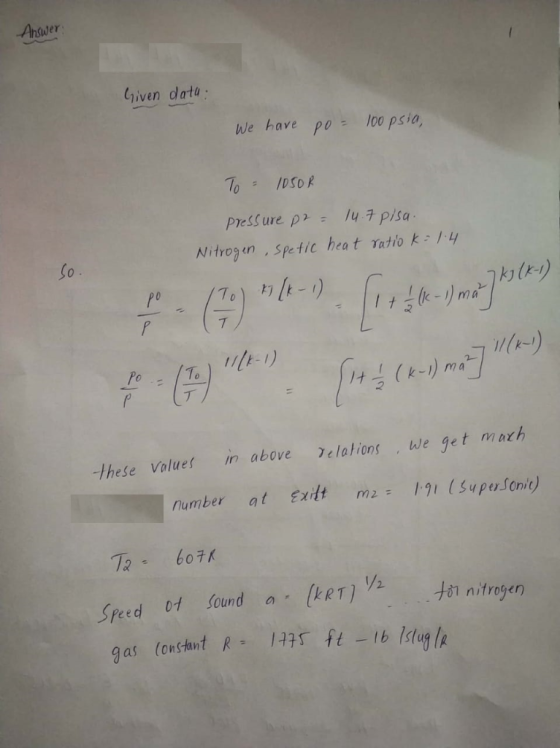
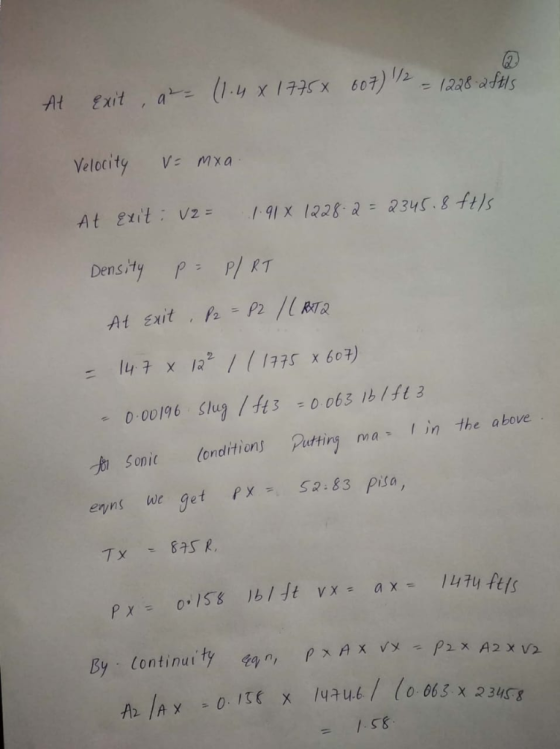
1. A subsonic (M) fow of nitrogen with stagnation temperature T, and stagnation pressure p, values...
a subsonic flow enters a 1-D duct that is frictionless. the inlet stagnation temperature is 250K....
a subsonic flow enters a 1-D duct that is frictionless. the inlet stagnation temperature is 250K. Heat is added at 350 kJ/kg. what is the maximum possible Mach No. at the inket of the duct?
TURBO MACHINES SUBJECT QUESTION 10 A multi-stage high -pressure steam turbine is supplied with steam at a stagnation pressure of 7 MPa and a stagnation temperature of 500°C. The corresponding specifi...
 TURBO MACHINES SUBJECT
QUESTION 10 A multi-stage high -pressure steam turbine is supplied with steam at a stagnation pressure of 7 MPa and a stagnation temperature of 500°C. The corresponding specific enthalpy is 3410kJ.kg. The steam exhaust from the turbine at a stagnation pressure of 0.7 MPa abs., the steam having been in a super-heated condition throughout the expansion. It can be assumed that the steam behaves like a perfect gas over the range of the expansion and that v...
TURBO MACHINES SUBJECT
QUESTION 10 A multi-stage high -pressure steam turbine is supplied with steam at a stagnation pressure of 7 MPa and a stagnation temperature of 500°C. The corresponding specific enthalpy is 3410kJ.kg. The steam exhaust from the turbine at a stagnation pressure of 0.7 MPa abs., the steam having been in a super-heated condition throughout the expansion. It can be assumed that the steam behaves like a perfect gas over the range of the expansion and that v...
2. A piston-cylinder device maintain a constant pressure of 800 kPa while containing 20 kg of...
 2. A piston-cylinder device maintain a constant pressure of 800 kPa while containing 20 kg of saturated water vapor. The system is heated with a resistance heater for 10 min at a current of 8 A at the standard wall voltage of 120 V. In that time, 3.2 kJ of heat is lost through the walls. What is the temperature at the heated state? 3 5-18E Hydrogen is contained in a piston-cylinder device at 14.7 psia and 15 ft. At...
P2) (50 pts.) The boiling temperature of nitrogen at atmospheric pressure at sea level (1 atm pre...
 P2) (50 pts.) The boiling temperature of nitrogen at atmospheric pressure at sea level (1 atm pressure) is -196°C. Therefore, nitrogen is commonly used in low-temperature scientific studies, since the temperature of liquid nitrogen in a tank open to the atmosphere will remain constant at -196°C until it is depleted. Any heat transfer to the tank will result in the evaporation of some liquid nitrogen, which has a heat of vaporization of 198 kJ/kg and a density of 810 kg/m3...
The boiling temperature of nitrogen at atmospheric pressure at sea level (1 atm pressure) is -196°C. Therefore, nitroge...
 The boiling temperature of nitrogen at atmospheric pressure at sea level (1 atm pressure) is -196°C. Therefore, nitrogen is commonly used in low-temperature scientific studies since the temperature of liquid nitrogen in a tank open to the atmosphere will remain constant at -196°C until it is depleted. Any heat transfer to the tank will result in the evaporation of some liquid nitrogen, which has a heat of vaporization of 198 kJ/kg and a density of 810 kg/m3 at 1 atm....
Problem 7 A cylinder fitted with a piston has a volume of Vi = 0.1 m...
 Problem 7 A cylinder fitted with a piston has a volume of Vi = 0.1 m and cross-sectional area of A= 0.2 m². It contains m = 0.5 kg of steam at p=0.3 MPa. Heat is transferred to the steam such that the temperature increases from Ti = 100°C to T2 = 300°C, while the pressure remains constant. The convective heat transfer coefficient h is 1000 W/m²K. The internal/thermal energy per unit mass at the beginning and end of the...
Problem 1 - Gas Turbine Engine. Assume the gas turbine engine operates on basic non-ideal Brayton...
 Problem 1 - Gas Turbine Engine. Assume the gas turbine engine operates on basic non-ideal Brayton cycle with the following specifications Inlet Condition: Dry air at 537 R and 14.7 psia Pressure Ratio: 24.2 Actual Exhaust Temperature: 950 F Compressor and Turbine Efficiency: 85% Actual Power Output 34 MW Using given/assumed values, determine: a) firing temperature, b) cycle efficiency, c) air mass flow rate. Problem 2- HRSG. Assume the HRSG is used to produce saturated steam at 600 psia using...
3. A stream of nitrogen (use the tables to find the necessary gas data) enters a diffuser at 200 m /s with a pressure of 80 kPa and -20 C. The speed at the outlet is 15 m/s at a pressure of 95 kP...
 3. A stream of nitrogen (use the tables to find the necessary gas data) enters a diffuser at 200 m /s with a pressure of 80 kPa and -20 C. The speed at the outlet is 15 m/s at a pressure of 95 kPa. If the diameter at the entrance is 100 mm, calculate: a) The mass flow b) The temperature at the outlet of the diffuser c) The temperature at the outlet of the diffuser if heat escapes at...
1. (10 points) A combined gas turbine-vapor power plant has a net power output of 45...
 1. (10 points) A combined gas turbine-vapor power plant has a net power output of 45 MW. Air enters the compressor of the gas turbine at 100 kPa, 300 K, and is compressed to 1200 kPa. The isentropic efficiency of the compressor is 84%. The condition at the inlet to the turbine is 1200 kPa, 1400 K. Air expands through the turbine, which has an isentropic efficiency of 88%, to a pressure of 100 kPa. The air then passes through...
please answer all 4 questions, please write clear 4. If the pressure in the thermometer abo temperature? ve was 121 kPa, to the nearest Celsius degree what is the 9. The cross-sectional area of t...
 please answer all 4 questions, please write clear
4. If the pressure in the thermometer abo temperature? ve was 121 kPa, to the nearest Celsius degree what is the 9. The cross-sectional area of the output piston in a hydraulic device is 10 times the area of the input piston. By how much can the device multiply the input force? The cross-sectional area of the output piston in a hydraulic device is 3.0 times the area of the input piston....
please answer all 4 questions, please write clear
4. If the pressure in the thermometer abo temperature? ve was 121 kPa, to the nearest Celsius degree what is the 9. The cross-sectional area of the output piston in a hydraulic device is 10 times the area of the input piston. By how much can the device multiply the input force? The cross-sectional area of the output piston in a hydraulic device is 3.0 times the area of the input piston....
 TURBO MACHINES SUBJECT
QUESTION 10 A multi-stage high -pressure steam turbine is supplied with steam at a stagnation pressure of 7 MPa and a stagnation temperature of 500°C. The corresponding specific enthalpy is 3410kJ.kg. The steam exhaust from the turbine at a stagnation pressure of 0.7 MPa abs., the steam having been in a super-heated condition throughout the expansion. It can be assumed that the steam behaves like a perfect gas over the range of the expansion and that v...
TURBO MACHINES SUBJECT
QUESTION 10 A multi-stage high -pressure steam turbine is supplied with steam at a stagnation pressure of 7 MPa and a stagnation temperature of 500°C. The corresponding specific enthalpy is 3410kJ.kg. The steam exhaust from the turbine at a stagnation pressure of 0.7 MPa abs., the steam having been in a super-heated condition throughout the expansion. It can be assumed that the steam behaves like a perfect gas over the range of the expansion and that v...
 2. A piston-cylinder device maintain a constant pressure of 800 kPa while containing 20 kg of saturated water vapor. The system is heated with a resistance heater for 10 min at a current of 8 A at the standard wall voltage of 120 V. In that time, 3.2 kJ of heat is lost through the walls. What is the temperature at the heated state? 3 5-18E Hydrogen is contained in a piston-cylinder device at 14.7 psia and 15 ft. At...
 P2) (50 pts.) The boiling temperature of nitrogen at atmospheric pressure at sea level (1 atm pressure) is -196°C. Therefore, nitrogen is commonly used in low-temperature scientific studies, since the temperature of liquid nitrogen in a tank open to the atmosphere will remain constant at -196°C until it is depleted. Any heat transfer to the tank will result in the evaporation of some liquid nitrogen, which has a heat of vaporization of 198 kJ/kg and a density of 810 kg/m3...
 The boiling temperature of nitrogen at atmospheric pressure at sea level (1 atm pressure) is -196°C. Therefore, nitrogen is commonly used in low-temperature scientific studies since the temperature of liquid nitrogen in a tank open to the atmosphere will remain constant at -196°C until it is depleted. Any heat transfer to the tank will result in the evaporation of some liquid nitrogen, which has a heat of vaporization of 198 kJ/kg and a density of 810 kg/m3 at 1 atm....
 Problem 7 A cylinder fitted with a piston has a volume of Vi = 0.1 m and cross-sectional area of A= 0.2 m². It contains m = 0.5 kg of steam at p=0.3 MPa. Heat is transferred to the steam such that the temperature increases from Ti = 100°C to T2 = 300°C, while the pressure remains constant. The convective heat transfer coefficient h is 1000 W/m²K. The internal/thermal energy per unit mass at the beginning and end of the...
 Problem 1 - Gas Turbine Engine. Assume the gas turbine engine operates on basic non-ideal Brayton cycle with the following specifications Inlet Condition: Dry air at 537 R and 14.7 psia Pressure Ratio: 24.2 Actual Exhaust Temperature: 950 F Compressor and Turbine Efficiency: 85% Actual Power Output 34 MW Using given/assumed values, determine: a) firing temperature, b) cycle efficiency, c) air mass flow rate. Problem 2- HRSG. Assume the HRSG is used to produce saturated steam at 600 psia using...
 3. A stream of nitrogen (use the tables to find the necessary gas data) enters a diffuser at 200 m /s with a pressure of 80 kPa and -20 C. The speed at the outlet is 15 m/s at a pressure of 95 kPa. If the diameter at the entrance is 100 mm, calculate: a) The mass flow b) The temperature at the outlet of the diffuser c) The temperature at the outlet of the diffuser if heat escapes at...
 1. (10 points) A combined gas turbine-vapor power plant has a net power output of 45 MW. Air enters the compressor of the gas turbine at 100 kPa, 300 K, and is compressed to 1200 kPa. The isentropic efficiency of the compressor is 84%. The condition at the inlet to the turbine is 1200 kPa, 1400 K. Air expands through the turbine, which has an isentropic efficiency of 88%, to a pressure of 100 kPa. The air then passes through...
 please answer all 4 questions, please write clear
4. If the pressure in the thermometer abo temperature? ve was 121 kPa, to the nearest Celsius degree what is the 9. The cross-sectional area of the output piston in a hydraulic device is 10 times the area of the input piston. By how much can the device multiply the input force? The cross-sectional area of the output piston in a hydraulic device is 3.0 times the area of the input piston....
please answer all 4 questions, please write clear
4. If the pressure in the thermometer abo temperature? ve was 121 kPa, to the nearest Celsius degree what is the 9. The cross-sectional area of the output piston in a hydraulic device is 10 times the area of the input piston. By how much can the device multiply the input force? The cross-sectional area of the output piston in a hydraulic device is 3.0 times the area of the input piston....
Most questions answered within 3 hours.
-
Where is the error in this code sequence?
String s1 = "Hello";
String s2 = "ello";...
asked 11 months ago -
Financial data for Joel de Paris, Inc., for last year
follow:
Joel de Paris, Inc.
Balance...
asked 11 months ago -
Consider this reaction:
Al2(SO4)3 (aq)+ BaCl3
(aq) Al2Cl6 (aq)- +
3BaSO4(s) . What is the...
asked 11 months ago -
Suppose that Savneet is considering increasing her
recent random sample from 20 car rentals to 40...
asked 11 months ago -
Trucks arrive at an unloading terminal at an average rate of 120
per hour.
Trucks arrive...
asked 11 months ago -
Why are methanol and ethanol completely soluble in water while
octanol is not very little soluble....
asked 11 months ago -
A facilities manager at a university reads in a research report
that the mean amount of...
asked 11 months ago -
When the CuSO4 is rehydrated by adding water to the anhydrous
compound, is this an endothermic...
asked 11 months ago -
A ray of sunlight is passing from diamond into crown glass; the
angle of incidence is...
asked 11 months ago -
A block of mass 0.249 kg is placed on top of a light, vertical
spring of...
asked 11 months ago -
how do the kidneys compensate in the presences of acidosis
a) trigger hyperventilate
b) reserve acid...
asked 11 months ago -
Question 501 pts
The rental rate of capital to the firm increases. Which of the
following...
asked 11 months ago