Private Marginal Cost /Social Marginal Cost
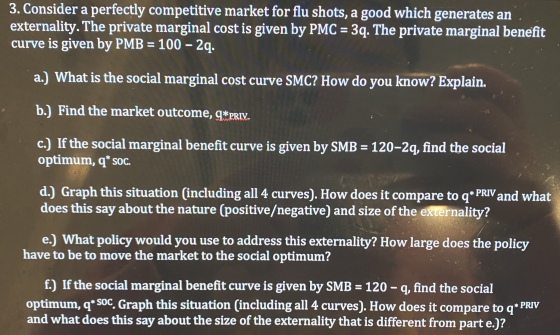 Consider a perfectly competitive market for the flu shots, a good which generates an externality.
Homework Answers
Request Answer!
We need at least 10 more requests to produce the answer.
0 / 10 have requested this problem solution
The more requests, the faster the answer.
government is considering a policy of voluntary administration of flu shots for all individuals. will a...
government is considering a policy of voluntary administration of flu shots for all individuals. will a free perfectly competitive market ensure efficient production of flu shots? why? demonstrate graphically.
Price ($) 100T Social Cost ! Private Cost 50 Quantity Figure 7 23. Refer to Figure 7, which shows a market in which the...
 Price ($) 100T Social Cost ! Private Cost 50 Quantity Figure 7 23. Refer to Figure 7, which shows a market in which the production of the good generates a $45 external cost. Which area(s) represent(s) the deadweight loss associated with the competitive market outcome? a) A b) B c) C d) B+C 24. Refer to Figure 7, which shows a market in which the production of the good generates a $45 external cost. Which of the following policies would...
government is considering a policy of voluntary administration of flu shots for all individuals. will a...
government is considering a policy of voluntary administration of flu shots for all individuals. will a free perfectly competitive market ensure efficient production of flu shots? why? demonstrate graphically. also how can you demonstrate on your graph how can an efficient outcome be achieved? (Hint: will it require change in equilibrium)? will you recommend any government intervention/regulation if yes in what form?if no,why?
please give all the answers. dont need explanations too much Marginal social cost Marginal private cost...
 please give all the answers. dont need explanations too much
Marginal social cost Marginal private cost Market Demand Quantity 23. Refer to Exhibit 15-2. The deadweight loss due to externality is represented by the area a. A + B. b. C+D C. A+B+C+D. d. E+F. e. A + B+E+E. 24. A station broadcasts an unscrambled radio program over the airwaves. The program is non-excludable because a. everyone is willing to pay a market price for it. b. only one listener...
please give all the answers. dont need explanations too much
Marginal social cost Marginal private cost Market Demand Quantity 23. Refer to Exhibit 15-2. The deadweight loss due to externality is represented by the area a. A + B. b. C+D C. A+B+C+D. d. E+F. e. A + B+E+E. 24. A station broadcasts an unscrambled radio program over the airwaves. The program is non-excludable because a. everyone is willing to pay a market price for it. b. only one listener...
5) (28 points) Suppose the demand and supply for flu shots are given by pd =...
 5) (28 points) Suppose the demand and supply for flu shots are given by pd = 1200-Q ps = 440 + Q Suppose flu shots generate a positive externality, and the marginal external benefit (MEB) is MEB=60 -0.050. (a) Derive the marginal social benefit (MSB) curve. (b) Draw the Demand, Supply, and MSB curves on the same graph (with P on the vertical axis and Q on the horizontal axis) and clearly indicate the curves in your graph. (c) Calculate...
Consider an industry where firms have a production function with private marginal cost ??? (?) =...
Consider an industry where firms have a production function with private marginal cost ??? (?) = 40 + 2? and an additional (external) marginal cost to society of ??? (?) = ?/4. The market is characterized by the inverse demand function ?(?) = 400 − 2?. 1. Find the equilibrium in the competitive market. Calculate the (private) producer and consumer surplus in this case. 2. Find the equilibrium if the market is monopolized. Calculate the (private) producer and consumer surplus...
1) A good that generates a negative externality is sold in a competitive market. Demand is...
1) A good that generates a negative externality is sold in a competitive market. Demand is defined by P(Q)=600-2Q and supply is defined by P(Q)=Q. The externality from production is E(Q)=0.5Q2. a)What is the quantity produced in the competitive equilibrium? Q= b)What is the price in the competitive equilibrium? P= c)What is consumer surplus in the competitive equilibrium? CS= d)What is producer surplus in the competitive equilibrium? PS= e)What is the total value of the externality in the competitive equilibrium?...
Question 14 (1 point) Which of these is a pure public good? a) 1-95 b) flu...
 Question 14 (1 point) Which of these is a pure public good? a) 1-95 b) flu shots c) a public park d) environmental protection Question 15 (1 point) If an unregulated industry generates pollution, the market price is than the socially optimal price, and the market quantity is than the socially optimal quantity. a) greater; greater b) less; greater c) less; less d) greater; less
A monopoly firm operates with declining marginal cost. If regulators impose marginal cost pricing, the market...
A monopoly firm operates with declining marginal cost. If regulators impose marginal cost pricing, the market will a. be entered by additional firms but will not necessarily become perfectly competitive. b. be exited by the existing firm if the regulators will let the firm leave the market. c. become perfectly competitive. d. remain a monopoly but behave like a perfectly competitive industry.
I. The pollution emitted by a car is an example of atn b. social eextenal e....
 I. The pollution emitted by a car is an example of atn b. social eextenal e. publio-good 2. Lila shares a house with two other people. She is a concert pianist and often practices an home. One roommate enjoys listening to her practice, but the other does not. For the roommate who enjoys listening to Lila play, this is an example of for the other , it is an example of a. the tragedy of the commons; b. e. a...
 Price ($) 100T Social Cost ! Private Cost 50 Quantity Figure 7 23. Refer to Figure 7, which shows a market in which the production of the good generates a $45 external cost. Which area(s) represent(s) the deadweight loss associated with the competitive market outcome? a) A b) B c) C d) B+C 24. Refer to Figure 7, which shows a market in which the production of the good generates a $45 external cost. Which of the following policies would...
 please give all the answers. dont need explanations too much
Marginal social cost Marginal private cost Market Demand Quantity 23. Refer to Exhibit 15-2. The deadweight loss due to externality is represented by the area a. A + B. b. C+D C. A+B+C+D. d. E+F. e. A + B+E+E. 24. A station broadcasts an unscrambled radio program over the airwaves. The program is non-excludable because a. everyone is willing to pay a market price for it. b. only one listener...
please give all the answers. dont need explanations too much
Marginal social cost Marginal private cost Market Demand Quantity 23. Refer to Exhibit 15-2. The deadweight loss due to externality is represented by the area a. A + B. b. C+D C. A+B+C+D. d. E+F. e. A + B+E+E. 24. A station broadcasts an unscrambled radio program over the airwaves. The program is non-excludable because a. everyone is willing to pay a market price for it. b. only one listener...
 5) (28 points) Suppose the demand and supply for flu shots are given by pd = 1200-Q ps = 440 + Q Suppose flu shots generate a positive externality, and the marginal external benefit (MEB) is MEB=60 -0.050. (a) Derive the marginal social benefit (MSB) curve. (b) Draw the Demand, Supply, and MSB curves on the same graph (with P on the vertical axis and Q on the horizontal axis) and clearly indicate the curves in your graph. (c) Calculate...
 Question 14 (1 point) Which of these is a pure public good? a) 1-95 b) flu shots c) a public park d) environmental protection Question 15 (1 point) If an unregulated industry generates pollution, the market price is than the socially optimal price, and the market quantity is than the socially optimal quantity. a) greater; greater b) less; greater c) less; less d) greater; less
 I. The pollution emitted by a car is an example of atn b. social eextenal e. publio-good 2. Lila shares a house with two other people. She is a concert pianist and often practices an home. One roommate enjoys listening to her practice, but the other does not. For the roommate who enjoys listening to Lila play, this is an example of for the other , it is an example of a. the tragedy of the commons; b. e. a...
Most questions answered within 3 hours.
-
Where is the error in this code sequence?
String s1 = "Hello";
String s2 = "ello";...
asked 10 months ago -
Financial data for Joel de Paris, Inc., for last year
follow:
Joel de Paris, Inc.
Balance...
asked 10 months ago -
Consider this reaction:
Al2(SO4)3 (aq)+ BaCl3
(aq) Al2Cl6 (aq)- +
3BaSO4(s) . What is the...
asked 10 months ago -
Suppose that Savneet is considering increasing her
recent random sample from 20 car rentals to 40...
asked 10 months ago -
Trucks arrive at an unloading terminal at an average rate of 120
per hour.
Trucks arrive...
asked 10 months ago -
Why are methanol and ethanol completely soluble in water while
octanol is not very little soluble....
asked 10 months ago -
A facilities manager at a university reads in a research report
that the mean amount of...
asked 10 months ago -
When the CuSO4 is rehydrated by adding water to the anhydrous
compound, is this an endothermic...
asked 10 months ago -
A ray of sunlight is passing from diamond into crown glass; the
angle of incidence is...
asked 10 months ago -
A block of mass 0.249 kg is placed on top of a light, vertical
spring of...
asked 10 months ago -
how do the kidneys compensate in the presences of acidosis
a) trigger hyperventilate
b) reserve acid...
asked 10 months ago -
Question 501 pts
The rental rate of capital to the firm increases. Which of the
following...
asked 10 months ago