Consider an industry where firms have a production function with private marginal cost ??? (?) =...
Consider an industry where firms have a production function with private marginal cost ??? (?) = 40 + 2? and an additional (external) marginal cost to society of ??? (?) = ?/4. The market is characterized by the inverse demand function ?(?) = 400 − 2?. 1. Find the equilibrium in the competitive market. Calculate the (private) producer and consumer surplus in this case. 2. Find the equilibrium if the market is monopolized. Calculate the (private) producer and consumer surplus in this case. 3. Find the social optimum, and calculate the (private) producer surplus, consumer surplus, and the externality cost in this case. 4. Compare the three outcomes (price, output, total surplus) in the three cases (1-3).
Homework Answers
TR = p x Q = 400Q - 2Q2
MR = dTR/dQ = 400 - 4Q
From demand function, when Q = 0, P = 400
From MCp function, when Q = 0, MCp = 40
(1)
Setting p = MCp,
400 - 2Q = 40 + 2Q
4Q = 360
Q = 90
p = 400 - 2 x 90 = 400 - 180 = 220
CS = (1/2) x (400 - 220) x 90 = 45 x 180 = 8100
PS = (1/2) x (220 - 40) x 90 = 45 x 180 = 8100
TS = CS + PS = 8100 + 8100 = 16200
(2)
Setting MR = MCp,
400 - 4Q = 40 + 2Q
6Q = 360
Q = 60
p = 400 - 2 x 60 = 400 - 120 = 280
CS = (1/2) x (400 - 280) x 60 = 30 x 120 = 3600
When Q = 60, MR = 400 - 4 x 60 = 400 - 240 = 160
PS = (1/2) x [(280 - 40) + (280 - 160)] x 60 = 30 x 360 = 10800
TS = CS + PS = 3600 + 10800 = 14400
(3)
In social optimal, p = MCp + MCe
400 - 2Q = 40 + 2Q + 0.25Q
4.25Q = 360
Q = 84.71
p = 400 - 2 x 84.71 = 400 - 169.42 = 230.58
CS = (1/2) x (400 - 230.58) x 84.71 = (1/2) x 169.42 x 84.71 = 7175.78
PS = (1/2) x (230.58 - 40) x 84.71 = (1/2) x 190.58 x 84.71 = 8072.02
MCe = 0.25 x 84.71 = 21.18
TS = CS + PS = 7175.78 + 8072.02 = 15247.8
(4)
Price is maximum with monopoly (case 2).
Output is maximum in competitive market (case 1).
TS (total surplus) is maximum in competitive market (case 1).
Add Answer to:
Consider an industry where firms have a production function with
private marginal cost ??? (?) =...
Suppose a perfectly competitive market has the following inverse supply and demand curves: Supply: P= 5+2Q...
Suppose a perfectly competitive market has the following inverse supply and demand curves: Supply: P= 5+2Q Demand: P = 50-Q. 1) Solve for the perfectly competitive Pe and Qe, and calculate consumer+producer surplus at Pe, Qe. 2) Suppose each unit of good produced created a negative externality to society valued at $1 per unit. Calculate the social optimum Pe and Qe for this case and compute consumer+producer surplus. 3) Show graphically the welfare loss if the externality is ignored.
3) Assume that the market for energy efficient window installations in San Diego is perfectly competitive. Quarterly inverse supply and inverse demand are: P 1200 3Q (Private MB) P 440Qs (Private...
 3) Assume that the market for energy efficient window installations in San Diego is perfectly competitive. Quarterly inverse supply and inverse demand are: P 1200 3Q (Private MB) P 440Qs (Private MC) neighbors (lowering the overall price of electricity, reducing pollution, and so on) These external benefits to consumers are estimated to be EMB 2Q (the more windows installed, the more external benefit to installing more windows). a) Find the equilibrium price and quantity that will be produced in a...
6. There are two firms in a market with marginal cost functions given by MC:(9) =...
 6. There are two firms in a market with marginal cost functions given by MC:(9) = 59 MC2(q) = q. Market demand is given by D(p) = 20 - 2p. (a) Obtain the competitive equilibrium output and price. Calculate consumer surplus and each firm's producer surplus. (b) Derive the monopoly price when only firm 1 operates. Calculate consumer surplus and each firm's producer surplus. (c) Derive the monopoly price when only firm 2 operates. (d) Now assume that a monopolist...
1 Production Externality A barbecue restaurant on Monroe Street has a (private) marginal cost function given...
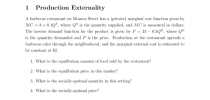 1 Production Externality A barbecue restaurant on Monroe Street has a (private) marginal cost function given by MC = 8 + 0.10%, where QⓇ is the quantity supplied, and MC is measured in dollars. The inverse demand function for the product is given by P = 25 -0.52", where Q" is the quantity demanded and P is the price. Production at the restaurant spreads a barbecue odor through the neighborhood, and the marginal external cost is estimated to be constant...
3. The demand in a market is Q (P) 150-3P. The supply in the market is...
 3. The demand in a market is Q (P) 150-3P. The supply in the market is QS(P)- 3P- 30 (a) Find the competitive equilibrium in the market (P*, Q*) (b) Determine the levels of Consumer, Producer and Total Surplus in the competitive equilibrium (c) Consumption of the good leads to a negative externality. The external marginal benefit function is mbeQw . Draw a graph that shows the Demand, Supply and the Social Marginal Benefits. where measures units consumed in the...
We are considering a market with marginal cost of P=100+2Q and a demand of P=500-2Q. Use...
We are considering a market with marginal cost of P=100+2Q and a demand of P=500-2Q. Use that information to answer the following questions. a. Find the market equilibrium (price and quantity in the market). b. Find producer and consumer surplus. c. Now imagine production of this good created a negative externality of 1$ per unit of output. Find the socially optimal outcome (price and quantity) taking this externality into account. d. Find consumer and producer surplus at the socially efficient...
Part II: Market Failure in the Passenger Airline Industry and Policy (30%) For full marks: Craphs:...
 Part II: Market Failure in the Passenger Airline Industry and Policy (30%) For full marks: Craphs: Plot graphs to scale on graph paper by hand, include a figure number, title, and label all axis including correct units, be neat and tidy and put in order in the assignment. Introduce the graph with a sentence before it. 2) For algebra, use short sentences to guide the reader (SSTGR) through your work. Example: "To find the perfectly competitive market equilibrium global daily...
1. (18pts) Suppose there are 100 firms in a perfectly competitive industry. Short run marginal costs...
 1. (18pts) Suppose there are 100 firms in a perfectly competitive industry. Short run marginal costs for each firm are given by SMC = q + 2 and market demand is given by Qd = 1000-20P (5pts) Calculate the short run equilibrium price and quantity for each firm.. b. (3pts) Suppose each firm has a U-shaped, long-run average cost curve that reaches a minimum of $10. Calculate the long run equilibrium price and the total industry output.. (4pts) What is...
Two firms in an industry engaged in Bertrand competition. The industry inverse demand function is p...
Two firms in an industry engaged in Bertrand competition. The industry inverse demand function is p = 40 - 2Q, and marginal cost is MC = 10 for both firms. No firm faces capacity constraints. Find the BertrandNash equilibrium (prices, quantities, profits consumer surplus, total surplus, herfindahl index and lerner index)
Problem 2: Externality Consider the market for education. The marginal social cost of education (MSC) and...
 Problem 2: Externality Consider the market for education. The marginal social cost of education (MSC) and the marginal private benefit of education (MPB) are given by the following equations where Q is the number of units of education provided per year. MSC 10+ Q MPB 100-Q You are also told that each unit of education provides an external benefit to society of $10 per unit. This external benefit is currently not being internalized in the market. a) Given the MSC...
 3) Assume that the market for energy efficient window installations in San Diego is perfectly competitive. Quarterly inverse supply and inverse demand are: P 1200 3Q (Private MB) P 440Qs (Private MC) neighbors (lowering the overall price of electricity, reducing pollution, and so on) These external benefits to consumers are estimated to be EMB 2Q (the more windows installed, the more external benefit to installing more windows). a) Find the equilibrium price and quantity that will be produced in a...
 6. There are two firms in a market with marginal cost functions given by MC:(9) = 59 MC2(q) = q. Market demand is given by D(p) = 20 - 2p. (a) Obtain the competitive equilibrium output and price. Calculate consumer surplus and each firm's producer surplus. (b) Derive the monopoly price when only firm 1 operates. Calculate consumer surplus and each firm's producer surplus. (c) Derive the monopoly price when only firm 2 operates. (d) Now assume that a monopolist...
 1 Production Externality A barbecue restaurant on Monroe Street has a (private) marginal cost function given by MC = 8 + 0.10%, where QⓇ is the quantity supplied, and MC is measured in dollars. The inverse demand function for the product is given by P = 25 -0.52", where Q" is the quantity demanded and P is the price. Production at the restaurant spreads a barbecue odor through the neighborhood, and the marginal external cost is estimated to be constant...
 3. The demand in a market is Q (P) 150-3P. The supply in the market is QS(P)- 3P- 30 (a) Find the competitive equilibrium in the market (P*, Q*) (b) Determine the levels of Consumer, Producer and Total Surplus in the competitive equilibrium (c) Consumption of the good leads to a negative externality. The external marginal benefit function is mbeQw . Draw a graph that shows the Demand, Supply and the Social Marginal Benefits. where measures units consumed in the...
 Part II: Market Failure in the Passenger Airline Industry and Policy (30%) For full marks: Craphs: Plot graphs to scale on graph paper by hand, include a figure number, title, and label all axis including correct units, be neat and tidy and put in order in the assignment. Introduce the graph with a sentence before it. 2) For algebra, use short sentences to guide the reader (SSTGR) through your work. Example: "To find the perfectly competitive market equilibrium global daily...
 1. (18pts) Suppose there are 100 firms in a perfectly competitive industry. Short run marginal costs for each firm are given by SMC = q + 2 and market demand is given by Qd = 1000-20P (5pts) Calculate the short run equilibrium price and quantity for each firm.. b. (3pts) Suppose each firm has a U-shaped, long-run average cost curve that reaches a minimum of $10. Calculate the long run equilibrium price and the total industry output.. (4pts) What is...
 Problem 2: Externality Consider the market for education. The marginal social cost of education (MSC) and the marginal private benefit of education (MPB) are given by the following equations where Q is the number of units of education provided per year. MSC 10+ Q MPB 100-Q You are also told that each unit of education provides an external benefit to society of $10 per unit. This external benefit is currently not being internalized in the market. a) Given the MSC...
Most questions answered within 3 hours.
-
Where is the error in this code sequence?
String s1 = "Hello";
String s2 = "ello";...
asked 10 months ago -
Financial data for Joel de Paris, Inc., for last year
follow:
Joel de Paris, Inc.
Balance...
asked 10 months ago -
Consider this reaction:
Al2(SO4)3 (aq)+ BaCl3
(aq) Al2Cl6 (aq)- +
3BaSO4(s) . What is the...
asked 10 months ago -
Suppose that Savneet is considering increasing her
recent random sample from 20 car rentals to 40...
asked 10 months ago -
Trucks arrive at an unloading terminal at an average rate of 120
per hour.
Trucks arrive...
asked 10 months ago -
Why are methanol and ethanol completely soluble in water while
octanol is not very little soluble....
asked 10 months ago -
A facilities manager at a university reads in a research report
that the mean amount of...
asked 10 months ago -
When the CuSO4 is rehydrated by adding water to the anhydrous
compound, is this an endothermic...
asked 10 months ago -
A ray of sunlight is passing from diamond into crown glass; the
angle of incidence is...
asked 10 months ago -
A block of mass 0.249 kg is placed on top of a light, vertical
spring of...
asked 10 months ago -
how do the kidneys compensate in the presences of acidosis
a) trigger hyperventilate
b) reserve acid...
asked 10 months ago -
Question 501 pts
The rental rate of capital to the firm increases. Which of the
following...
asked 10 months ago