Calculate the equilibrium membrane potentials to be expected across a membrane at 37 ∘C, with a...
Calculate the equilibrium membrane potentials to be expected across a membrane at 37 ∘C, with a NaCl concentration of 0.10 M on the right and 0.01 M on the left, given the following conditions. Consider the process is spontaneous.
Part A
Membrane permeable only to Na+.
Express your answer to three significant figures and include the appropriate units.
|
|
|||
| Δψ = |
Part B
State which side is positive (+)
Part C
Membrane permeable only to Cl−.
Express your answer to three significant figures and include the appropriate units.
Part D
State which side is positive (+)
| A. Charge is equalized on both sides of the bilayer. | |||
| B. The left side of the bilayer is (+). | |||
|
C. The right side of the bilayer is (+). Part E Membrane equally permeable to both ions. Express your answer to three significant figures and include the appropriate units. Part F State which side is positive (+)
|
Homework Answers
The left side has NaCl in the concentration of 0.01 M i.e. that is the concentration of both Na+ ions and Cl- ions on the left side. Same is the case with NaCl ions on the right side at a concentration of 0.1 M, To determine the membrane potentials across a membrane, the nernst equation is used. It can be explained as follows:
![Memb. Potential = \frac{RT}{zF}ln\frac{[Ion]outside}{[Ion]inside}](http://img.homeworklib.com/questions/d16f76f0-5a10-11ec-8bfd-a3a90d608a28.png?x-oss-process=image/resize,w_560)
So the memb. potential is expressed in Volts. In the equation,
R= Universal gas constant: 8.314 J. K-1Mole-1
T= Temperature in Kelvin (So in this case, T= 273.15 + 37 K =310.15 K)
z= elementary charge on the ions involved (1 in this case)
F= Faraday's constant: 96485 J. V-1. Mole-1
[Ion]outside= Ionic concentratiom on the outside in moles
[Ion]inside= Ionic concentratiom on the inside in moles
Here, let us consider the right side to be the 'outside' and the left side to be the 'inside'. To calculate the membrane potential on the inside i.e. left side, the equation will be as follows:

Solving the equation we get the potential as 0.061548 V or 61.548 mV (Answer part A)
Part B: The left side has positive charge because the permeability of the membrane for Na+ ions has increased the +ve charge on the left side. Where as the cloride ions (-ve) were initially more in concentration on the right side and are still the same. So, the net charge on the left side is positive.
Part C: The membrane potential will have the same value if the membrane becomes permeable to the cloride ions since the concentration of both Na+ and Cl- ions is the same on both sides. So, the membrane potential would still be 61.548 mV
Part D: In this part, considering the membrane to be permeable for cloride ions, the charge on the right side of the bilayer would be positive since the negatively charged cloride ions got equalised through the membrane, but the positively charged sodium ions remain in higher concentration on the right side. So net charge on the right side is + (positive).
Add Answer to:
Calculate the equilibrium membrane potentials to be expected
across a membrane at 37 ∘C, with a...
The equilibrium membrane potentials to be expected across a membrane at 37 ∘ C, with a...
 The equilibrium membrane potentials to be expected across a
membrane at 37 ∘ C, with a NaCl concentration of 0.10 M on the
right and 0.01 M on the left, given the following conditions.
Membrane permeable only to Na+: Δψ = +0.0615 V.
Membrane permeable only to Cl−: Δψ = −0.0615 V.
Membrane equally permeable to both ions: Δψ = 0 V.
Will any appreciable transport of material take place in
establishing the membrane potential? Briefly explain each
answer.
Match...
The equilibrium membrane potentials to be expected across a
membrane at 37 ∘ C, with a NaCl concentration of 0.10 M on the
right and 0.01 M on the left, given the following conditions.
Membrane permeable only to Na+: Δψ = +0.0615 V.
Membrane permeable only to Cl−: Δψ = −0.0615 V.
Membrane equally permeable to both ions: Δψ = 0 V.
Will any appreciable transport of material take place in
establishing the membrane potential? Briefly explain each
answer.
Match...
Problem 10.11 - Enhanced - with Solution membrane at 37° C, with a NaCl concentration of...
 Problem 10.11 - Enhanced - with Solution membrane at 37° C, with a NaCl concentration of 0.10 M on the right and 0.01 M on the left, given the following conditions. The equilibrium membrane potentials to be expected across Membrane permeable only to Nat: Ah= +0.0615 V L0 0615 V Membrane equally permeable to both ions: Ab0 V Part A Will any appreciable transport f material take place in establishing the membrane potential? Briefly explain each answer. Match the items...
If the membrane shown in the beakers is permeable only to Na^+, and the beaker on...
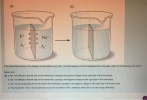 If the membrane shown in the beakers is permeable only to Na^+, and the beaker on the left represents the initial state, which of the following will occur? Select one: a. Na^+ will diffuse to the left side of the membrane, causing a net positive charge on the right tide of the membrane. b. Na^+ will diffuse to the left side of the membrane, causing a not negative charge on the right side of the membrane. c. Na^+ will be...
What is the current in amperes if 1500 Na+ ions flow across a cell membrane in...
What is the current in amperes if 1500 Na+ ions flow across a cell membrane in 3.6 μs ? The charge on the sodium is the same as on an electron, but positive. Express your answer to two significant figures and include the appropriate units.
Attach a 14 V voltage source between the terminals a-b in (Figure 1). with the postive...
 Attach a 14 V voltage source between the terminals a-b in (Figure 1). with the postive terminal at the top Part A Use voltage division to find the voltage across the resistor, positive at the left Express your answer to three significant figures and include the appropriate units. 40= 187 V Submit Previous Answers Correct Part B Use the result from part A to find the current in the 4 resistor from left to right. Express your answer to three...
A cube of side 9.50 cm is placed in a uniform field E= 7.50 x 10'...
 A cube of side 9.50 cm is placed in a uniform field E= 7.50 x 10' N/C with edges parallel to the field lines (field enters into the right face of the cube, passes through it and exits from the left side). What is the net flux through the cube? Express your answer to three significant figures and include the appropriate units. μΑ ? net - Value Units Submit Request Answer Part B What is the flux through the right...
Part A Determine the forces in members AB and CB of the truss, and state if the members are in tension or compression. Set θ:00 (Figure 1) Express your answer to three significant figures and include...
 Part A Determine the forces in members AB and CB of the truss, and state if the members are in tension or compression. Set θ:00 (Figure 1) Express your answer to three significant figures and include the appropriate units. Assume positive scalars for members in tension and negative scalars for members in compression. FAB-FOBValue Units Figure 1 of 1 Submit Request Answer Part B 3 kN Determine the force in member AD of the truss, and state if the member...
Part A Determine the force in member AB, and state if the member is in tension...
 Part A
Determine the force in member AB, and state if the member is in
tension or compression.
Express your answer to three significant figures and include the
appropriate units. Enter negative value in the case of compression
and positive value in the case of tension.
FAB=
Part B
Determine the force in member AI, and state if the member is in
tension or compression.
Express your answer to three significant figures and include the
appropriate units. Enter negative value...
Part A
Determine the force in member AB, and state if the member is in
tension or compression.
Express your answer to three significant figures and include the
appropriate units. Enter negative value in the case of compression
and positive value in the case of tension.
FAB=
Part B
Determine the force in member AI, and state if the member is in
tension or compression.
Express your answer to three significant figures and include the
appropriate units. Enter negative value...
Problem 14.21 - Enhanced - with Solution 19 of 19 Assuming a membrane potential across the inner ...
 Problem 14.21 - Enhanced - with Solution 19 of 19 Assuming a membrane potential across the inner membrane of 177 mV (inside negative), calculate the ratio of the [Ca2 matrix to that in the cytoplasm(Cthat would exist at equilibrium (i.e, AG 0) Express your answer using two significant figures. in the ReviewI Constants Periodic Table Calcium is an important regulator of the citric acid cycle. Calcium is transported across the mitochondrial inner membrane by the negative potential inside the matrix....
A. Calculate the heat change in calories for vaporization of 25.0 g of water at 100...
A. Calculate the heat change in calories for vaporization of 25.0 g of water at 100 ∘C. Express your answer as a positive value using three significant figures and include the appropriate units. B. Calculate the heat change in joules for vaporization of 7.00 g of water at 100 ∘C. Express your answer as a positive value using three significant figures and include the appropriate units. C. Calculate the heat change in kilocalories for condensation of 6.5 kg of steam...
 The equilibrium membrane potentials to be expected across a
membrane at 37 ∘ C, with a NaCl concentration of 0.10 M on the
right and 0.01 M on the left, given the following conditions.
Membrane permeable only to Na+: Δψ = +0.0615 V.
Membrane permeable only to Cl−: Δψ = −0.0615 V.
Membrane equally permeable to both ions: Δψ = 0 V.
Will any appreciable transport of material take place in
establishing the membrane potential? Briefly explain each
answer.
Match...
The equilibrium membrane potentials to be expected across a
membrane at 37 ∘ C, with a NaCl concentration of 0.10 M on the
right and 0.01 M on the left, given the following conditions.
Membrane permeable only to Na+: Δψ = +0.0615 V.
Membrane permeable only to Cl−: Δψ = −0.0615 V.
Membrane equally permeable to both ions: Δψ = 0 V.
Will any appreciable transport of material take place in
establishing the membrane potential? Briefly explain each
answer.
Match...
 Problem 10.11 - Enhanced - with Solution membrane at 37° C, with a NaCl concentration of 0.10 M on the right and 0.01 M on the left, given the following conditions. The equilibrium membrane potentials to be expected across Membrane permeable only to Nat: Ah= +0.0615 V L0 0615 V Membrane equally permeable to both ions: Ab0 V Part A Will any appreciable transport f material take place in establishing the membrane potential? Briefly explain each answer. Match the items...
 If the membrane shown in the beakers is permeable only to Na^+, and the beaker on the left represents the initial state, which of the following will occur? Select one: a. Na^+ will diffuse to the left side of the membrane, causing a net positive charge on the right tide of the membrane. b. Na^+ will diffuse to the left side of the membrane, causing a not negative charge on the right side of the membrane. c. Na^+ will be...
 Attach a 14 V voltage source between the terminals a-b in (Figure 1). with the postive terminal at the top Part A Use voltage division to find the voltage across the resistor, positive at the left Express your answer to three significant figures and include the appropriate units. 40= 187 V Submit Previous Answers Correct Part B Use the result from part A to find the current in the 4 resistor from left to right. Express your answer to three...
 A cube of side 9.50 cm is placed in a uniform field E= 7.50 x 10' N/C with edges parallel to the field lines (field enters into the right face of the cube, passes through it and exits from the left side). What is the net flux through the cube? Express your answer to three significant figures and include the appropriate units. μΑ ? net - Value Units Submit Request Answer Part B What is the flux through the right...
 Part A Determine the forces in members AB and CB of the truss, and state if the members are in tension or compression. Set θ:00 (Figure 1) Express your answer to three significant figures and include the appropriate units. Assume positive scalars for members in tension and negative scalars for members in compression. FAB-FOBValue Units Figure 1 of 1 Submit Request Answer Part B 3 kN Determine the force in member AD of the truss, and state if the member...
 Part A
Determine the force in member AB, and state if the member is in
tension or compression.
Express your answer to three significant figures and include the
appropriate units. Enter negative value in the case of compression
and positive value in the case of tension.
FAB=
Part B
Determine the force in member AI, and state if the member is in
tension or compression.
Express your answer to three significant figures and include the
appropriate units. Enter negative value...
Part A
Determine the force in member AB, and state if the member is in
tension or compression.
Express your answer to three significant figures and include the
appropriate units. Enter negative value in the case of compression
and positive value in the case of tension.
FAB=
Part B
Determine the force in member AI, and state if the member is in
tension or compression.
Express your answer to three significant figures and include the
appropriate units. Enter negative value...
 Problem 14.21 - Enhanced - with Solution 19 of 19 Assuming a membrane potential across the inner membrane of 177 mV (inside negative), calculate the ratio of the [Ca2 matrix to that in the cytoplasm(Cthat would exist at equilibrium (i.e, AG 0) Express your answer using two significant figures. in the ReviewI Constants Periodic Table Calcium is an important regulator of the citric acid cycle. Calcium is transported across the mitochondrial inner membrane by the negative potential inside the matrix....
Most questions answered within 3 hours.
-
Where is the error in this code sequence?
String s1 = "Hello";
String s2 = "ello";...
asked 10 months ago -
Financial data for Joel de Paris, Inc., for last year
follow:
Joel de Paris, Inc.
Balance...
asked 10 months ago -
Consider this reaction:
Al2(SO4)3 (aq)+ BaCl3
(aq) Al2Cl6 (aq)- +
3BaSO4(s) . What is the...
asked 10 months ago -
Suppose that Savneet is considering increasing her
recent random sample from 20 car rentals to 40...
asked 10 months ago -
Trucks arrive at an unloading terminal at an average rate of 120
per hour.
Trucks arrive...
asked 10 months ago -
Why are methanol and ethanol completely soluble in water while
octanol is not very little soluble....
asked 10 months ago -
A facilities manager at a university reads in a research report
that the mean amount of...
asked 10 months ago -
When the CuSO4 is rehydrated by adding water to the anhydrous
compound, is this an endothermic...
asked 10 months ago -
A ray of sunlight is passing from diamond into crown glass; the
angle of incidence is...
asked 10 months ago -
A block of mass 0.249 kg is placed on top of a light, vertical
spring of...
asked 10 months ago -
how do the kidneys compensate in the presences of acidosis
a) trigger hyperventilate
b) reserve acid...
asked 10 months ago -
Question 501 pts
The rental rate of capital to the firm increases. Which of the
following...
asked 10 months ago