Suppose that a 15 star finally runs out of nuclear fuel in its core and undergoes...
Suppose that a 15  star finally runs out of nuclear fuel in its core and undergoes a
Type II supernova explosion. You are going to analyse the energy
budget, calculating all the quantities in Joules.
star finally runs out of nuclear fuel in its core and undergoes a
Type II supernova explosion. You are going to analyse the energy
budget, calculating all the quantities in Joules.
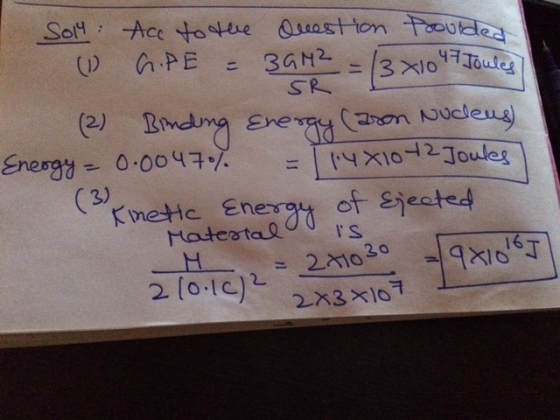
a) Estimate the amount of gravitational energy that would be
liberated by the collapse of the core (say) 1.4 M
to the size of neutron star.
b) How much of this energy would be required to disintegrate the iron nuclei in the core?
c) How much of this energy would be required to provide the kinetic energy of the ejecta if a typical velocity for the ejecta in the initial stages of a supernova explosion is up to 0.1c?
d) The absolute visual magnitude at maximum of a typical supernova is comparable to that of a modest galaxy for a few weeks. Estimate the total light output of the supernova.
e) Compare this with the other aspects of the energy budget available and comment on any deficit.
Homework Answers
d) Total light output = Galaxy light x 100 weeks = = 20.9 x 100 = 2090 absolute magnitude.
Add Answer to:
Suppose that a 15
star finally runs out of nuclear fuel in its core and undergoes...
5. A core-collapse supernova located near the Galactic Center ejects the outer 10 Msun of the env...
 Astrophysics/physics
5. A core-collapse supernova located near the Galactic Center ejects the outer 10 Msun of the envelope of its star star at a speed of 5000 km s1 a. Estimate the kinetic energy of the expanding ejecta b. The remnant core is a neutron star with a mass of 1.6 Msun and a radius of 11 km. Estimate the c. What percentage of the binding energy liberated by the formation of the neutron star was d. Estimate the number...
Astrophysics/physics
5. A core-collapse supernova located near the Galactic Center ejects the outer 10 Msun of the envelope of its star star at a speed of 5000 km s1 a. Estimate the kinetic energy of the expanding ejecta b. The remnant core is a neutron star with a mass of 1.6 Msun and a radius of 11 km. Estimate the c. What percentage of the binding energy liberated by the formation of the neutron star was d. Estimate the number...
Answer all of the following questions: A core-collapse supernova located near the Galactic Center ejects the...
 Answer all of the following questions:
A core-collapse supernova located near the Galactic Center ejects the outer 10 Msun of the envelope of its star star at a speed of 5000 km s-1. a. Estimate the kinetic energy of the expanding ejecta. b. The remnant core is a neutron star with a mass of 1.6 Msun and a radius of 11 km. Estimate the 5. gravitational binding energy of this neutron star. You may assume it is uniform density. What...
Answer all of the following questions:
A core-collapse supernova located near the Galactic Center ejects the outer 10 Msun of the envelope of its star star at a speed of 5000 km s-1. a. Estimate the kinetic energy of the expanding ejecta. b. The remnant core is a neutron star with a mass of 1.6 Msun and a radius of 11 km. Estimate the 5. gravitational binding energy of this neutron star. You may assume it is uniform density. What...
C. i. As a star runs out of hydrogen to fuel nuclear fusion in its core,...
 C. i. As a star runs out of hydrogen to fuel nuclear fusion in its core, changes within the star usually cause it to leave the main sequence, expanding and cooling as it does so. Would a star with a radius 100 times that of the Sun, but a surface temperature 0.4 times that of the Sun, be more, or less luminous than the Sun? Show and explain your reasoning. You may assume the surface area of a sphere is...
Before leaving Alpha Centauri, you change from the shuttle to a light speed interstellar cruiser and head out deep into the galaxy to visit another binary star system - but this one is composed...
 Before leaving Alpha Centauri, you change from the shuttle to a light speed interstellar cruiser and head out deep into the galaxy to visit another binary star system - but this one is composed of dead stars! To occupy your waking travel time by reading about this star system in the "Outer Space Tourbook": Stars spend most of their lifetimes undergoing nuclear fusion in their cores, which is why they give off so much light. However, when the material necessary...
 Astrophysics/physics
5. A core-collapse supernova located near the Galactic Center ejects the outer 10 Msun of the envelope of its star star at a speed of 5000 km s1 a. Estimate the kinetic energy of the expanding ejecta b. The remnant core is a neutron star with a mass of 1.6 Msun and a radius of 11 km. Estimate the c. What percentage of the binding energy liberated by the formation of the neutron star was d. Estimate the number...
Astrophysics/physics
5. A core-collapse supernova located near the Galactic Center ejects the outer 10 Msun of the envelope of its star star at a speed of 5000 km s1 a. Estimate the kinetic energy of the expanding ejecta b. The remnant core is a neutron star with a mass of 1.6 Msun and a radius of 11 km. Estimate the c. What percentage of the binding energy liberated by the formation of the neutron star was d. Estimate the number...
 Answer all of the following questions:
A core-collapse supernova located near the Galactic Center ejects the outer 10 Msun of the envelope of its star star at a speed of 5000 km s-1. a. Estimate the kinetic energy of the expanding ejecta. b. The remnant core is a neutron star with a mass of 1.6 Msun and a radius of 11 km. Estimate the 5. gravitational binding energy of this neutron star. You may assume it is uniform density. What...
Answer all of the following questions:
A core-collapse supernova located near the Galactic Center ejects the outer 10 Msun of the envelope of its star star at a speed of 5000 km s-1. a. Estimate the kinetic energy of the expanding ejecta. b. The remnant core is a neutron star with a mass of 1.6 Msun and a radius of 11 km. Estimate the 5. gravitational binding energy of this neutron star. You may assume it is uniform density. What...
 C. i. As a star runs out of hydrogen to fuel nuclear fusion in its core, changes within the star usually cause it to leave the main sequence, expanding and cooling as it does so. Would a star with a radius 100 times that of the Sun, but a surface temperature 0.4 times that of the Sun, be more, or less luminous than the Sun? Show and explain your reasoning. You may assume the surface area of a sphere is...
 Before leaving Alpha Centauri, you change from the shuttle to a light speed interstellar cruiser and head out deep into the galaxy to visit another binary star system - but this one is composed of dead stars! To occupy your waking travel time by reading about this star system in the "Outer Space Tourbook": Stars spend most of their lifetimes undergoing nuclear fusion in their cores, which is why they give off so much light. However, when the material necessary...
Most questions answered within 3 hours.
-
Where is the error in this code sequence?
String s1 = "Hello";
String s2 = "ello";...
asked 11 months ago -
Financial data for Joel de Paris, Inc., for last year
follow:
Joel de Paris, Inc.
Balance...
asked 11 months ago -
Consider this reaction:
Al2(SO4)3 (aq)+ BaCl3
(aq) Al2Cl6 (aq)- +
3BaSO4(s) . What is the...
asked 11 months ago -
Suppose that Savneet is considering increasing her
recent random sample from 20 car rentals to 40...
asked 11 months ago -
Trucks arrive at an unloading terminal at an average rate of 120
per hour.
Trucks arrive...
asked 11 months ago -
Why are methanol and ethanol completely soluble in water while
octanol is not very little soluble....
asked 11 months ago -
A facilities manager at a university reads in a research report
that the mean amount of...
asked 11 months ago -
When the CuSO4 is rehydrated by adding water to the anhydrous
compound, is this an endothermic...
asked 11 months ago -
A ray of sunlight is passing from diamond into crown glass; the
angle of incidence is...
asked 11 months ago -
A block of mass 0.249 kg is placed on top of a light, vertical
spring of...
asked 11 months ago -
how do the kidneys compensate in the presences of acidosis
a) trigger hyperventilate
b) reserve acid...
asked 11 months ago -
Question 501 pts
The rental rate of capital to the firm increases. Which of the
following...
asked 11 months ago