In 1909, Robert Millikan was the first to find the charge of an electron in his...
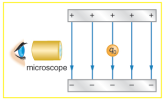
In 1909, Robert Millikan was the first to find the
charge of an electron in his now-famous oil-drop
experiment. In that experiment tiny oil drops were
sprayed into a uniform electric field between a
horizontal pair of oppositely charged plates. The drops
were observed with a magnifying eyepiece, and the
electric field was adjusted so that the electric force on
some negatively charged oil drops was just sufficient to
balance their weight. Millikan accurately measured the charges on
many oil drops and found the values to be whole-number multiples of
1.6 x 10?19 C, the charge of an electron. For this, he won the
Nobel Prize.
a) Draw a force diagram for an oil droplet suspended at rest in midair. Label your forces and be careful about the sizes of your vectors.
b) Next to your force diagram, draw and label a vector that shows the direction of the electric field that acts on a negatively charged oil droplet to balance gravity and keep it afloat.
c) If a drop of mass 1.37 x 10⁻¹⁴ kg remains stationary in an electric field of 1.4 x 10⁵ N/C, what is the charge of this drop?
d) How many extra electrons are on this particular oil drop?
Homework Answers

Add Answer to:
In 1909, Robert Millikan was the first to find the
charge of an electron in his...
To analyze the experiment used to determine the properties of an electron. In 1909, Robert Millikan...
 To analyze the experiment used to determine the properties of an electron. In 1909, Robert Millikan performed an experiment involving tiny, charged drops of oil. The drops were charged because they had picked up extra electrons. Millikan was able to measure the charge on each drop in coulombs. Here is an example of what his data may have looked like. In Millikan's experiment, the charge on each drop of oil was measured in coulombs. Imagine the same experiment, but with...
In 1909, Millikan performed a famous experiment in which he measured the charge of the electron...
In 1909, Millikan performed a famous experiment in which he measured the charge of the electron (and for which he won the Nobel prize). In his experiment, oil drops carrying excess electrons are made to float between two charged large parallel, horizontal plates, as shown, by adjusting a uniform vertical electric field between the plates so that the drops do not fall down. Suppose each drop has a mass of 3.3 × 10⁻¹⁵kg, and one of the drops floats (the...
Oil Drop 11. Robert Millikan received a Nobel Prize for determining the charge on the electron....
 Oil Drop 11. Robert Millikan received a Nobel Prize for determining the charge on the electron. To do this, he set up a of oil between potential difference between two horizontal parallel metal plates. He then sprayed drops the plates and adjusted the potential difference until drops of a certain size between the plates, as shown above. Suppose that when the potential difference adjusted until the electric field is 10,000 N/C downward, a certain drop with a mass of remains...
Experiments carried out by Robert Millikan in 1910-1913 determined the charge of an electron. In his...
Experiments carried out by Robert Millikan in 1910-1913 determined the charge of an electron. In his experiment, oil droplets are charged when sprayed into a chamber. He then studied the motion of the charged oil droplets in a uniform electric field. He found that the following measured value of charge appeared on the oil droplets: Drop Charge (10-19 C) 1 13.13 2 6.563 3 19.71 4 22.89 5 16.48 6 8.204 7 11.50 8 26.13 9 18.08 What value of...
In the famous Millikan oil-drop experiment, tiny spherical droplets of oil are sprayed into a uniform...
In the famous Millikan oil-drop experiment, tiny spherical droplets of oil are sprayed into a uniform vertical electric field. The drops get a very small charge (just a few electrons) due to friction with the atomizer as they are sprayed. The field is adjusted until the drop (which is viewed through a small telescope) is just balanced against gravity and therefore remains stationary. Using the measured value of the electric field, we can calculate the charge on the drop and...
with diagram if possible 0.0200 mx Figure 16-33 Problem 86 In the famous Millikan oil-drop experiment,...
 with diagram if possible
0.0200 mx Figure 16-33 Problem 86 In the famous Millikan oil-drop experiment, tiny cal droplets of oil are sprayed into a uniform vertical electric field. The drops get a very small charge (just a few elec trons) due to friction with the atomizer as they are sprayed. The field is adjusted until the drop (which is viewed through a small telescope) is just balanced against gravity and there- fore remains stationary. Using the measured value of...
with diagram if possible
0.0200 mx Figure 16-33 Problem 86 In the famous Millikan oil-drop experiment, tiny cal droplets of oil are sprayed into a uniform vertical electric field. The drops get a very small charge (just a few elec trons) due to friction with the atomizer as they are sprayed. The field is adjusted until the drop (which is viewed through a small telescope) is just balanced against gravity and there- fore remains stationary. Using the measured value of...
In the famous Millikan oil-drop experiment, tiny spherical droplets of oil are sprayed into a uniform...
In the famous Millikan oil-drop experiment, tiny spherical droplets of oil are sprayed into a uniform vertical electric field. The drops get a very small charge (just a few electrons) due to friction with the atomizer as they are sprayed. The field is adjusted until the drop (which is viewed through a small telescope) is just balanced against gravity and therefore remains stationary. Using the measured value of the electric field, we can calculate the charge on the drop and...
In the early 1900s, Robert Millikan used small charged droplets of oil, suspended in an electric...
In the early 1900s, Robert Millikan used small charged droplets of oil, suspended in an electric field, to make the first quantitative measurements of the electron’s charge. A 0.74-μm-diameter droplet of oil, having a charge of +e+e, is suspended in midair between two horizontal plates of a parallel-plate capacitor. The upward electric force on the droplet is exactly balanced by the downward force of gravity. The oil has a density of 860 kg/m3, and the capacitor plates are 6.0 mm...
The classic Millikan oil drop experiment was the first to obtain an accurate measurement of the...
 The classic Millikan oil drop experiment was the first to obtain
an accurate measurement of the charge on an electron. In it, oil
drops were suspended against the gravitational force by a vertical
electric field. Consider an oil drop with a weight of 1.6 x 10⁻¹⁴N,
if the drop has a single excess electron, find the magnitude (in
N/C) of the electric field needed to balance its weight. Your
should round your answer to an integer, indicate only the number,...
The classic Millikan oil drop experiment was the first to obtain
an accurate measurement of the charge on an electron. In it, oil
drops were suspended against the gravitational force by a vertical
electric field. Consider an oil drop with a weight of 1.6 x 10⁻¹⁴N,
if the drop has a single excess electron, find the magnitude (in
N/C) of the electric field needed to balance its weight. Your
should round your answer to an integer, indicate only the number,...
The classic Millikan oil drop experiment was the first to obtain an accurate measurement of the...
The classic Millikan oil drop experiment was the first to obtain an accurate measurement of the charge on an electron. In it, oil drops were suspended against the gravitational force by a vertical electric field. Consider an oil drop with a weight of 1.2 x 10⁻¹⁴N, if the drop has a single excess electron, find the magnitude (in N/C) of the electric field needed to balance its weight. Your should round your answer to an integer, indicate only the number,...
 To analyze the experiment used to determine the properties of an electron. In 1909, Robert Millikan performed an experiment involving tiny, charged drops of oil. The drops were charged because they had picked up extra electrons. Millikan was able to measure the charge on each drop in coulombs. Here is an example of what his data may have looked like. In Millikan's experiment, the charge on each drop of oil was measured in coulombs. Imagine the same experiment, but with...
 Oil Drop 11. Robert Millikan received a Nobel Prize for determining the charge on the electron. To do this, he set up a of oil between potential difference between two horizontal parallel metal plates. He then sprayed drops the plates and adjusted the potential difference until drops of a certain size between the plates, as shown above. Suppose that when the potential difference adjusted until the electric field is 10,000 N/C downward, a certain drop with a mass of remains...
 with diagram if possible
0.0200 mx Figure 16-33 Problem 86 In the famous Millikan oil-drop experiment, tiny cal droplets of oil are sprayed into a uniform vertical electric field. The drops get a very small charge (just a few elec trons) due to friction with the atomizer as they are sprayed. The field is adjusted until the drop (which is viewed through a small telescope) is just balanced against gravity and there- fore remains stationary. Using the measured value of...
with diagram if possible
0.0200 mx Figure 16-33 Problem 86 In the famous Millikan oil-drop experiment, tiny cal droplets of oil are sprayed into a uniform vertical electric field. The drops get a very small charge (just a few elec trons) due to friction with the atomizer as they are sprayed. The field is adjusted until the drop (which is viewed through a small telescope) is just balanced against gravity and there- fore remains stationary. Using the measured value of...
 The classic Millikan oil drop experiment was the first to obtain
an accurate measurement of the charge on an electron. In it, oil
drops were suspended against the gravitational force by a vertical
electric field. Consider an oil drop with a weight of 1.6 x 10⁻¹⁴N,
if the drop has a single excess electron, find the magnitude (in
N/C) of the electric field needed to balance its weight. Your
should round your answer to an integer, indicate only the number,...
The classic Millikan oil drop experiment was the first to obtain
an accurate measurement of the charge on an electron. In it, oil
drops were suspended against the gravitational force by a vertical
electric field. Consider an oil drop with a weight of 1.6 x 10⁻¹⁴N,
if the drop has a single excess electron, find the magnitude (in
N/C) of the electric field needed to balance its weight. Your
should round your answer to an integer, indicate only the number,...
Most questions answered within 3 hours.
-
Where is the error in this code sequence?
String s1 = "Hello";
String s2 = "ello";...
asked 11 months ago -
Financial data for Joel de Paris, Inc., for last year
follow:
Joel de Paris, Inc.
Balance...
asked 11 months ago -
Consider this reaction:
Al2(SO4)3 (aq)+ BaCl3
(aq) Al2Cl6 (aq)- +
3BaSO4(s) . What is the...
asked 11 months ago -
Suppose that Savneet is considering increasing her
recent random sample from 20 car rentals to 40...
asked 11 months ago -
Trucks arrive at an unloading terminal at an average rate of 120
per hour.
Trucks arrive...
asked 11 months ago -
Why are methanol and ethanol completely soluble in water while
octanol is not very little soluble....
asked 11 months ago -
A facilities manager at a university reads in a research report
that the mean amount of...
asked 11 months ago -
When the CuSO4 is rehydrated by adding water to the anhydrous
compound, is this an endothermic...
asked 11 months ago -
A ray of sunlight is passing from diamond into crown glass; the
angle of incidence is...
asked 11 months ago -
A block of mass 0.249 kg is placed on top of a light, vertical
spring of...
asked 11 months ago -
how do the kidneys compensate in the presences of acidosis
a) trigger hyperventilate
b) reserve acid...
asked 11 months ago -
Question 501 pts
The rental rate of capital to the firm increases. Which of the
following...
asked 11 months ago