please explain with the diagram
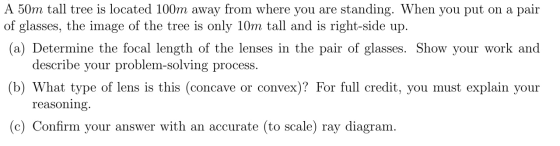
A 50m tall tree is located 100m away from where you are standing. When you put on a pair
of glasses, the image of the tree is only 10m tall and is right-side up.
(a) Determine the focal length of the lenses in the pair of glasses. Show your work and
describe your problem-solving process.
(b) What type of lens is this (concave or convex)? For full credit, you must explain your
reasoning.
(c) Confirm your answer with an accurate (to scale) ray diagram.
Homework Answers
Request Answer!
We need at least 10 more requests to produce the answer.
0 / 10 have requested this problem solution
The more requests, the faster the answer.
10. [15 pts] A 50 m tall tree is located 100 m away from where you...
 10. [15 pts] A 50 m tall tree is located 100 m away from where you are standing. When you put on a pair of glasses, the image of the tree is only 10 m tall and is right-side up. A. Determine the focal length of the lenses in the pair of glasses. Show your work and describe your problem-solving process. f= B. What type of lens is this? For full credit, you must explain your reasoning. O Concave O...
Please answer all questions: 1. An f=7.95 cm convex lens produces an inverted image of a...
Please answer all questions: 1. An f=7.95 cm convex lens produces an inverted image of a 1.6 m tall person. If the lens must be 5.04 m from the person to produce a sharp image, what is the magnitude of the magnification (no - sign!)? 2. You put a convex lens with f=21.4 cm right next to a concave lens with f=-19.3 cm. The two lenses combined act like one single lens. What is the effective focal length of this...
webassign.net Active Figure 26.25 Thin Lenses The animation below shows a thin lens, an object (blue...
 webassign.net Active Figure 26.25 Thin Lenses The animation below shows a thin lens, an object (blue arrow) and an image (tan arrow). Three rays are shown that locate the positic orientation, and size of the image. Readouts are provided for object distance, object height, image distance and image height. Instructions: Click and drag the blue object. Click the button in the lower left of the applet window to toggle between a conc convex lens. Explore Images formed by thin lenses...
A spherical lens has a magnification is +3.0. (a) Determine the focal length in terms of...
A spherical lens has a magnification is +3.0. (a) Determine the focal length in terms of the object distance. (b) Suppose the object is located 6.0 cm to the left of the mirror. What are the focal length and image distance? (c) Is the lens concave or convex? (d) Using a ray diagram, confirm the locations of the image and focal point.
can you please explain the correct answer. 12. Which of these images could be inverted? image of a customer in a sto...
 can you please explain the correct answer.
12. Which of these images could be inverted? image of a customer in a store's convex security mirror ) image of an object placed between the focal point and the surface of a concave mirror image of a tree in the lens of a person's convex sunglasses image of a strawberry in the concave bowl of a shiny spoon d.
12. Which of these images could be inverted? image of a customer in...
can you please explain the correct answer.
12. Which of these images could be inverted? image of a customer in a store's convex security mirror ) image of an object placed between the focal point and the surface of a concave mirror image of a tree in the lens of a person's convex sunglasses image of a strawberry in the concave bowl of a shiny spoon d.
12. Which of these images could be inverted? image of a customer in...
Pls. hep me answer these questions and show solution Thanks 1.You have a converging (convex) lens...
Pls. hep me answer these questions and show solution Thanks 1.You have a converging (convex) lens and a diverging (concave) lens and the magnitude of the focal length of each lens is 44.4 cm.Determine how far from the lens you should locate the screen in order to produce an image of the light bulb that is magnified by a factor of 1.55. (Answer in m) 2.A lens is needed to provide an image with a height of −6.80 cm. The...
Explain answers thoroughly, and ignore air resistance and gravity. I dont expect an answer for number...
 Explain answers thoroughly, and ignore air resistance and
gravity. I dont expect an answer for number 2 or 3. I just am
wanting an answer for the extra credit question, number 4.
Thanks!
2. A convex mirror has a radius of curvature of 4 m. A boy stands in front of the mirror so that he appears 3 times shorter than his actual height. If the image is upright, how far is he standing from the mirror? Explain if the...
Explain answers thoroughly, and ignore air resistance and
gravity. I dont expect an answer for number 2 or 3. I just am
wanting an answer for the extra credit question, number 4.
Thanks!
2. A convex mirror has a radius of curvature of 4 m. A boy stands in front of the mirror so that he appears 3 times shorter than his actual height. If the image is upright, how far is he standing from the mirror? Explain if the...
For the following question, draw a ray diagram for each lens draw a careful and accurate...
For the following question, draw a ray diagram for each lens draw a careful and accurate ray diagram of this image (from lens 1) as an object (for lens 2) forming an image through the second lens. Finally, draw a careful and accurate ray diagram of the entire situation, including both lenses and all images. An object 5 cm high is located 75 cm from a converging lens (X1 = 75 cm) of focal length f1 = 50 cm. A...
Could someone please help complet Table 1 and Table 2 Lab 12 Concave and Convex Lenses...
 Could someone please help complet Table 1 and Table 2
Lab 12 Concave and Convex Lenses PHYS 1110L Conceptual Physics Lab Name: Date: Results:-- -(90 pts max) OBJECTIVES To demonstrate the formation of images from convex and concave lenses. To identify the type of image formed by convex and concave lenses. - To confirm the lens equations. PART 1 CONVEX LENS 1. Open GOOGLE CHROME or other compatible browser and DISABLE all BROWSER POP-UP BLOCKERS 2. Go to PhET Simulations...
Could someone please help complet Table 1 and Table 2
Lab 12 Concave and Convex Lenses PHYS 1110L Conceptual Physics Lab Name: Date: Results:-- -(90 pts max) OBJECTIVES To demonstrate the formation of images from convex and concave lenses. To identify the type of image formed by convex and concave lenses. - To confirm the lens equations. PART 1 CONVEX LENS 1. Open GOOGLE CHROME or other compatible browser and DISABLE all BROWSER POP-UP BLOCKERS 2. Go to PhET Simulations...
lens 1 @ 56 cm lens 2 @ 74.8cm screen @ 77.5 cm size of image 1.5 x 1.5 cm and is inverted what would be a ray diagram...
 lens 1 @ 56 cm
lens 2 @ 74.8cm
screen @ 77.5 cm
size of image 1.5 x 1.5 cm and is inverted
what would be a ray diagram dor this set ? (nswer questjon #4
pls
focal length of lens 1 =15.55cm
focal lengh of lens 2= 31.04 cm
is removed. It is as if there is a light source where the screen used to be that produces light, ie, a new "object". In the later parts of the...
lens 1 @ 56 cm
lens 2 @ 74.8cm
screen @ 77.5 cm
size of image 1.5 x 1.5 cm and is inverted
what would be a ray diagram dor this set ? (nswer questjon #4
pls
focal length of lens 1 =15.55cm
focal lengh of lens 2= 31.04 cm
is removed. It is as if there is a light source where the screen used to be that produces light, ie, a new "object". In the later parts of the...
 10. [15 pts] A 50 m tall tree is located 100 m away from where you are standing. When you put on a pair of glasses, the image of the tree is only 10 m tall and is right-side up. A. Determine the focal length of the lenses in the pair of glasses. Show your work and describe your problem-solving process. f= B. What type of lens is this? For full credit, you must explain your reasoning. O Concave O...
 webassign.net Active Figure 26.25 Thin Lenses The animation below shows a thin lens, an object (blue arrow) and an image (tan arrow). Three rays are shown that locate the positic orientation, and size of the image. Readouts are provided for object distance, object height, image distance and image height. Instructions: Click and drag the blue object. Click the button in the lower left of the applet window to toggle between a conc convex lens. Explore Images formed by thin lenses...
 can you please explain the correct answer.
12. Which of these images could be inverted? image of a customer in a store's convex security mirror ) image of an object placed between the focal point and the surface of a concave mirror image of a tree in the lens of a person's convex sunglasses image of a strawberry in the concave bowl of a shiny spoon d.
12. Which of these images could be inverted? image of a customer in...
can you please explain the correct answer.
12. Which of these images could be inverted? image of a customer in a store's convex security mirror ) image of an object placed between the focal point and the surface of a concave mirror image of a tree in the lens of a person's convex sunglasses image of a strawberry in the concave bowl of a shiny spoon d.
12. Which of these images could be inverted? image of a customer in...
 Explain answers thoroughly, and ignore air resistance and
gravity. I dont expect an answer for number 2 or 3. I just am
wanting an answer for the extra credit question, number 4.
Thanks!
2. A convex mirror has a radius of curvature of 4 m. A boy stands in front of the mirror so that he appears 3 times shorter than his actual height. If the image is upright, how far is he standing from the mirror? Explain if the...
Explain answers thoroughly, and ignore air resistance and
gravity. I dont expect an answer for number 2 or 3. I just am
wanting an answer for the extra credit question, number 4.
Thanks!
2. A convex mirror has a radius of curvature of 4 m. A boy stands in front of the mirror so that he appears 3 times shorter than his actual height. If the image is upright, how far is he standing from the mirror? Explain if the...
 Could someone please help complet Table 1 and Table 2
Lab 12 Concave and Convex Lenses PHYS 1110L Conceptual Physics Lab Name: Date: Results:-- -(90 pts max) OBJECTIVES To demonstrate the formation of images from convex and concave lenses. To identify the type of image formed by convex and concave lenses. - To confirm the lens equations. PART 1 CONVEX LENS 1. Open GOOGLE CHROME or other compatible browser and DISABLE all BROWSER POP-UP BLOCKERS 2. Go to PhET Simulations...
Could someone please help complet Table 1 and Table 2
Lab 12 Concave and Convex Lenses PHYS 1110L Conceptual Physics Lab Name: Date: Results:-- -(90 pts max) OBJECTIVES To demonstrate the formation of images from convex and concave lenses. To identify the type of image formed by convex and concave lenses. - To confirm the lens equations. PART 1 CONVEX LENS 1. Open GOOGLE CHROME or other compatible browser and DISABLE all BROWSER POP-UP BLOCKERS 2. Go to PhET Simulations...
 lens 1 @ 56 cm
lens 2 @ 74.8cm
screen @ 77.5 cm
size of image 1.5 x 1.5 cm and is inverted
what would be a ray diagram dor this set ? (nswer questjon #4
pls
focal length of lens 1 =15.55cm
focal lengh of lens 2= 31.04 cm
is removed. It is as if there is a light source where the screen used to be that produces light, ie, a new "object". In the later parts of the...
lens 1 @ 56 cm
lens 2 @ 74.8cm
screen @ 77.5 cm
size of image 1.5 x 1.5 cm and is inverted
what would be a ray diagram dor this set ? (nswer questjon #4
pls
focal length of lens 1 =15.55cm
focal lengh of lens 2= 31.04 cm
is removed. It is as if there is a light source where the screen used to be that produces light, ie, a new "object". In the later parts of the...
Most questions answered within 3 hours.
-
Where is the error in this code sequence?
String s1 = "Hello";
String s2 = "ello";...
asked 11 months ago -
Financial data for Joel de Paris, Inc., for last year
follow:
Joel de Paris, Inc.
Balance...
asked 11 months ago -
Consider this reaction:
Al2(SO4)3 (aq)+ BaCl3
(aq) Al2Cl6 (aq)- +
3BaSO4(s) . What is the...
asked 11 months ago -
Suppose that Savneet is considering increasing her
recent random sample from 20 car rentals to 40...
asked 11 months ago -
Trucks arrive at an unloading terminal at an average rate of 120
per hour.
Trucks arrive...
asked 11 months ago -
Why are methanol and ethanol completely soluble in water while
octanol is not very little soluble....
asked 11 months ago -
A facilities manager at a university reads in a research report
that the mean amount of...
asked 11 months ago -
When the CuSO4 is rehydrated by adding water to the anhydrous
compound, is this an endothermic...
asked 11 months ago -
A ray of sunlight is passing from diamond into crown glass; the
angle of incidence is...
asked 11 months ago -
A block of mass 0.249 kg is placed on top of a light, vertical
spring of...
asked 11 months ago -
how do the kidneys compensate in the presences of acidosis
a) trigger hyperventilate
b) reserve acid...
asked 11 months ago -
Question 501 pts
The rental rate of capital to the firm increases. Which of the
following...
asked 11 months ago