Please explain why
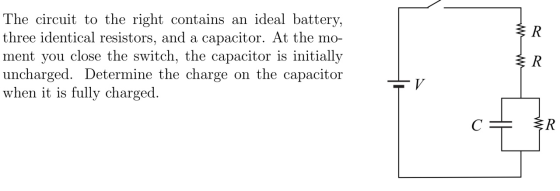
The circuit to the right contains an ideal battery,
three identical resistors, and a capacitor. At the mo-
ment you close the switch, the capacitor is initially
uncharged. Determine the charge on the capacitor
when it is fully charged.
Homework Answers
Request Answer!
We need at least 10 more requests to produce the answer.
0 / 10 have requested this problem solution
The more requests, the faster the answer.
A circuit consists of a 6-pif capacitor, a 12 m-F capacitor, a 12-V battery, and a...
 A circuit consists of a 6-pif capacitor, a 12 m-F capacitor, a 12-V battery, and a switch, connected as shown in Figure 24-14. Initially, the switch is open and the capacitors are uncharged. The switch is then closed and the capacitors charge. When the capacitors are fully charged and open-circuit terminal volt- age is restored, (a) what is the potential of each conductor in the circuit? (Choose the zero-potential reference point on the negative battery terminal.) If the potential of...
4. Suppose that you are supplied with this equipment: 1 non-ideal battery (with internal resistance r 0.012 Q), plu...
 4. Suppose that you are supplied with this equipment: 1 non-ideal battery (with internal resistance r 0.012 Q), plus 2 switches and plenty of wire (of negligible resistance) parallel-plate capacitor, initially uncharged. 4 identical ohmic resistors, each with resistance R 4.00 2 solenoid inductors, with inductance values L, and L, respectively. Inductor A is half as long as inductor B Inductor A has a diameter of 5.30 cm; inductor B has a diameter of 6.36 cm And you conduct the...
4. Suppose that you are supplied with this equipment: 1 non-ideal battery (with internal resistance r...
 4. Suppose that you are supplied with this equipment: 1 non-ideal battery (with internal resistance r 0.012 Q), plus 2 switches and plenty of wire (of negligible resistance) parallel-plate capacitor, initially uncharged. 4 identical ohmic resistors, each with resistance R 4.00 2 solenoid inductors, with inductance values L, and L, respectively. Inductor A is half as long as inductor B Inductor A has a diameter of 5.30 cm; inductor B has a diameter of 6.36 cm And you conduct the...
4. Suppose that you are supplied with this equipment: 1 non-ideal battery (with internal resistance r...
 4. Suppose that you are supplied with this equipment: 1 non-ideal battery (with internal resistance r 0.012 Q), plus 2 switches and plenty of wire (of negligible resistance) parallel-plate capacitor, initially uncharged. 4 identical ohmic resistors, each with resistance R 4.00 2 solenoid inductors, with inductance values L, and L, respectively. Inductor A is half as long as inductor B Inductor A has a diameter of 5.30 cm; inductor B has a diameter of 6.36 cm And you conduct the...
4. Suppose that you are supplied with this equipment = 0.012 2), plus 2 switches and plenty of wire (of negligible resi...
 4. Suppose that you are supplied with this equipment = 0.012 2), plus 2 switches and plenty of wire (of negligible resistance) 1 non-ideal battery (with internal resistance 1 parallel-plate capacitor, initially uncharged 4 identical ohmic resistors, each with resistance R 4.00 Q 2 solenoid inductors, with inductance values L and L, respectively. Inductor A is half as long as inductor B Inductor A has a diameter of 5.30 cm; inductor B has a diameter of 6.36 cm. r And...
Suppose that you are supplied with this equipment 4. Inon-ideal battery (with internal resistance r 0.012 ), plus 2...
 Suppose that you are supplied with this equipment 4. Inon-ideal battery (with internal resistance r 0.012 ), plus 2 switches and plenty of wire (of negligible resistance). I parallel-plate capacitor, initially uncharged. 4 identical ohmic resistors, each with resistance R 400 Q 2 solenoid inductors, with inductance values L and Ly, respectively. Inductor A is half as long as inductor B Inductor A has a diameter of 5.30 cm; inductor B has a diameter of 6.36 cm And you conduct...
uncharged capacitor C1 is charging. At the time inst . capacitor CI - 80 F, and...
 uncharged capacitor C1 is charging. At the time inst . capacitor CI - 80 F, and ressitor R-10 kOhm are connected as magnitude, find (a) voltage on resistor R1 and Next, when C1 is fully charged, the switch charges capacitor C2 = 30 F. (d) Find the voltage on the magnitude of electric charge of C1 then? s charging. At the time instant b or R=10 kOhm are connected as shown and the initially u t in the circuit is...
4) Midterm question Problem 2 (30 points) C=30 uF The air capacitors with C=Cq=3.0 MF, C=2.04F...
 4) Midterm question Problem 2 (30 points) C=30 uF The air capacitors with C=Cq=3.0 MF, C=2.04F and C3= 1.0F are connected to a Vo battery as shown. If the charge on C2 is Q2=20.0 C, | ,2015 Foton C1.0 F (a) (15 pts. Find the equivalent capacitance of the circuit. (b) (15 pts.) Find V. 1) A charge Q is placed on a capacitor of capacitance C=C. The capacitor is then, connected to a resistor and another capacitor of capacitance...
An LC circuit like the one in the figure below contains an 80.0 mH inductor and...
 An LC circuit like the one in the figure below contains
an 80.0 mH inductor and a 30.0 µF capacitor that initially carries
a 175 µC charge. The switch is open for t < 0 and is
then thrown closed at t = 0.
A rectangular loop forms an L C circuit. The
left side of the loop contains a capacitor C carrying a
charge Qmax, with the positively charged plate
above the negatively charged plate. The right side of...
An LC circuit like the one in the figure below contains
an 80.0 mH inductor and a 30.0 µF capacitor that initially carries
a 175 µC charge. The switch is open for t < 0 and is
then thrown closed at t = 0.
A rectangular loop forms an L C circuit. The
left side of the loop contains a capacitor C carrying a
charge Qmax, with the positively charged plate
above the negatively charged plate. The right side of...
The picture displays a 13.3 V battery and three uncharged capacitors of capacitances C1 = 4.47...
 The picture displays a 13.3 V battery and three uncharged
capacitors of capacitances C1 = 4.47 μF,C2 = 6.48 μF and C3 = 3.48
μF. The switch is thrown to the left side until capacitor 1 is
fully charged. Then the switch is thrown to the right. What is the
final charge (in C) on capacitor 3?
The picture displays a 13.3 V battery and three uncharged
capacitors of capacitances C1 = 4.47 μF,C2 = 6.48 μF and C3 = 3.48
μF. The switch is thrown to the left side until capacitor 1 is
fully charged. Then the switch is thrown to the right. What is the
final charge (in C) on capacitor 3?
 A circuit consists of a 6-pif capacitor, a 12 m-F capacitor, a 12-V battery, and a switch, connected as shown in Figure 24-14. Initially, the switch is open and the capacitors are uncharged. The switch is then closed and the capacitors charge. When the capacitors are fully charged and open-circuit terminal volt- age is restored, (a) what is the potential of each conductor in the circuit? (Choose the zero-potential reference point on the negative battery terminal.) If the potential of...
 4. Suppose that you are supplied with this equipment: 1 non-ideal battery (with internal resistance r 0.012 Q), plus 2 switches and plenty of wire (of negligible resistance) parallel-plate capacitor, initially uncharged. 4 identical ohmic resistors, each with resistance R 4.00 2 solenoid inductors, with inductance values L, and L, respectively. Inductor A is half as long as inductor B Inductor A has a diameter of 5.30 cm; inductor B has a diameter of 6.36 cm And you conduct the...
 4. Suppose that you are supplied with this equipment: 1 non-ideal battery (with internal resistance r 0.012 Q), plus 2 switches and plenty of wire (of negligible resistance) parallel-plate capacitor, initially uncharged. 4 identical ohmic resistors, each with resistance R 4.00 2 solenoid inductors, with inductance values L, and L, respectively. Inductor A is half as long as inductor B Inductor A has a diameter of 5.30 cm; inductor B has a diameter of 6.36 cm And you conduct the...
 4. Suppose that you are supplied with this equipment: 1 non-ideal battery (with internal resistance r 0.012 Q), plus 2 switches and plenty of wire (of negligible resistance) parallel-plate capacitor, initially uncharged. 4 identical ohmic resistors, each with resistance R 4.00 2 solenoid inductors, with inductance values L, and L, respectively. Inductor A is half as long as inductor B Inductor A has a diameter of 5.30 cm; inductor B has a diameter of 6.36 cm And you conduct the...
 4. Suppose that you are supplied with this equipment = 0.012 2), plus 2 switches and plenty of wire (of negligible resistance) 1 non-ideal battery (with internal resistance 1 parallel-plate capacitor, initially uncharged 4 identical ohmic resistors, each with resistance R 4.00 Q 2 solenoid inductors, with inductance values L and L, respectively. Inductor A is half as long as inductor B Inductor A has a diameter of 5.30 cm; inductor B has a diameter of 6.36 cm. r And...
 Suppose that you are supplied with this equipment 4. Inon-ideal battery (with internal resistance r 0.012 ), plus 2 switches and plenty of wire (of negligible resistance). I parallel-plate capacitor, initially uncharged. 4 identical ohmic resistors, each with resistance R 400 Q 2 solenoid inductors, with inductance values L and Ly, respectively. Inductor A is half as long as inductor B Inductor A has a diameter of 5.30 cm; inductor B has a diameter of 6.36 cm And you conduct...
 uncharged capacitor C1 is charging. At the time inst . capacitor CI - 80 F, and ressitor R-10 kOhm are connected as magnitude, find (a) voltage on resistor R1 and Next, when C1 is fully charged, the switch charges capacitor C2 = 30 F. (d) Find the voltage on the magnitude of electric charge of C1 then? s charging. At the time instant b or R=10 kOhm are connected as shown and the initially u t in the circuit is...
 4) Midterm question Problem 2 (30 points) C=30 uF The air capacitors with C=Cq=3.0 MF, C=2.04F and C3= 1.0F are connected to a Vo battery as shown. If the charge on C2 is Q2=20.0 C, | ,2015 Foton C1.0 F (a) (15 pts. Find the equivalent capacitance of the circuit. (b) (15 pts.) Find V. 1) A charge Q is placed on a capacitor of capacitance C=C. The capacitor is then, connected to a resistor and another capacitor of capacitance...
 An LC circuit like the one in the figure below contains
an 80.0 mH inductor and a 30.0 µF capacitor that initially carries
a 175 µC charge. The switch is open for t < 0 and is
then thrown closed at t = 0.
A rectangular loop forms an L C circuit. The
left side of the loop contains a capacitor C carrying a
charge Qmax, with the positively charged plate
above the negatively charged plate. The right side of...
An LC circuit like the one in the figure below contains
an 80.0 mH inductor and a 30.0 µF capacitor that initially carries
a 175 µC charge. The switch is open for t < 0 and is
then thrown closed at t = 0.
A rectangular loop forms an L C circuit. The
left side of the loop contains a capacitor C carrying a
charge Qmax, with the positively charged plate
above the negatively charged plate. The right side of...
 The picture displays a 13.3 V battery and three uncharged
capacitors of capacitances C1 = 4.47 μF,C2 = 6.48 μF and C3 = 3.48
μF. The switch is thrown to the left side until capacitor 1 is
fully charged. Then the switch is thrown to the right. What is the
final charge (in C) on capacitor 3?
The picture displays a 13.3 V battery and three uncharged
capacitors of capacitances C1 = 4.47 μF,C2 = 6.48 μF and C3 = 3.48
μF. The switch is thrown to the left side until capacitor 1 is
fully charged. Then the switch is thrown to the right. What is the
final charge (in C) on capacitor 3?
Most questions answered within 3 hours.
-
Where is the error in this code sequence?
String s1 = "Hello";
String s2 = "ello";...
asked 11 months ago -
Financial data for Joel de Paris, Inc., for last year
follow:
Joel de Paris, Inc.
Balance...
asked 11 months ago -
Consider this reaction:
Al2(SO4)3 (aq)+ BaCl3
(aq) Al2Cl6 (aq)- +
3BaSO4(s) . What is the...
asked 11 months ago -
Suppose that Savneet is considering increasing her
recent random sample from 20 car rentals to 40...
asked 11 months ago -
Trucks arrive at an unloading terminal at an average rate of 120
per hour.
Trucks arrive...
asked 11 months ago -
Why are methanol and ethanol completely soluble in water while
octanol is not very little soluble....
asked 11 months ago -
A facilities manager at a university reads in a research report
that the mean amount of...
asked 11 months ago -
When the CuSO4 is rehydrated by adding water to the anhydrous
compound, is this an endothermic...
asked 11 months ago -
A ray of sunlight is passing from diamond into crown glass; the
angle of incidence is...
asked 11 months ago -
A block of mass 0.249 kg is placed on top of a light, vertical
spring of...
asked 11 months ago -
how do the kidneys compensate in the presences of acidosis
a) trigger hyperventilate
b) reserve acid...
asked 11 months ago -
Question 501 pts
The rental rate of capital to the firm increases. Which of the
following...
asked 11 months ago