Just the program code please, thank you
Homework Answers
x = input('Enter x: ');
h = input('Enter h: ') ;
Ni = length(x);
Nh = length(h);
y = zeros(1,Ni+Nh);
t = zeros(1,Nh);
for i = 1:Ni+Nh-1
if i<=Ni
t(1)= x(i);
for j = 1:Nh
y(i) = y(i) + h(j)*t(j);
end
for k = Nh:-1:2
t(k) = t(k-1);
end
else
t(1)= 0;
for j = 1:Nh
y(i) = y(i) + (h(j)*t(j));
end
for k = Nh:-1:2
t(k) = t(k-1);
end
end
end
stem(y);
Add Answer to:
Just the program code please, thank you
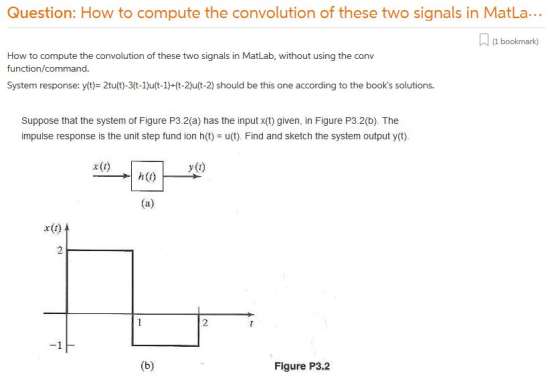
Question: How to compute the convolution of these two...
9. MATLAB Problem: Use Matlab to find the convolution y(t) of f(t)2tu(t) and h(t) ut1u(t-1). You ...
 9. MATLAB Problem: Use Matlab to find the convolution y(t) of f(t)2tu(t) and h(t) ut1u(t-1). You should submit a printout of the matlab code as an m-file with comments (using %) explaining the role of each line. You should also submit a plot ofy(t) for-l sts 4. You may find Computer Example C2.4 on page 137 useful EXAMPLE FROM BOOK IS BELOW. System Response to External Input: The Zero-Sta 2.4 QComputer Example C2.4 Find c(t) = f(t) * g(t) for...
Help please! Problem No. P1: Convolution Below is a Matlab code for performing convolution of two...
 Help please!
Problem No. P1: Convolution Below is a Matlab code for performing convolution of two sequences. function [y,ny] conv m(x,nx,h,nh) % Modified convolution routine for signal processing [y,ny] convolution result x,nx] first signal Dh,nh] second signal nyb nx(1)+nh(1); nye nx(length(x)) y-conv (x,h); Use the code to perform convolution of r) 1.2,3,4 and h( 3.2,1 nh (length(h));
Help please!
Problem No. P1: Convolution Below is a Matlab code for performing convolution of two sequences. function [y,ny] conv m(x,nx,h,nh) % Modified convolution routine for signal processing [y,ny] convolution result x,nx] first signal Dh,nh] second signal nyb nx(1)+nh(1); nye nx(length(x)) y-conv (x,h); Use the code to perform convolution of r) 1.2,3,4 and h( 3.2,1 nh (length(h));
A system has an input, x(t) and an impulse response, h(t). Using the convolution integral, find...
 A system has an input, x(t) and an impulse response, h(t). Using
the convolution integral,
find and plot the system output, y(t), for the combination given
below.
x(t) is P3.2(e) and h(t) is P3.2(f).
1/2 cycle of 2 cos at -2. (e)
A system has an input, x(t) and an impulse response, h(t). Using
the convolution integral,
find and plot the system output, y(t), for the combination given
below.
x(t) is P3.2(e) and h(t) is P3.2(f).
1/2 cycle of 2 cos at -2. (e)
Please provide MATLAB code and plot, about system response. Will thumbs up. Thanks. Question 1: MATLAB contains a built-...
 Please provide MATLAB code and plot, about system response. Will
thumbs up. Thanks.
Question 1: MATLAB contains a built-in function called conv which performs the convolution of two vectors: >> help conv conv Convolution and polynomial multiplication. C - conv(A, B) convolves vectors A and B. The resulting vector is length MAX ([LENGTH (A)+LENGTH (B)-1, LENGTH(A),LENGTH (B) 1) If A and B are vectors of polynomial coefficients, convolving them is equivalent to multiplying the two polynomials. Compute the system response...
Please provide MATLAB code and plot, about system response. Will
thumbs up. Thanks.
Question 1: MATLAB contains a built-in function called conv which performs the convolution of two vectors: >> help conv conv Convolution and polynomial multiplication. C - conv(A, B) convolves vectors A and B. The resulting vector is length MAX ([LENGTH (A)+LENGTH (B)-1, LENGTH(A),LENGTH (B) 1) If A and B are vectors of polynomial coefficients, convolving them is equivalent to multiplying the two polynomials. Compute the system response...
CONVOLUTION - Questions 4 and 5 4. Consider an LTI system with an impulse response h(n)...
 CONVOLUTION - Questions 4 and 5 4. Consider an LTI system with an impulse response h(n) = [1 2 1] for 0 <n<2. If the input to the system is x(n) = u(n)-un-2) where u(n) is the unit-step, calculate the output of the system y(n) analytically. Check your answer using the "conv" function in MATLAB. 5. Consider an LTI system with an impulse response h(n) = u(n) where u(n) is the unit-step. (a) If the input to the system is...
Analytically solve for the response y[t] of the system h[t]=2e‐10t for a pulse input x[t] of...
Analytically solve for the response y[t] of the system h[t]=2e‐10t for a pulse input x[t] of width 1, 10 or 100 msec with its amplitude such that its width times its amplitude is equal to .1 a.) For each pulse, solve assuming it is an ideal impulse (i.e. use convolution integral) b.) solve not making this assumption (i.e. use convolution integral). c. ) Plot your results Matlab and also calculate the response using the conv command in Matlab.
Use MATLAB to compute the convolution as a sum ofechoes of the input signal x[n] = cos () with th...
 Use MATLAB to compute the convolution as a sum ofechoes of the input signal x[n] = cos () with the impulse response h[n]1.5un un - 6]) of an LTI system S. Is the output periodic? Why or why not? Please explain.
Use MATLAB to compute the convolution as a sum ofechoes of the input signal x[n] = cos () with the impulse response h[n]1.5un un - 6]) of an LTI system S. Is the output periodic? Why or why not?...
Use MATLAB to compute the convolution as a sum ofechoes of the input signal x[n] = cos () with the impulse response h[n]1.5un un - 6]) of an LTI system S. Is the output periodic? Why or why not? Please explain.
Use MATLAB to compute the convolution as a sum ofechoes of the input signal x[n] = cos () with the impulse response h[n]1.5un un - 6]) of an LTI system S. Is the output periodic? Why or why not?...
I need help with this MATLAB exercise. The given system is y[n] - (3/10)y[n-1] - (1/10)y[n-2]...
 I need help with this MATLAB exercise.
The given system is y[n] - (3/10)y[n-1] - (1/10)y[n-2] =
2x[n]
The input x[n] is 2cos(2*pi*n/6)(u[n] - u[n-10])
Don't have to answer part 2 of the question.
Zero-state response of a system can be found by using convolution of the input signal and unit impulse response: Use conv command from MATLAB to compute the zero-state response of the system defined in part B to the input x[n] in part C. 1. 2. 3....
I need help with this MATLAB exercise.
The given system is y[n] - (3/10)y[n-1] - (1/10)y[n-2] =
2x[n]
The input x[n] is 2cos(2*pi*n/6)(u[n] - u[n-10])
Don't have to answer part 2 of the question.
Zero-state response of a system can be found by using convolution of the input signal and unit impulse response: Use conv command from MATLAB to compute the zero-state response of the system defined in part B to the input x[n] in part C. 1. 2. 3....
Q4. Consider the two sequences x [n] = [0 otherwise h[n] = {00 otherwise α>1 calculate the convol...
 Q4. Consider the two sequences x [n] = [0 otherwise h[n] = {00 otherwise α>1 calculate the convolution of two signals. Q5. Consider an L'TI system with input x (o] and impulse response h (o] specified as follows. x [n] = 2"u [-n] h [n] -u [n] Find the output y [n] using convolution sum.
Q4. Consider the two sequences x [n] = [0 otherwise h[n] = {00 otherwise α>1 calculate the convolution of two signals. Q5. Consider an L'TI...
Q4. Consider the two sequences x [n] = [0 otherwise h[n] = {00 otherwise α>1 calculate the convolution of two signals. Q5. Consider an L'TI system with input x (o] and impulse response h (o] specified as follows. x [n] = 2"u [-n] h [n] -u [n] Find the output y [n] using convolution sum.
Q4. Consider the two sequences x [n] = [0 otherwise h[n] = {00 otherwise α>1 calculate the convolution of two signals. Q5. Consider an L'TI...
please write code in MATLAB as well 5. (12 points) Create the following signal in Matlab:...
 please write code in MATLAB as well
5. (12 points) Create the following signal in Matlab: x[n] = u(n) - u[n-6] a. Mathematically compute yi[n] = x[n] * x[n] where * means convolution. Now use the conv command to perform the convolution. Graph x[n) and the resulting y(n), both over the interval Osns 20. How many non-zero terms does y(n) have? Does your computational result agree with the Matlab result? b. Repeat a. but this time with yz[n] = x[n]*h[n)...
please write code in MATLAB as well
5. (12 points) Create the following signal in Matlab: x[n] = u(n) - u[n-6] a. Mathematically compute yi[n] = x[n] * x[n] where * means convolution. Now use the conv command to perform the convolution. Graph x[n) and the resulting y(n), both over the interval Osns 20. How many non-zero terms does y(n) have? Does your computational result agree with the Matlab result? b. Repeat a. but this time with yz[n] = x[n]*h[n)...
 9. MATLAB Problem: Use Matlab to find the convolution y(t) of f(t)2tu(t) and h(t) ut1u(t-1). You should submit a printout of the matlab code as an m-file with comments (using %) explaining the role of each line. You should also submit a plot ofy(t) for-l sts 4. You may find Computer Example C2.4 on page 137 useful EXAMPLE FROM BOOK IS BELOW. System Response to External Input: The Zero-Sta 2.4 QComputer Example C2.4 Find c(t) = f(t) * g(t) for...
 Help please!
Problem No. P1: Convolution Below is a Matlab code for performing convolution of two sequences. function [y,ny] conv m(x,nx,h,nh) % Modified convolution routine for signal processing [y,ny] convolution result x,nx] first signal Dh,nh] second signal nyb nx(1)+nh(1); nye nx(length(x)) y-conv (x,h); Use the code to perform convolution of r) 1.2,3,4 and h( 3.2,1 nh (length(h));
Help please!
Problem No. P1: Convolution Below is a Matlab code for performing convolution of two sequences. function [y,ny] conv m(x,nx,h,nh) % Modified convolution routine for signal processing [y,ny] convolution result x,nx] first signal Dh,nh] second signal nyb nx(1)+nh(1); nye nx(length(x)) y-conv (x,h); Use the code to perform convolution of r) 1.2,3,4 and h( 3.2,1 nh (length(h));
 A system has an input, x(t) and an impulse response, h(t). Using
the convolution integral,
find and plot the system output, y(t), for the combination given
below.
x(t) is P3.2(e) and h(t) is P3.2(f).
1/2 cycle of 2 cos at -2. (e)
A system has an input, x(t) and an impulse response, h(t). Using
the convolution integral,
find and plot the system output, y(t), for the combination given
below.
x(t) is P3.2(e) and h(t) is P3.2(f).
1/2 cycle of 2 cos at -2. (e)
 Please provide MATLAB code and plot, about system response. Will
thumbs up. Thanks.
Question 1: MATLAB contains a built-in function called conv which performs the convolution of two vectors: >> help conv conv Convolution and polynomial multiplication. C - conv(A, B) convolves vectors A and B. The resulting vector is length MAX ([LENGTH (A)+LENGTH (B)-1, LENGTH(A),LENGTH (B) 1) If A and B are vectors of polynomial coefficients, convolving them is equivalent to multiplying the two polynomials. Compute the system response...
Please provide MATLAB code and plot, about system response. Will
thumbs up. Thanks.
Question 1: MATLAB contains a built-in function called conv which performs the convolution of two vectors: >> help conv conv Convolution and polynomial multiplication. C - conv(A, B) convolves vectors A and B. The resulting vector is length MAX ([LENGTH (A)+LENGTH (B)-1, LENGTH(A),LENGTH (B) 1) If A and B are vectors of polynomial coefficients, convolving them is equivalent to multiplying the two polynomials. Compute the system response...
 CONVOLUTION - Questions 4 and 5 4. Consider an LTI system with an impulse response h(n) = [1 2 1] for 0 <n<2. If the input to the system is x(n) = u(n)-un-2) where u(n) is the unit-step, calculate the output of the system y(n) analytically. Check your answer using the "conv" function in MATLAB. 5. Consider an LTI system with an impulse response h(n) = u(n) where u(n) is the unit-step. (a) If the input to the system is...
 Use MATLAB to compute the convolution as a sum ofechoes of the input signal x[n] = cos () with the impulse response h[n]1.5un un - 6]) of an LTI system S. Is the output periodic? Why or why not? Please explain.
Use MATLAB to compute the convolution as a sum ofechoes of the input signal x[n] = cos () with the impulse response h[n]1.5un un - 6]) of an LTI system S. Is the output periodic? Why or why not?...
Use MATLAB to compute the convolution as a sum ofechoes of the input signal x[n] = cos () with the impulse response h[n]1.5un un - 6]) of an LTI system S. Is the output periodic? Why or why not? Please explain.
Use MATLAB to compute the convolution as a sum ofechoes of the input signal x[n] = cos () with the impulse response h[n]1.5un un - 6]) of an LTI system S. Is the output periodic? Why or why not?...
 I need help with this MATLAB exercise.
The given system is y[n] - (3/10)y[n-1] - (1/10)y[n-2] =
2x[n]
The input x[n] is 2cos(2*pi*n/6)(u[n] - u[n-10])
Don't have to answer part 2 of the question.
Zero-state response of a system can be found by using convolution of the input signal and unit impulse response: Use conv command from MATLAB to compute the zero-state response of the system defined in part B to the input x[n] in part C. 1. 2. 3....
I need help with this MATLAB exercise.
The given system is y[n] - (3/10)y[n-1] - (1/10)y[n-2] =
2x[n]
The input x[n] is 2cos(2*pi*n/6)(u[n] - u[n-10])
Don't have to answer part 2 of the question.
Zero-state response of a system can be found by using convolution of the input signal and unit impulse response: Use conv command from MATLAB to compute the zero-state response of the system defined in part B to the input x[n] in part C. 1. 2. 3....
 Q4. Consider the two sequences x [n] = [0 otherwise h[n] = {00 otherwise α>1 calculate the convolution of two signals. Q5. Consider an L'TI system with input x (o] and impulse response h (o] specified as follows. x [n] = 2"u [-n] h [n] -u [n] Find the output y [n] using convolution sum.
Q4. Consider the two sequences x [n] = [0 otherwise h[n] = {00 otherwise α>1 calculate the convolution of two signals. Q5. Consider an L'TI...
Q4. Consider the two sequences x [n] = [0 otherwise h[n] = {00 otherwise α>1 calculate the convolution of two signals. Q5. Consider an L'TI system with input x (o] and impulse response h (o] specified as follows. x [n] = 2"u [-n] h [n] -u [n] Find the output y [n] using convolution sum.
Q4. Consider the two sequences x [n] = [0 otherwise h[n] = {00 otherwise α>1 calculate the convolution of two signals. Q5. Consider an L'TI...
 please write code in MATLAB as well
5. (12 points) Create the following signal in Matlab: x[n] = u(n) - u[n-6] a. Mathematically compute yi[n] = x[n] * x[n] where * means convolution. Now use the conv command to perform the convolution. Graph x[n) and the resulting y(n), both over the interval Osns 20. How many non-zero terms does y(n) have? Does your computational result agree with the Matlab result? b. Repeat a. but this time with yz[n] = x[n]*h[n)...
please write code in MATLAB as well
5. (12 points) Create the following signal in Matlab: x[n] = u(n) - u[n-6] a. Mathematically compute yi[n] = x[n] * x[n] where * means convolution. Now use the conv command to perform the convolution. Graph x[n) and the resulting y(n), both over the interval Osns 20. How many non-zero terms does y(n) have? Does your computational result agree with the Matlab result? b. Repeat a. but this time with yz[n] = x[n]*h[n)...
Most questions answered within 3 hours.
-
Where is the error in this code sequence?
String s1 = "Hello";
String s2 = "ello";...
asked 11 months ago -
Financial data for Joel de Paris, Inc., for last year
follow:
Joel de Paris, Inc.
Balance...
asked 11 months ago -
Consider this reaction:
Al2(SO4)3 (aq)+ BaCl3
(aq) Al2Cl6 (aq)- +
3BaSO4(s) . What is the...
asked 11 months ago -
Suppose that Savneet is considering increasing her
recent random sample from 20 car rentals to 40...
asked 11 months ago -
Trucks arrive at an unloading terminal at an average rate of 120
per hour.
Trucks arrive...
asked 11 months ago -
Why are methanol and ethanol completely soluble in water while
octanol is not very little soluble....
asked 11 months ago -
A facilities manager at a university reads in a research report
that the mean amount of...
asked 11 months ago -
When the CuSO4 is rehydrated by adding water to the anhydrous
compound, is this an endothermic...
asked 11 months ago -
A ray of sunlight is passing from diamond into crown glass; the
angle of incidence is...
asked 11 months ago -
A block of mass 0.249 kg is placed on top of a light, vertical
spring of...
asked 11 months ago -
how do the kidneys compensate in the presences of acidosis
a) trigger hyperventilate
b) reserve acid...
asked 11 months ago -
Question 501 pts
The rental rate of capital to the firm increases. Which of the
following...
asked 11 months ago