Analytically solve for the response y[t] of the system h[t]=2e‐10t for a pulse input x[t] of...
Analytically solve for the response y[t] of the system h[t]=2e‐10t for a pulse input x[t] of width 1, 10 or 100 msec with its amplitude such that its width times its amplitude is equal to .1
a.) For each pulse, solve assuming it is an ideal impulse (i.e. use convolution integral)
b.) solve not making this assumption (i.e. use convolution integral).
c. ) Plot your results Matlab and also calculate the response using the conv command in Matlab.
Homework Answers
Script:
clc;close all;clear all;
%solution without the assumption
%For pulse width 1msec
T=0.001;TT=5*T;
t=0:TT/500:TT;
h=5*(exp(-20*t));
x=0.1.*T*(t>=0);
y=conv(x,h);
m=0:TT/500:2*TT;
subplot(221)
plot(m,y);grid;xlabel('t');ylabel('y(t)')
title('Pulse width T=1ms')
%For pulse width 10msec
T=0.01;TT=5*T;
t=0:TT/500:TT;
h=5*(exp(-20*t));
x=0.1.*T*(t>=0);
y=conv(x,h);
m=0:TT/500:2*TT;
subplot(222)
plot(m,y);grid;xlabel('t');ylabel('y(t)')
title('Pulse width T=10ms')
%For pulse width 100msec
T=0.1;TT=5*T;
t=0:TT/500:TT;
h=5*(exp(-20*t));
x=0.1.*T*(t>=0);
y=conv(x,h);
m=0:TT/500:2*TT;
subplot(223)
plot(m,y);grid;xlabel('t');ylabel('y(t)')
title('Pulse width T=100ms')
Plot:
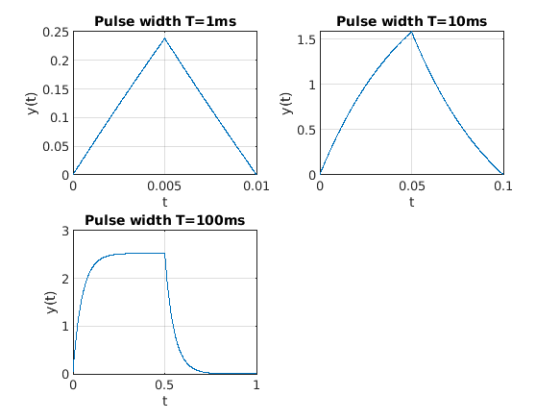
Script
clc;close all;clear all;
%solution with the assumption as impulse input
%For 1msec
T=0.001;TT=5*T;
t=0:TT/500:TT;
h=5*(exp(-20*t));
x=0.1.*T*(t==T);
y=conv(x,h);
m=0:TT/500:2*TT;
subplot(221)
plot(m,y);grid;xlabel('t');ylabel('y(t)')
title('T=1ms')
%For10msec
T=0.01;TT=5*T;
t=0:TT/500:TT;
h=5*(exp(-20*t));
x=0.1.*T*(t==T);
y=conv(x,h);
m=0:TT/500:2*TT;
subplot(222)
plot(m,y);grid;xlabel('t');ylabel('y(t)')
title('T=10ms')
%For100msec
T=0.1;TT=5*T;
t=0:TT/500:TT;
h=5*(exp(-20*t));
x=0.1.*T*(t==T);
y=conv(x,h);
m=0:TT/500:2*TT;
subplot(223)
plot(m,y);grid;xlabel('t');ylabel('y(t)')
title('T=100ms')
Plot:
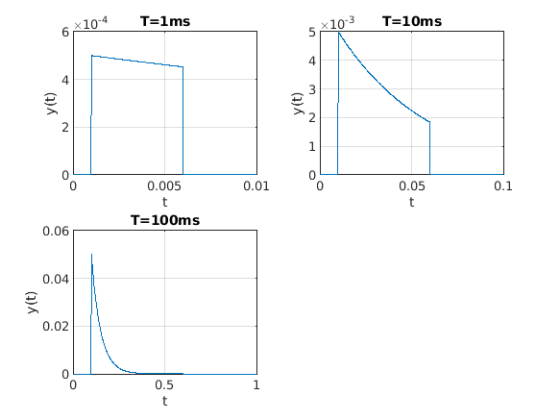
Add Answer to:
Analytically solve for the response y[t] of the system
h[t]=2e‐10t for a pulse input x[t] of...
(1) For the impulse response (h(t)) and input signal (x(t)) of an LTI system shown below,...
 (1) For the impulse response (h(t)) and input signal (x(t)) of an LTI system shown below, find and plot the output response (y(t)) by integrating the convolution analytically h(t) x(t) t (s)
CONVOLUTION - Questions 4 and 5 4. Consider an LTI system with an impulse response h(n)...
 CONVOLUTION - Questions 4 and 5 4. Consider an LTI system with an impulse response h(n) = [1 2 1] for 0 <n<2. If the input to the system is x(n) = u(n)-un-2) where u(n) is the unit-step, calculate the output of the system y(n) analytically. Check your answer using the "conv" function in MATLAB. 5. Consider an LTI system with an impulse response h(n) = u(n) where u(n) is the unit-step. (a) If the input to the system is...
A system has an input, x(t) and an impulse response, h(t). Using the convolution integral, find...
 A system has an input, x(t) and an impulse response, h(t). Using
the convolution integral,
find and plot the system output, y(t), for the combination given
below.
x(t) is P3.2(e) and h(t) is P3.2(f).
1/2 cycle of 2 cos at -2. (e)
A system has an input, x(t) and an impulse response, h(t). Using
the convolution integral,
find and plot the system output, y(t), for the combination given
below.
x(t) is P3.2(e) and h(t) is P3.2(f).
1/2 cycle of 2 cos at -2. (e)
4. A linear time invariant system has the following impulse response: h(t) =2e-at u(t) Use convolution...
 4. A linear time invariant system has the following impulse response: h(t) =2e-at u(t) Use convolution to find the response y(t) to the following input: x(t) = u(t)-u(t-4) Sketch y(t) for the case when a = 1
Problem 4. Use the convolution integral to find the response y(t) of the LTI system with...
 Problem 4. Use the convolution integral to find the response y(t) of the LTI system with impulse response h(t) to input x(t) a) x(I)-2expl_2t)u(t) , h(1)-expl-t)u(t)
1. Evaluate and sketch the convolution integral (the output y(t)) for a system with input x(t)...
 1. Evaluate and sketch the convolution integral (the output y(t)) for a system with input x(t) and impulse response h(t), where x(t) = u(1-2) and h(t)= "u(t) u(t) is the unit step function. Please show clearly all the necessary steps of convolution. Determine the values of the output y(t) at 1 = 0,1 = 3,1 = 00. (3 pts)
4. Convolution EX4. The input X(t) and impulse response h(t) for a system are given. Using...
 4. Convolution EX4. The input X(t) and impulse response h(t) for a system are given. Using convolution evaluating the system output y(t). X(t)=1 O<t1 h(t)=sin pi*t 0<<2 =0 else where =0 elsewhere Xit) ↑ hlt) E mer
Consider a continuous-time LTI system S with impulse response h(t) = 2(u(t + 1)-u(t 1)). Determine...
 Consider a continuous-time LTI system S with impulse response h(t) = 2(u(t + 1)-u(t 1)). Determine the values of the amplitude scaling and the tme shifting that takes place when each of the following input signals is provided to the system S. Don't use the convolution integral, instead use the result about how LTI systems respond to complex exponential signals. (a) x(t) 2 (b) x(t) ej0.5Tt (c) x(t) = e-j0.5πt (d) x(t) = e-jmt (e) x(t) = cos (0.5t) (f)...
Problem 4. Convolve the following input X(t) with the system impulse response h(t) and plot the...
 Problem 4. Convolve the following input X(t) with the system impulse response h(t) and plot the system output y(t). h(t) Problem 5. Construct a Bode plot of the input impedance DMM 100nF zin - 300F CM 500 ohms
Problem 4: Evaluation of the convolution integral too y(t) = (f * h)(t) = f(t)h(t –...
 Problem 4: Evaluation of the convolution integral too y(t) = (f * h)(t) = f(t)h(t – 7)dt is greatly simplified when either the input f(t) or impulse response h(t) is the sum of weighted impulse functions. This fact will be used later in the semester when we study the operation of communication systems using Fourier analysis methods. a) Use the convolution integral to prove that f(t) *8(t – T) = f(t – T) and 8(t – T) *h(t) = h(t...
 (1) For the impulse response (h(t)) and input signal (x(t)) of an LTI system shown below, find and plot the output response (y(t)) by integrating the convolution analytically h(t) x(t) t (s)
 CONVOLUTION - Questions 4 and 5 4. Consider an LTI system with an impulse response h(n) = [1 2 1] for 0 <n<2. If the input to the system is x(n) = u(n)-un-2) where u(n) is the unit-step, calculate the output of the system y(n) analytically. Check your answer using the "conv" function in MATLAB. 5. Consider an LTI system with an impulse response h(n) = u(n) where u(n) is the unit-step. (a) If the input to the system is...
 A system has an input, x(t) and an impulse response, h(t). Using
the convolution integral,
find and plot the system output, y(t), for the combination given
below.
x(t) is P3.2(e) and h(t) is P3.2(f).
1/2 cycle of 2 cos at -2. (e)
A system has an input, x(t) and an impulse response, h(t). Using
the convolution integral,
find and plot the system output, y(t), for the combination given
below.
x(t) is P3.2(e) and h(t) is P3.2(f).
1/2 cycle of 2 cos at -2. (e)
 4. A linear time invariant system has the following impulse response: h(t) =2e-at u(t) Use convolution to find the response y(t) to the following input: x(t) = u(t)-u(t-4) Sketch y(t) for the case when a = 1
 Problem 4. Use the convolution integral to find the response y(t) of the LTI system with impulse response h(t) to input x(t) a) x(I)-2expl_2t)u(t) , h(1)-expl-t)u(t)
 1. Evaluate and sketch the convolution integral (the output y(t)) for a system with input x(t) and impulse response h(t), where x(t) = u(1-2) and h(t)= "u(t) u(t) is the unit step function. Please show clearly all the necessary steps of convolution. Determine the values of the output y(t) at 1 = 0,1 = 3,1 = 00. (3 pts)
 4. Convolution EX4. The input X(t) and impulse response h(t) for a system are given. Using convolution evaluating the system output y(t). X(t)=1 O<t1 h(t)=sin pi*t 0<<2 =0 else where =0 elsewhere Xit) ↑ hlt) E mer
 Consider a continuous-time LTI system S with impulse response h(t) = 2(u(t + 1)-u(t 1)). Determine the values of the amplitude scaling and the tme shifting that takes place when each of the following input signals is provided to the system S. Don't use the convolution integral, instead use the result about how LTI systems respond to complex exponential signals. (a) x(t) 2 (b) x(t) ej0.5Tt (c) x(t) = e-j0.5πt (d) x(t) = e-jmt (e) x(t) = cos (0.5t) (f)...
 Problem 4. Convolve the following input X(t) with the system impulse response h(t) and plot the system output y(t). h(t) Problem 5. Construct a Bode plot of the input impedance DMM 100nF zin - 300F CM 500 ohms
 Problem 4: Evaluation of the convolution integral too y(t) = (f * h)(t) = f(t)h(t – 7)dt is greatly simplified when either the input f(t) or impulse response h(t) is the sum of weighted impulse functions. This fact will be used later in the semester when we study the operation of communication systems using Fourier analysis methods. a) Use the convolution integral to prove that f(t) *8(t – T) = f(t – T) and 8(t – T) *h(t) = h(t...
Most questions answered within 3 hours.
-
Where is the error in this code sequence?
String s1 = "Hello";
String s2 = "ello";...
asked 10 months ago -
Financial data for Joel de Paris, Inc., for last year
follow:
Joel de Paris, Inc.
Balance...
asked 10 months ago -
Consider this reaction:
Al2(SO4)3 (aq)+ BaCl3
(aq) Al2Cl6 (aq)- +
3BaSO4(s) . What is the...
asked 10 months ago -
Suppose that Savneet is considering increasing her
recent random sample from 20 car rentals to 40...
asked 10 months ago -
Trucks arrive at an unloading terminal at an average rate of 120
per hour.
Trucks arrive...
asked 10 months ago -
Why are methanol and ethanol completely soluble in water while
octanol is not very little soluble....
asked 10 months ago -
A facilities manager at a university reads in a research report
that the mean amount of...
asked 10 months ago -
When the CuSO4 is rehydrated by adding water to the anhydrous
compound, is this an endothermic...
asked 10 months ago -
A ray of sunlight is passing from diamond into crown glass; the
angle of incidence is...
asked 10 months ago -
A block of mass 0.249 kg is placed on top of a light, vertical
spring of...
asked 10 months ago -
how do the kidneys compensate in the presences of acidosis
a) trigger hyperventilate
b) reserve acid...
asked 10 months ago -
Question 501 pts
The rental rate of capital to the firm increases. Which of the
following...
asked 10 months ago