Suppose a firm the firm's initial costs when hiring a worker include hiring and training costs...
Suppose a firm the firm's initial costs when hiring a worker include hiring and training costs of $50. The wage rate for each period of employment is Wt=$100 (the same for all periods), and the value marginal product of a worker is also the same in every period, VMPt=VMP (a constant). Assume the interest rate is zero (the firm has no discounting factor over time).
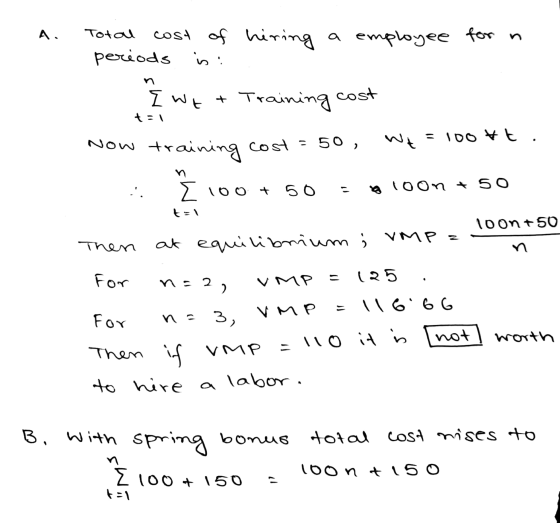
A. Write out this firm's profit maximizing employment rule for two periods. How productive must a worker be each period in order for the firm to hire a worker expected to work 2 periods: VMP = . If VMP=110 is it worth it to hire a worker for 3 periods? (yes/no)
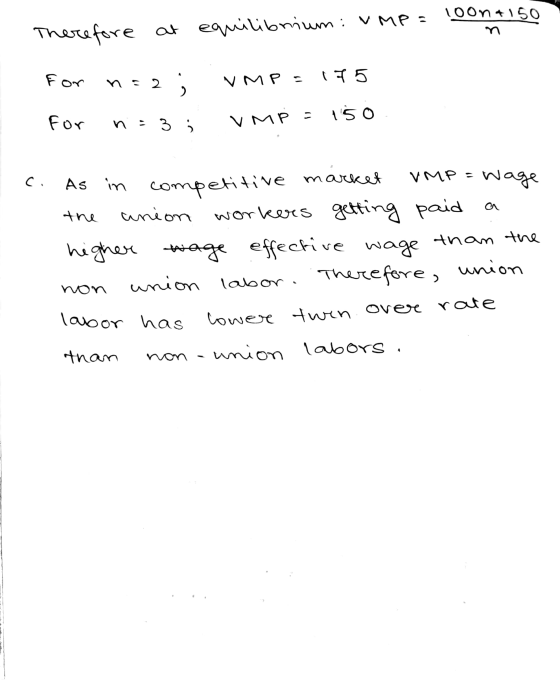
B. Now suppose that the union negotiates a signing bonus of $100 which the firm must pay initially (in addition to the hiring and training costs) when it hires a worker. Write out the new profit maximizing employment rule for two periods. How productive must a worker be each period in order for the firm to hire a worker expected to work 2 periods: VMP = . In order for the firm to hire a worker for 3 periods, a worker's productivity in each period must be VMP = .
C. Explain how this might relate to the observation that unionized workers have lower turnover rates.
Homework Answers
Add Answer to:
Suppose a firm the
firm's initial costs when hiring a worker include hiring and
training costs...
To maximize profit, a firm will hire workers when the in revenue from hiring an additional worker the worker's wage. O increase; is greater than O decrease; is less than or equal to O increase; i...
 To maximize profit, a firm will hire workers when the in revenue from hiring an additional worker the worker's wage. O increase; is greater than O decrease; is less than or equal to O increase; is less than or equal to O decrease, is greater than
To maximize profit, a firm will hire workers when the in revenue from hiring an additional worker the worker's wage. O increase; is greater than O decrease; is less than or equal to O...
To maximize profit, a firm will hire workers when the in revenue from hiring an additional worker the worker's wage. O increase; is greater than O decrease; is less than or equal to O increase; is less than or equal to O decrease, is greater than
To maximize profit, a firm will hire workers when the in revenue from hiring an additional worker the worker's wage. O increase; is greater than O decrease; is less than or equal to O...
38.)If the last worker employed ($10/hour) produces 50 additional units of output per hour and the...
38.)If the last worker employed ($10/hour) produces 50 additional units of output per hour and the last unit of capital employed ($500/hour) produces 2,500 units of output per hour, how can the firm minimize the cost of its current output? a.)hire more labor and less capital b.)hire more capital and less labor c.)hire more labor and capital d.)hire less labor and capital e.)maintain current employment levels of labor and capital 39.)The least-cost hiring rule states that costs are minimized when...
1. Suppose a firm’s cost of hiring another worker is $100. The firm pays an hourly...
1. Suppose a firm’s cost of hiring another worker is $100. The firm pays an hourly wage of $15 to all workers. Each additional worker adds 100 units to total production, holding constant capital and average hours per worker. If a current worker works an additional hour, holding constant capital and the number of employees, total production increases by 8. The firm faces diminishing marginal returns to workers and to hours per worker. A. Is the firm maximizing profits? Why...
Consider a competitive firm that produces bots. Labor (L) and capital (K) are the only two...
 Consider a competitive firm that produces bots. Labor (L) and capital (K) are the only two inputs of production; each unit of labor is paid the market wage (w), and each unit of capital is rented at the rental price of capital (r). Output (Y) is therefore a function of labor and capital, or Y = f (K, L), and is sold at the market price (P). The goal of this firm is to maximize profit given the price of...
4. cosider a firm that produces a certain good. The demand is uncertain. There is 50%...
 4. cosider a firm that produces a certain good. The demand is uncertain. There is 50% chance the demand is high, and 50% chance the demand is low. When the demand is high, its demand for labor is w- 12 -0.5L. When the demand is low, its demand for labor is w 8 - 0.5L. Here uw is wage for each worker and L is the total number of workers it hires. When the demand is high, the profit of...
4. cosider a firm that produces a certain good. The demand is uncertain. There is 50%...
 4. cosider a firm that produces a certain good. The demand is uncertain. There is 50% chance the demand is high, and 50% chance the demand is low. When the demand is high, its demand for labor is w- 12 -0.5L. When the demand is low, its demand for labor is w 8 - 0.5L. Here uw is wage for each worker and L is the total number of workers it hires. When the demand is high, the profit of...
4. Cosider a firm that produces a certain good. The demand is uncertain. There is 50%...
 4. Cosider a firm that produces a certain good. The demand is uncertain. There is 50% chance the demand is high, and 50% chance the demand is low. When the demand is high, its demand for labor is w 12-0.5L. When the demand is low, its demand for labor is w 8-0.5L. Here w is wage for each worker and L is the total number of workers it hires. When the demand is high, the profit of the firm can...
please briefly explain any answers thanks! Suppose that low-skilled workers employed in clearing woodland can each...
 please briefly explain any answers thanks!
Suppose that low-skilled workers employed in clearing woodland can each clear one acre per month if each is equipped with a shovel. a machete, and a chainsaw. Clearing one acre brings in $1,000 in revenue. Each worker's equipment costs the worker's employer $150 per month to rent and each worker toils 40 hours per week for four weeks each month a. What is the marginal revenue product of hiring one low-skilled worker to clear...
please briefly explain any answers thanks!
Suppose that low-skilled workers employed in clearing woodland can each clear one acre per month if each is equipped with a shovel. a machete, and a chainsaw. Clearing one acre brings in $1,000 in revenue. Each worker's equipment costs the worker's employer $150 per month to rent and each worker toils 40 hours per week for four weeks each month a. What is the marginal revenue product of hiring one low-skilled worker to clear...
The labor demand curve shows how many workers the firm is willing to hire A. at...
The labor demand curve shows how many workers the firm is willing to hire A. at any particular time. B. at a particular amount of labor supplied. C. at any given wage. D. into high-skill jobs. E. when demand for the firm's output is low. In part labor economics concerns: A. How labor markets work. B. The study of education decisions C. The study of how households decide where to live. D. The study of income inequality. E. All of...
Suppose that a firm manufactures wallets. The firm's fixed cost is $102,972, and the variable cost...
Suppose that a firm manufactures wallets. The firm's fixed cost is $102,972, and the variable cost is $3 per wallet. If each wallet sells for $71, how many wallets need to be sold in order for the firm's profit to be $54,104?
 To maximize profit, a firm will hire workers when the in revenue from hiring an additional worker the worker's wage. O increase; is greater than O decrease; is less than or equal to O increase; is less than or equal to O decrease, is greater than
To maximize profit, a firm will hire workers when the in revenue from hiring an additional worker the worker's wage. O increase; is greater than O decrease; is less than or equal to O...
To maximize profit, a firm will hire workers when the in revenue from hiring an additional worker the worker's wage. O increase; is greater than O decrease; is less than or equal to O increase; is less than or equal to O decrease, is greater than
To maximize profit, a firm will hire workers when the in revenue from hiring an additional worker the worker's wage. O increase; is greater than O decrease; is less than or equal to O...
 Consider a competitive firm that produces bots. Labor (L) and capital (K) are the only two inputs of production; each unit of labor is paid the market wage (w), and each unit of capital is rented at the rental price of capital (r). Output (Y) is therefore a function of labor and capital, or Y = f (K, L), and is sold at the market price (P). The goal of this firm is to maximize profit given the price of...
 4. cosider a firm that produces a certain good. The demand is uncertain. There is 50% chance the demand is high, and 50% chance the demand is low. When the demand is high, its demand for labor is w- 12 -0.5L. When the demand is low, its demand for labor is w 8 - 0.5L. Here uw is wage for each worker and L is the total number of workers it hires. When the demand is high, the profit of...
 4. cosider a firm that produces a certain good. The demand is uncertain. There is 50% chance the demand is high, and 50% chance the demand is low. When the demand is high, its demand for labor is w- 12 -0.5L. When the demand is low, its demand for labor is w 8 - 0.5L. Here uw is wage for each worker and L is the total number of workers it hires. When the demand is high, the profit of...
 4. Cosider a firm that produces a certain good. The demand is uncertain. There is 50% chance the demand is high, and 50% chance the demand is low. When the demand is high, its demand for labor is w 12-0.5L. When the demand is low, its demand for labor is w 8-0.5L. Here w is wage for each worker and L is the total number of workers it hires. When the demand is high, the profit of the firm can...
 please briefly explain any answers thanks!
Suppose that low-skilled workers employed in clearing woodland can each clear one acre per month if each is equipped with a shovel. a machete, and a chainsaw. Clearing one acre brings in $1,000 in revenue. Each worker's equipment costs the worker's employer $150 per month to rent and each worker toils 40 hours per week for four weeks each month a. What is the marginal revenue product of hiring one low-skilled worker to clear...
please briefly explain any answers thanks!
Suppose that low-skilled workers employed in clearing woodland can each clear one acre per month if each is equipped with a shovel. a machete, and a chainsaw. Clearing one acre brings in $1,000 in revenue. Each worker's equipment costs the worker's employer $150 per month to rent and each worker toils 40 hours per week for four weeks each month a. What is the marginal revenue product of hiring one low-skilled worker to clear...
Most questions answered within 3 hours.
-
Where is the error in this code sequence?
String s1 = "Hello";
String s2 = "ello";...
asked 10 months ago -
Financial data for Joel de Paris, Inc., for last year
follow:
Joel de Paris, Inc.
Balance...
asked 10 months ago -
Consider this reaction:
Al2(SO4)3 (aq)+ BaCl3
(aq) Al2Cl6 (aq)- +
3BaSO4(s) . What is the...
asked 10 months ago -
Suppose that Savneet is considering increasing her
recent random sample from 20 car rentals to 40...
asked 10 months ago -
Trucks arrive at an unloading terminal at an average rate of 120
per hour.
Trucks arrive...
asked 10 months ago -
Why are methanol and ethanol completely soluble in water while
octanol is not very little soluble....
asked 10 months ago -
A facilities manager at a university reads in a research report
that the mean amount of...
asked 10 months ago -
When the CuSO4 is rehydrated by adding water to the anhydrous
compound, is this an endothermic...
asked 10 months ago -
A ray of sunlight is passing from diamond into crown glass; the
angle of incidence is...
asked 10 months ago -
A block of mass 0.249 kg is placed on top of a light, vertical
spring of...
asked 10 months ago -
how do the kidneys compensate in the presences of acidosis
a) trigger hyperventilate
b) reserve acid...
asked 10 months ago -
Question 501 pts
The rental rate of capital to the firm increases. Which of the
following...
asked 10 months ago