A block of mass m is placed against the vertical front of a cart of mass M as shown in the figure. (Figure 1)
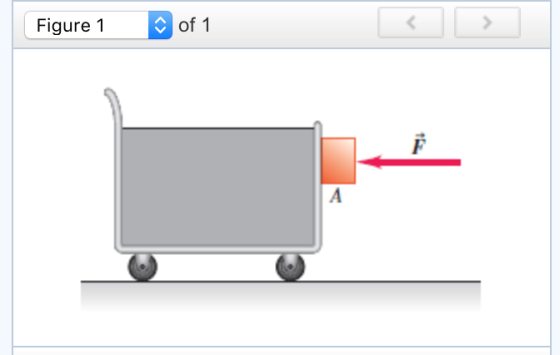
Assume that the cart is free to roll without friction and that the coefficient of static friction between the block and the cart is μs. Derive an expression for the minimum horizontal force that must be applied to the block in order to keep it from falling to the ground.
Express your answer in terms of m, M, μs, and g.
Homework Answers

Add Answer to:
A block of mass m is placed against the vertical front of a cart
of mass...
Help please A block of mass m is placed against the vertical facet of mass M...
 Help please
A block of mass m is placed against the vertical facet of mass M as shown in the figure. Assume that the cart is free without friction and that the coefficients of static Express your answer in terms of M mu and g.
Help please
A block of mass m is placed against the vertical facet of mass M as shown in the figure. Assume that the cart is free without friction and that the coefficients of static Express your answer in terms of M mu and g.
The left-hand end of a slender uniform rod of mass m is placed against a vertical...
The left-hand end of a slender uniform rod of mass m is placed against a vertical wall. The rod is held in a horizontal position by friction at the wall and by a light wire that runs from the right-hand end of the rod to a point on the wall above the rod. The wire makes an angle θ with the rod. a)What must the magnitude of the friction force be in order for the rod to remain at rest?...
Block A with mass m is placed on a block B with mass M (Figure 1)....
 Block A with mass m is placed on a block B with mass M (Figure 1). The coefficient of static friction between the two blocks surfaces is mu_s. Block B is on a frictionless, horizontal surface. Find the minimal horizontal force F rightarrow necessary to be applied to block B to make block A starting sliding on block B. Include the free-body diagrams you used to determine your answer and explain in detail each reasoning you followed to solve the...
1 You pin a 0.15 kg block against a vertical wall applying a horizontal force. If...
 1 You pin a 0.15 kg block against a vertical wall applying a horizontal force. If the coefficient of static friction between the block & the wall in 0.82, then what is the minimum magnitude of the applied force such that the block will not slide? a) 8.IN b) 8.4 N C) 679 d) 9.0N e) 9.3N
One end of a uniform meter stick is placed against a vertical wall as shown in...
 One end of a uniform meter stick is placed against a vertical wall as shown in (Figure 1). The other end is held by a lightweight cord that makes an angle with the stick. The coefficient of static friction between the end of the meter stick and the wall is 0.36. Figure 2 of 2 > Let the angle between the cord and the stick is = 18°. A block of the same weight as the meter stick is suspended...
A 10 kg block is pushed against a vertical wall by a horizontal force of 100...
 A 10 kg block is pushed against a vertical wall by a
horizontal force of 100 N as shown in the figure the coefficient of
static friction between the block and the wall is 0.60 and the
coefficient of kinetic friction is 0.40 which of the following
statements is true if the block is initially at rest
1) The block slides down the wall with an acceleration of magnitude 3.8 m/s2 The block will slide down the wall because the...
A 10 kg block is pushed against a vertical wall by a
horizontal force of 100 N as shown in the figure the coefficient of
static friction between the block and the wall is 0.60 and the
coefficient of kinetic friction is 0.40 which of the following
statements is true if the block is initially at rest
1) The block slides down the wall with an acceleration of magnitude 3.8 m/s2 The block will slide down the wall because the...
A block of mass “m” sits on a (bigger) block of mass “4m” that is on...
A block of mass “m” sits on a (bigger) block of mass “4m” that is on a frictionless table. The coefficients of friction between the two blocks are μs (static) and μk (kinetic). Assume that a horizontal force “F” is applied to the block on top (i.e. the smaller block with mass “m”). The force “F” is variable. The figure below is representative of this scenario. (You may use m = 10 kg, μs = 0.8, μk = 0.6, and...
A block with mass m1 = 9.4 kg is on an incline with an angle θ = 26° with respect to the horizontal
 A block with mass m1 = 9.4 kg is on an incline with an angle θ = 26° with respect to the horizontal. For the first question there is no friction, but for the rest of this problem the coefficients of friction are: μk = 0.24 and μs = 0.264. 1) When there is no friction, what is the magnitude of the acceleration of the block? 2) Now with friction, what is the magnitude of the acceleration of the block after it...
Block A, with mass mA, is initially at rest on a frictionless horizontal floor. Block B,...
Block A, with mass mA, is initially at rest on a frictionless horizontal floor. Block B, with mass mB, is initially at rest on the horizontal top surface of A. The coefficient of static friction between the two blocks is μs. Block A is pulled with a horizontal force. What is the minimum magnitude of the force that causes Block A to slide out from under B? Write the expression in terms of the given variables.
A uniform ladder of length L and mass m leans against a frictionless vertical wall, making...
A uniform ladder of length L and mass m leans against a frictionless vertical wall, making an angle of 49° with the horizontal. The coefficient of static friction between the ladder and the ground is 0.45. If your mass is four times that of the ladder, how high can you climb before the ladder begins to slip?
 Help please
A block of mass m is placed against the vertical facet of mass M as shown in the figure. Assume that the cart is free without friction and that the coefficients of static Express your answer in terms of M mu and g.
Help please
A block of mass m is placed against the vertical facet of mass M as shown in the figure. Assume that the cart is free without friction and that the coefficients of static Express your answer in terms of M mu and g.
 Block A with mass m is placed on a block B with mass M (Figure 1). The coefficient of static friction between the two blocks surfaces is mu_s. Block B is on a frictionless, horizontal surface. Find the minimal horizontal force F rightarrow necessary to be applied to block B to make block A starting sliding on block B. Include the free-body diagrams you used to determine your answer and explain in detail each reasoning you followed to solve the...
 1 You pin a 0.15 kg block against a vertical wall applying a horizontal force. If the coefficient of static friction between the block & the wall in 0.82, then what is the minimum magnitude of the applied force such that the block will not slide? a) 8.IN b) 8.4 N C) 679 d) 9.0N e) 9.3N
 One end of a uniform meter stick is placed against a vertical wall as shown in (Figure 1). The other end is held by a lightweight cord that makes an angle with the stick. The coefficient of static friction between the end of the meter stick and the wall is 0.36. Figure 2 of 2 > Let the angle between the cord and the stick is = 18°. A block of the same weight as the meter stick is suspended...
 A 10 kg block is pushed against a vertical wall by a
horizontal force of 100 N as shown in the figure the coefficient of
static friction between the block and the wall is 0.60 and the
coefficient of kinetic friction is 0.40 which of the following
statements is true if the block is initially at rest
1) The block slides down the wall with an acceleration of magnitude 3.8 m/s2 The block will slide down the wall because the...
A 10 kg block is pushed against a vertical wall by a
horizontal force of 100 N as shown in the figure the coefficient of
static friction between the block and the wall is 0.60 and the
coefficient of kinetic friction is 0.40 which of the following
statements is true if the block is initially at rest
1) The block slides down the wall with an acceleration of magnitude 3.8 m/s2 The block will slide down the wall because the...
Most questions answered within 3 hours.
-
Where is the error in this code sequence?
String s1 = "Hello";
String s2 = "ello";...
asked 11 months ago -
Financial data for Joel de Paris, Inc., for last year
follow:
Joel de Paris, Inc.
Balance...
asked 11 months ago -
Consider this reaction:
Al2(SO4)3 (aq)+ BaCl3
(aq) Al2Cl6 (aq)- +
3BaSO4(s) . What is the...
asked 11 months ago -
Suppose that Savneet is considering increasing her
recent random sample from 20 car rentals to 40...
asked 11 months ago -
Trucks arrive at an unloading terminal at an average rate of 120
per hour.
Trucks arrive...
asked 11 months ago -
Why are methanol and ethanol completely soluble in water while
octanol is not very little soluble....
asked 11 months ago -
A facilities manager at a university reads in a research report
that the mean amount of...
asked 11 months ago -
When the CuSO4 is rehydrated by adding water to the anhydrous
compound, is this an endothermic...
asked 11 months ago -
A ray of sunlight is passing from diamond into crown glass; the
angle of incidence is...
asked 11 months ago -
A block of mass 0.249 kg is placed on top of a light, vertical
spring of...
asked 11 months ago -
how do the kidneys compensate in the presences of acidosis
a) trigger hyperventilate
b) reserve acid...
asked 11 months ago -
Question 501 pts
The rental rate of capital to the firm increases. Which of the
following...
asked 11 months ago