
Homework Answers
a.
Synapsis and crossing over causes segregation and recombination may occur.
- During meiosis I-prophase I- homologous chromosomes pair up to form tetrad.
- Crossing over occurs during synapsis: Synapsis is alignment of homologous chromosomes, forming tetrad. Crossing over involves exchange of genetic material between non-sister chromatids.
b.
- Primary spermatocytes undergo meiosis I to generate secondary spermatocytes.
- In meiosis I, after cytokinesis, 2 genetically haploid cells are produced, which enter meiosis II.
- Meiosis II to generate spermatids, which form spermatozoa.
- In meiosis II, after cytokinesis, 4 genetically haploid cells are produced.
- Thus, in primary spermatocytes there are diploid number of chromosomes.
- While, after meiosis II, spermatozoa will have haploid number of chromosomes.
c.
- Non-disjunction may occur due to- unable to pair, synapse, or cross-over during prophase of meiosis, failing to align during metaphase, or improper or failure to separate or dis-join during anaphase and telophase.
- In meiosis-I, non-disjunction will be occurring in Anaphase-I, when pairs of homologous chromosomes fail to separate.
- For meiosis –II in anaphase-II, the sister chromatids may not separate.
- Thus, some cells will have more chromosomes (4) than normal and some less (2).
d.
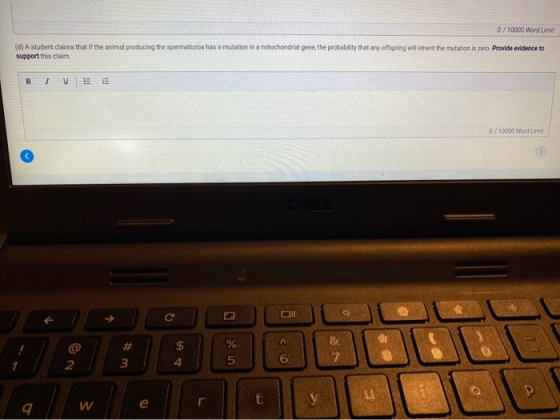
- Mitochondrial genes are transmitted from mother to offspring.
- This is because, mitochondria are inherited from cytoplasm of egg cells.
- Since, only egg cells contribute to mitochondrial inheritance, females can pass mutations in mitochondrial DNA to offspring.
- The mitochondrial disorders may be passed to both males and females but cannot be passed from the father.
- Mitochondrial DNA have high substitution rate and is random,but is majorly related to maternal lineage.
- Thus, spermatozoa being male gamete will not pass mutation in mitochondrial DNA.
Add Answer to:
primary spermatocytes are diploid (2n) cells with all of the
organelles typically found in eukaryotic animal...
Primary spermatocytes are diploid (2n) cells with all of the organelles typically found in eukaryotic animal...
 Primary spermatocytes are diploid (2n) cells with all of the organelles typically found in eukaryotic animal cells. A representation of spermatogenesis from a primary spermatocyte with six chromosomes is shown in Figure 1. Figure 1. A representation of spermatogenesis Primary Spermatocyte Meiosis Secondary Spermatocytes Meiosis II Spermatids Spermatozoa (a) Describe the process in meiosis that ensures that both maternal and paternal chromosomes are passed on to each spermatozoon. (b) Explain why the genetic content of individual chromosomes in a spermatozoon...
Primary spermatocytes are diploid (2n) cells with all of the organelles typically found in eukaryotic animal...
 Primary spermatocytes are diploid (2n) cells with all of the organelles typically found in eukaryotic animal cells. A representation of spermatogenesis from a primary spermatocyte with six chromosomes is shown in Figure 1.
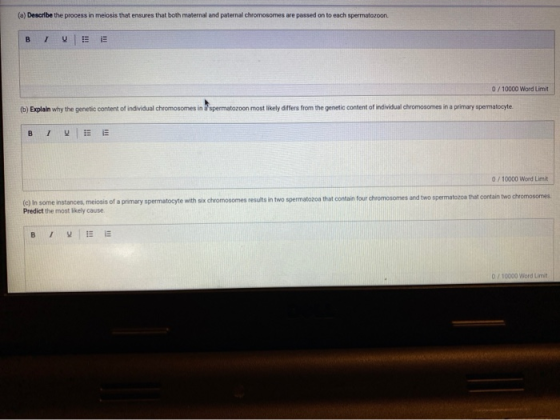
1. Describe the process in meiosis that ensures that both maternal and paternal chromosomes are passed on to each Spermatozoon
2. Explain why the genetic content of individual chromosomes in a spermatozoon most likely differs from the genetic content of individual chromosomes in a primary spermatocyte...
Primary spermatocytes are diploid (2n) cells with all of the organelles typically found in eukaryotic animal cells. A representation of spermatogenesis from a primary spermatocyte with six chromosomes is shown in Figure 1.
1. Describe the process in meiosis that ensures that both maternal and paternal chromosomes are passed on to each Spermatozoon
2. Explain why the genetic content of individual chromosomes in a spermatozoon most likely differs from the genetic content of individual chromosomes in a primary spermatocyte...
Unit 3 Study Resource Meiosis • Process by which diploid cells create haploid cells NOT part...
 Unit 3 Study Resource Meiosis • Process by which diploid cells create haploid cells NOT part of the cell cycle > only some cells ever undergo meiosis During meiosis I, homologous chromosomes line up to allow them to be separated into two new cells o They can become "tangled" during this phase, which leads to crossing-over (rearranging the alleles) O Result of meiosis I is two non-identical haploid cells Meiosis Il looks very similar to mitosis, in that sister chromatids...
 Primary spermatocytes are diploid (2n) cells with all of the organelles typically found in eukaryotic animal cells. A representation of spermatogenesis from a primary spermatocyte with six chromosomes is shown in Figure 1. Figure 1. A representation of spermatogenesis Primary Spermatocyte Meiosis Secondary Spermatocytes Meiosis II Spermatids Spermatozoa (a) Describe the process in meiosis that ensures that both maternal and paternal chromosomes are passed on to each spermatozoon. (b) Explain why the genetic content of individual chromosomes in a spermatozoon...
 Primary spermatocytes are diploid (2n) cells with all of the organelles typically found in eukaryotic animal cells. A representation of spermatogenesis from a primary spermatocyte with six chromosomes is shown in Figure 1.
1. Describe the process in meiosis that ensures that both maternal and paternal chromosomes are passed on to each Spermatozoon
2. Explain why the genetic content of individual chromosomes in a spermatozoon most likely differs from the genetic content of individual chromosomes in a primary spermatocyte...
Primary spermatocytes are diploid (2n) cells with all of the organelles typically found in eukaryotic animal cells. A representation of spermatogenesis from a primary spermatocyte with six chromosomes is shown in Figure 1.
1. Describe the process in meiosis that ensures that both maternal and paternal chromosomes are passed on to each Spermatozoon
2. Explain why the genetic content of individual chromosomes in a spermatozoon most likely differs from the genetic content of individual chromosomes in a primary spermatocyte...
 Unit 3 Study Resource Meiosis • Process by which diploid cells create haploid cells NOT part of the cell cycle > only some cells ever undergo meiosis During meiosis I, homologous chromosomes line up to allow them to be separated into two new cells o They can become "tangled" during this phase, which leads to crossing-over (rearranging the alleles) O Result of meiosis I is two non-identical haploid cells Meiosis Il looks very similar to mitosis, in that sister chromatids...
Most questions answered within 3 hours.
-
Where is the error in this code sequence?
String s1 = "Hello";
String s2 = "ello";...
asked 10 months ago -
Financial data for Joel de Paris, Inc., for last year
follow:
Joel de Paris, Inc.
Balance...
asked 10 months ago -
Consider this reaction:
Al2(SO4)3 (aq)+ BaCl3
(aq) Al2Cl6 (aq)- +
3BaSO4(s) . What is the...
asked 10 months ago -
Suppose that Savneet is considering increasing her
recent random sample from 20 car rentals to 40...
asked 10 months ago -
Trucks arrive at an unloading terminal at an average rate of 120
per hour.
Trucks arrive...
asked 10 months ago -
Why are methanol and ethanol completely soluble in water while
octanol is not very little soluble....
asked 10 months ago -
A facilities manager at a university reads in a research report
that the mean amount of...
asked 10 months ago -
When the CuSO4 is rehydrated by adding water to the anhydrous
compound, is this an endothermic...
asked 10 months ago -
A ray of sunlight is passing from diamond into crown glass; the
angle of incidence is...
asked 10 months ago -
A block of mass 0.249 kg is placed on top of a light, vertical
spring of...
asked 10 months ago -
how do the kidneys compensate in the presences of acidosis
a) trigger hyperventilate
b) reserve acid...
asked 10 months ago -
Question 501 pts
The rental rate of capital to the firm increases. Which of the
following...
asked 10 months ago