
Homework Answers

Add Answer to:
12. A clay ball is tossed straight up and sticks to the ceiling. Consider only the...
Justin throws a clay ball at the ceiling, where it sticks. The net force on the clay ball over time is shown below. Force (N) 10 5 10 15 20 25 30 35^ Time -10 -20 How does the clay ball's vel...
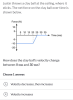 Justin throws a clay ball at the ceiling, where it sticks. The net force on the clay ball over time is shown below. Force (N) 10 5 10 15 20 25 30 35^ Time -10 -20 How does the clay ball's velocity change between 0 ms and 30 ms? Choose 1 answer: A Velocity decreases, then increases B Velocity increases
Justin throws a clay ball at the ceiling, where it sticks. The net force on the clay ball over time...
Justin throws a clay ball at the ceiling, where it sticks. The net force on the clay ball over time is shown below. Force (N) 10 5 10 15 20 25 30 35^ Time -10 -20 How does the clay ball's velocity change between 0 ms and 30 ms? Choose 1 answer: A Velocity decreases, then increases B Velocity increases
Justin throws a clay ball at the ceiling, where it sticks. The net force on the clay ball over time...
A 50 g ball of clay traveling at speed Vo hits and sticks to a 1.0...
A 50 g ball of clay traveling at speed Vo hits and sticks to a 1.0 kg block sitting at rest on a frictionless surface. What is the speed of the block after the collision? What percentage of the ball's initial energy is "lost"?
A 20.0 g ball of clay traveling east at 4.00 m/s collides and sticks together with...
A 20.0 g ball of clay traveling east at 4.00 m/s collides and sticks together with a 50.0 g ball of clay traveling north at 6.00 m/s. What is the speed of the resulting ball of clay?
A clay ball of mass 3 kg and velocity of 16 m/s strikes a stationary ball...
A clay ball of mass 3 kg and velocity of 16 m/s strikes a stationary ball of mass 5 kg and sticks to it... a) what was the momentum of the 3-kg ball before the collision? b) what was the momentum of the 5-kg ball before the collision? c) what was the combined omentum of the balls after the collision? d) what was the velocity of the balls after the collision? e) what is the momentum of the 3-kg ball...
A ball of clay with a mass of 0.250 kg is traveling horizontally to the left...
 A ball of clay with a mass of 0.250 kg is traveling horizontally to the left with a speed of 12.0 m/s when it hits a rod that can rotate about an axis through its center. The rotational inertia of the rod is 0.800 kg middot m^2 and the rod has a length 1.20 m. If the ball sticks to the rod, what is the angular speed of the rod and ball after the collision?
Question JO1 ball of unknown mass m is tossed straight up with initial speed v. At...
 Question JO1 ball of unknown mass m is tossed straight up with initial speed v. At the moment it is released, the ball is a heighth above a spring-mounted platform, as shown in the figure. The ball rises, peaks, and falls back toward the platform, ultimately compressing the spring a maximum distance d from its relaxed position. Assume that the spring is perfectly ideal, with spring constant k, and that the mass of the spring and platform is negligible. What...
1. A ball is tossed straight up from a height of 17 meters with an initial...
1. A ball is tossed straight up from a height of 17 meters with an initial speed of 7.2 m/s. What is its height above ground in meters after 0.869 seconds? Use g = 9.80 m/s2 . Assume 3 significant figures in your answer. 2. Suppose you release an object from rest from a height of 7.08 meters. How long does it take the object to hit the ground if g = 9.80 m/s2? Assume 3 significant digits in...
12. What is the velocity of a tennis ball just after release from a toss straight...
 12. What is the velocity of a tennis ball just after release from a toss straight up (vertical) into the air given the following information: The ball weighs 0.7 N and was tossed with vertical force applied of 10 N for 1.2 sec.
A ball is tossed straight upwards with an initial velocity of .30.00 metres per second from...
 A ball is tossed straight upwards with an initial velocity of .30.00 metres per second from a height of 20,000 meters. Assume that the only force acting on the object is acceleration due to Earth's gravity. Write out the position and velocity functions. With what velocity does the object hit the ground? When the object hits the ground, it bounces back up with one-fourth the speed that it had when it hit the ground. Determine the height of the ball...
A rock is tossed straight up from the ground with a speed of 12 m/s . When...
A rock is tossed straight up from the ground with a speed of 12 m/s . When it returns, it falls into a hole 10 m deep. What is the rock's speed as it hits the bottom of the hole? How long is the rock in the air, from the instant it is released until it hits the bottom of the hole?
 Justin throws a clay ball at the ceiling, where it sticks. The net force on the clay ball over time is shown below. Force (N) 10 5 10 15 20 25 30 35^ Time -10 -20 How does the clay ball's velocity change between 0 ms and 30 ms? Choose 1 answer: A Velocity decreases, then increases B Velocity increases
Justin throws a clay ball at the ceiling, where it sticks. The net force on the clay ball over time...
Justin throws a clay ball at the ceiling, where it sticks. The net force on the clay ball over time is shown below. Force (N) 10 5 10 15 20 25 30 35^ Time -10 -20 How does the clay ball's velocity change between 0 ms and 30 ms? Choose 1 answer: A Velocity decreases, then increases B Velocity increases
Justin throws a clay ball at the ceiling, where it sticks. The net force on the clay ball over time...
 A ball of clay with a mass of 0.250 kg is traveling horizontally to the left with a speed of 12.0 m/s when it hits a rod that can rotate about an axis through its center. The rotational inertia of the rod is 0.800 kg middot m^2 and the rod has a length 1.20 m. If the ball sticks to the rod, what is the angular speed of the rod and ball after the collision?
 Question JO1 ball of unknown mass m is tossed straight up with initial speed v. At the moment it is released, the ball is a heighth above a spring-mounted platform, as shown in the figure. The ball rises, peaks, and falls back toward the platform, ultimately compressing the spring a maximum distance d from its relaxed position. Assume that the spring is perfectly ideal, with spring constant k, and that the mass of the spring and platform is negligible. What...
 12. What is the velocity of a tennis ball just after release from a toss straight up (vertical) into the air given the following information: The ball weighs 0.7 N and was tossed with vertical force applied of 10 N for 1.2 sec.
 A ball is tossed straight upwards with an initial velocity of .30.00 metres per second from a height of 20,000 meters. Assume that the only force acting on the object is acceleration due to Earth's gravity. Write out the position and velocity functions. With what velocity does the object hit the ground? When the object hits the ground, it bounces back up with one-fourth the speed that it had when it hit the ground. Determine the height of the ball...
Most questions answered within 3 hours.
-
Where is the error in this code sequence?
String s1 = "Hello";
String s2 = "ello";...
asked 11 months ago -
Financial data for Joel de Paris, Inc., for last year
follow:
Joel de Paris, Inc.
Balance...
asked 11 months ago -
Consider this reaction:
Al2(SO4)3 (aq)+ BaCl3
(aq) Al2Cl6 (aq)- +
3BaSO4(s) . What is the...
asked 11 months ago -
Suppose that Savneet is considering increasing her
recent random sample from 20 car rentals to 40...
asked 11 months ago -
Trucks arrive at an unloading terminal at an average rate of 120
per hour.
Trucks arrive...
asked 11 months ago -
Why are methanol and ethanol completely soluble in water while
octanol is not very little soluble....
asked 11 months ago -
A facilities manager at a university reads in a research report
that the mean amount of...
asked 11 months ago -
When the CuSO4 is rehydrated by adding water to the anhydrous
compound, is this an endothermic...
asked 11 months ago -
A ray of sunlight is passing from diamond into crown glass; the
angle of incidence is...
asked 11 months ago -
A block of mass 0.249 kg is placed on top of a light, vertical
spring of...
asked 11 months ago -
how do the kidneys compensate in the presences of acidosis
a) trigger hyperventilate
b) reserve acid...
asked 11 months ago -
Question 501 pts
The rental rate of capital to the firm increases. Which of the
following...
asked 11 months ago