RC circuit question? You need to construct an RC circuit with a time constant of 0.25...
RC circuit question?
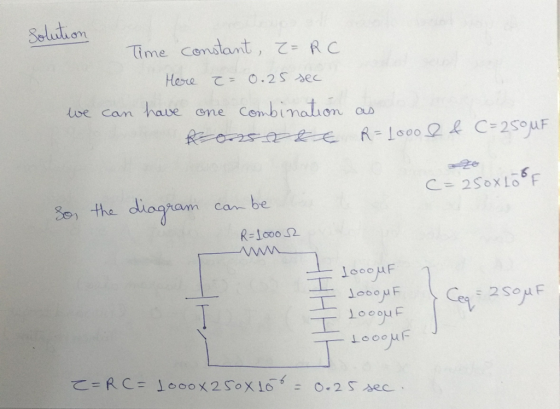
You need to construct an RC circuit with a time constant of 0.25 s, and you are given aselection of 1, 10, 100, and 1000 µF capacitors, and 1, 10, 100, and 1000 Ω resistors. Draw acircuit which accomplishes this task, labeling the resistance or capacitance of each component. Keep the circuit as simple as possible.
Homework Answers
Add Answer to:
RC circuit question?
You need to construct an RC circuit with a time constant of 0.25...
Construct an RC circuit with a time constant of 0.5 s using a selection of 5,...
 Construct an RC circuit with a time constant of 0.5 s using a selection of 5, 50, 500, and 5000 mu F capacitors, and 2, 20, 200, and 2000 ohm resistors. Use as few components as possible. Consider the circuit at right. After the switch is closed for a long time what is the potential difference between points b and a, V_b - V_a? What is the charge on the 6 mu F capacitor and how much energy is stored...
RC Circuits If you have an RC circuit with a resistance of 200 ohms and a...
RC Circuits If you have an RC circuit with a resistance of 200 ohms and a capacitance of 35 microfarads, what is the time constant? Time Constant= ? s This time constant represents how much time it will take to reach 63% of maximum. If the RC circuit is connected to an EMF of 12.0 V, what will be its voltage after 5.0 ms? Voltage after 5.0 ms= ? V Draw what the voltage looks like in a charging RC...
I need help trying to design this RC-circuit. PHYS 2120 LAB 6 - RC Circuit Capstone...
 I need help trying to design this RC-circuit.
PHYS 2120 LAB 6 - RC Circuit Capstone For example, if we wait long enough, eventually what do you expect the voltage over the capacitor to become? Part 1: Design an RC-circuit to charge a capacitor as quickly as possible. Your circuit must include the following elements (and only these elements): A Switch, a 10V Battery, a 0.1 F Capacitor, a 250 resistor, a 500 resistor, two 7512 resistors, a 1000 resistor,...
I need help trying to design this RC-circuit.
PHYS 2120 LAB 6 - RC Circuit Capstone For example, if we wait long enough, eventually what do you expect the voltage over the capacitor to become? Part 1: Design an RC-circuit to charge a capacitor as quickly as possible. Your circuit must include the following elements (and only these elements): A Switch, a 10V Battery, a 0.1 F Capacitor, a 250 resistor, a 500 resistor, two 7512 resistors, a 1000 resistor,...
1. What does the time constant of an RC circuit that is being charged tell you?
 Background Summary Questions: 1. What does the time constant of an RC circuit that is being charged tell you? 2. What does the time constant of an RC circuit that is being discharged tell you? 3. How is the voltage across the capacitor related to the charge on a capacitor? (Linear, Inverse, Quadratic, etc.) 4. Based on your answer to question 3, how would you write an expression for the voltage across the capacitor as a function of time? a. Charging: V(t) b. Discharging: V(t)= Background: The...
This is one original diagram for you to see what kind of circuit we have: Draw out the circuit d...
 This is one original diagram for you to see what kind of circuit
we have:
Draw out the circuit diagrams for these
tasks.
Each task is a separate task and you will need to construct a
specific circuit for each task, as well as indicate where the
measurement is taking place.
1. Specific Voltage
From a 5V power supply, have a drop of 3.3V over a specific
resistor accurate to the 0.1V mark. (Please point out which
specific resistor if...
This is one original diagram for you to see what kind of circuit
we have:
Draw out the circuit diagrams for these
tasks.
Each task is a separate task and you will need to construct a
specific circuit for each task, as well as indicate where the
measurement is taking place.
1. Specific Voltage
From a 5V power supply, have a drop of 3.3V over a specific
resistor accurate to the 0.1V mark. (Please point out which
specific resistor if...
Consider a series RC circuit with an R = 3.0 Ω and a capacitance of 20...
Consider a series RC circuit with an R = 3.0 Ω and a capacitance of 20 µF being charged to a voltage of 9.0 V. (Note, you will not include units in your answers.) (a) If you wished the charging of this capacitor to have a vertical displacement of 4.0 DIV from 0 charge to fully charged, what value must you set the vertical gain on the oscilloscope to achieve this? V/DIV (b) What is the value of the horizontal...
21.66- RC Circuits A 2.50-and a 7.30-uF capacitor can be connected in series or parallel, as can a 29.0-and a 100-kΩ re...
 21.66- RC Circuits A 2.50-and a 7.30-uF capacitor can be connected in series or parallel, as can a 29.0-and a 100-kΩ resistor. Calculate the four RC time constants possible from connecting the resulting capacitance and resistance in series. Both the resistors and the capacitors connected in series 0.240 s You are correct. Your receipt no. is 155-8312 The resistors connected in series and the capacitors connected in parallel 1.26 s You are correct. Your receipt no. is 155-7049Frevious Tries Both...
Design a circuit that provides a constant current of 10 milliamperes to a load resistance. The...
Design a circuit that provides a constant current of 10 milliamperes to a load resistance. The load resistance may vary from 100-ohms to 1000-ohms. You may only use op-amps, transistors, resistors, capacitors, and batteries in your design. You may assume that the op-amp is essentially ideal. Note: Once built, you may not change your circuit as the load resistance is changed. Your circuit must work for the range of resistances without modification. Explain how your design works.
1. Calculate the RC time constant of the circuit in Fig. 1 using equation (1) 2....
 1. Calculate the RC time constant of the circuit in Fig.
1 using equation (1)
2. Derive expressions of Vout(t) for circuits in
Figs. 1 and 2
3. Sketch your derived results for Vout(t), clearly
labeling your initial voltages and time constants
10 k22 M + + Vin 0.1 uf Vout Fig. 1. RC circuit 0.1 uf + + Vin 10 k2 Vout Fig. 2. RC circuit.
1. Calculate the RC time constant of the circuit in Fig.
1 using equation (1)
2. Derive expressions of Vout(t) for circuits in
Figs. 1 and 2
3. Sketch your derived results for Vout(t), clearly
labeling your initial voltages and time constants
10 k22 M + + Vin 0.1 uf Vout Fig. 1. RC circuit 0.1 uf + + Vin 10 k2 Vout Fig. 2. RC circuit.
 Construct an RC circuit with a time constant of 0.5 s using a selection of 5, 50, 500, and 5000 mu F capacitors, and 2, 20, 200, and 2000 ohm resistors. Use as few components as possible. Consider the circuit at right. After the switch is closed for a long time what is the potential difference between points b and a, V_b - V_a? What is the charge on the 6 mu F capacitor and how much energy is stored...
 I need help trying to design this RC-circuit.
PHYS 2120 LAB 6 - RC Circuit Capstone For example, if we wait long enough, eventually what do you expect the voltage over the capacitor to become? Part 1: Design an RC-circuit to charge a capacitor as quickly as possible. Your circuit must include the following elements (and only these elements): A Switch, a 10V Battery, a 0.1 F Capacitor, a 250 resistor, a 500 resistor, two 7512 resistors, a 1000 resistor,...
I need help trying to design this RC-circuit.
PHYS 2120 LAB 6 - RC Circuit Capstone For example, if we wait long enough, eventually what do you expect the voltage over the capacitor to become? Part 1: Design an RC-circuit to charge a capacitor as quickly as possible. Your circuit must include the following elements (and only these elements): A Switch, a 10V Battery, a 0.1 F Capacitor, a 250 resistor, a 500 resistor, two 7512 resistors, a 1000 resistor,...
 Background Summary Questions: 1. What does the time constant of an RC circuit that is being charged tell you? 2. What does the time constant of an RC circuit that is being discharged tell you? 3. How is the voltage across the capacitor related to the charge on a capacitor? (Linear, Inverse, Quadratic, etc.) 4. Based on your answer to question 3, how would you write an expression for the voltage across the capacitor as a function of time? a. Charging: V(t) b. Discharging: V(t)= Background: The...
 This is one original diagram for you to see what kind of circuit
we have:
Draw out the circuit diagrams for these
tasks.
Each task is a separate task and you will need to construct a
specific circuit for each task, as well as indicate where the
measurement is taking place.
1. Specific Voltage
From a 5V power supply, have a drop of 3.3V over a specific
resistor accurate to the 0.1V mark. (Please point out which
specific resistor if...
This is one original diagram for you to see what kind of circuit
we have:
Draw out the circuit diagrams for these
tasks.
Each task is a separate task and you will need to construct a
specific circuit for each task, as well as indicate where the
measurement is taking place.
1. Specific Voltage
From a 5V power supply, have a drop of 3.3V over a specific
resistor accurate to the 0.1V mark. (Please point out which
specific resistor if...
 21.66- RC Circuits A 2.50-and a 7.30-uF capacitor can be connected in series or parallel, as can a 29.0-and a 100-kΩ resistor. Calculate the four RC time constants possible from connecting the resulting capacitance and resistance in series. Both the resistors and the capacitors connected in series 0.240 s You are correct. Your receipt no. is 155-8312 The resistors connected in series and the capacitors connected in parallel 1.26 s You are correct. Your receipt no. is 155-7049Frevious Tries Both...
 1. Calculate the RC time constant of the circuit in Fig.
1 using equation (1)
2. Derive expressions of Vout(t) for circuits in
Figs. 1 and 2
3. Sketch your derived results for Vout(t), clearly
labeling your initial voltages and time constants
10 k22 M + + Vin 0.1 uf Vout Fig. 1. RC circuit 0.1 uf + + Vin 10 k2 Vout Fig. 2. RC circuit.
1. Calculate the RC time constant of the circuit in Fig.
1 using equation (1)
2. Derive expressions of Vout(t) for circuits in
Figs. 1 and 2
3. Sketch your derived results for Vout(t), clearly
labeling your initial voltages and time constants
10 k22 M + + Vin 0.1 uf Vout Fig. 1. RC circuit 0.1 uf + + Vin 10 k2 Vout Fig. 2. RC circuit.
Most questions answered within 3 hours.
-
Where is the error in this code sequence?
String s1 = "Hello";
String s2 = "ello";...
asked 10 months ago -
Financial data for Joel de Paris, Inc., for last year
follow:
Joel de Paris, Inc.
Balance...
asked 10 months ago -
Consider this reaction:
Al2(SO4)3 (aq)+ BaCl3
(aq) Al2Cl6 (aq)- +
3BaSO4(s) . What is the...
asked 10 months ago -
Suppose that Savneet is considering increasing her
recent random sample from 20 car rentals to 40...
asked 10 months ago -
Trucks arrive at an unloading terminal at an average rate of 120
per hour.
Trucks arrive...
asked 10 months ago -
Why are methanol and ethanol completely soluble in water while
octanol is not very little soluble....
asked 10 months ago -
A facilities manager at a university reads in a research report
that the mean amount of...
asked 10 months ago -
When the CuSO4 is rehydrated by adding water to the anhydrous
compound, is this an endothermic...
asked 10 months ago -
A ray of sunlight is passing from diamond into crown glass; the
angle of incidence is...
asked 10 months ago -
A block of mass 0.249 kg is placed on top of a light, vertical
spring of...
asked 10 months ago -
how do the kidneys compensate in the presences of acidosis
a) trigger hyperventilate
b) reserve acid...
asked 10 months ago -
Question 501 pts
The rental rate of capital to the firm increases. Which of the
following...
asked 10 months ago