

Homework Answers
Request Answer!
We need at least 10 more requests to produce the answer.
0 / 10 have requested this problem solution
The more requests, the faster the answer.
Add Answer to:
C. Execute the following statements in MATLAB: 1. A=3*5 2. A=2^10 3. A-abs(3 + i*4) 4.x=pi/2;...
Find the integral using matlab quad inbuilt for function (x^2)*cos(x)+3*sin(x)*tan(x) for 0 to pi/4
Find the integral using matlab quad inbuilt for function (x^2)*cos(x)+3*sin(x)*tan(x) for 0 to pi/4
*18% 8:30 Working with Phasors and Using Complex Polar Notation in MATLAB By default, MATLAB accepts...
 *18% 8:30 Working with Phasors and Using Complex Polar Notation in MATLAB By default, MATLAB accepts complex numbers only in rectangular form. Use i or j to represent the imaginary number. Type the following expressions >> in Matlab and print out the results ans = >> 5+41 ans = A number in polar form, such as (2245), can be entered using complex exponential notation. The angle must be converted to radians when entering numbers in complex exponential form: >> X...
Results for this submission Entered Answer Preview Result (3/2)+(6/pi)*cos(x) e + cos(2) correct (3/2)+(6/pi)*cos(x)-(2/pi)*cos(3*x) 3 6...
 Results for this submission Entered Answer Preview Result (3/2)+(6/pi)*cos(x) e + cos(2) correct (3/2)+(6/pi)*cos(x)-(2/pi)*cos(3*x) 3 6 st-ce 2 s(3x) correct (3/2)+(6/pi)*cos(x)-(2/pi)*cos(3*x)+(6/5)*pi*cos(5*x) it coule) = _ cou(30) + * cos(52) incorrect A correct f(x) f(x) correct At least one of the answers above is NOT correct. 1 (1 point) (a) Suppose you're given the following Fourier coefficients for a function on the interval (-1,7): a 3 6 6 6 = , ai = –, az = -2,25 = = and 22,...
Exercise 1: Use Matlab command to obtain the following a) Extract the fourth row of the...
 Exercise 1: Use Matlab command to obtain the following a) Extract the fourth row of the matrix generated by magic(6) b) Show the results of 'x' multiply by 'y' and 'y' divides by 'x'. Given x = [0:0.1:1.1] and y=[10:21] c) Generate random matrix 'r' of size 4 by 5 with number varying between -8 and 9 Exercise 2: Use MATLAB commands to get exactly as the figure shown below x=pi/2:pi/10:2*pi; y=sin(x); z=cos (x);
MATLAB code starts here --------- clear T0=2; w0=2*pi/T0; f0=1/T0; Tmax=4; Nmax=15; %--- i=1; for t=-Tmax: .01:Tmax...
 MATLAB
code starts here ---------
clear
T0=2;
w0=2*pi/T0;
f0=1/T0;
Tmax=4;
Nmax=15;
%---
i=1;
for t=-Tmax: .01:Tmax
T(i)=t;
if t>=(T0/2)
while (t>T0/2)
t=t-T0;
end
elseif t<=-(T0/2)
while (t<=-T0/2)
t=t+T0;
end
end
if abs(t)<=(T0/4)
y(i)=1;
else
y(i)=0;
end
i=i+1;
end
plot(T,y),grid, xlabel('Time (sec)'); title('y(t) square wave');
shg
disp('Hit return..');
pause
%---
a0=1/2;
F(1)=0; %dc freq
C(1)=a0;
for n=1:Nmax
a(n)=(2/(n*pi))*sin((n*pi)/2);
b(n)=0;
C(n+1)=sqrt(a(n)^2+b(n)^2);
F(n+1)=n*f0;
end
stem(F,abs,(C)), grid, title(['Line Spectrum: Harmonics = '
num2str(Nmax)]);
xlabel('Freq(Hz)'), ylabel('Cn'), shg
disp('Hit return...');
pause
%---
yest=a0*ones(1,length(T));
for n=1:Nmax
yest=yest+a(n)*cos(2*n*pi*T/T0)+b(n)*sin(2*n*pi*T/T0);...
MATLAB
code starts here ---------
clear
T0=2;
w0=2*pi/T0;
f0=1/T0;
Tmax=4;
Nmax=15;
%---
i=1;
for t=-Tmax: .01:Tmax
T(i)=t;
if t>=(T0/2)
while (t>T0/2)
t=t-T0;
end
elseif t<=-(T0/2)
while (t<=-T0/2)
t=t+T0;
end
end
if abs(t)<=(T0/4)
y(i)=1;
else
y(i)=0;
end
i=i+1;
end
plot(T,y),grid, xlabel('Time (sec)'); title('y(t) square wave');
shg
disp('Hit return..');
pause
%---
a0=1/2;
F(1)=0; %dc freq
C(1)=a0;
for n=1:Nmax
a(n)=(2/(n*pi))*sin((n*pi)/2);
b(n)=0;
C(n+1)=sqrt(a(n)^2+b(n)^2);
F(n+1)=n*f0;
end
stem(F,abs,(C)), grid, title(['Line Spectrum: Harmonics = '
num2str(Nmax)]);
xlabel('Freq(Hz)'), ylabel('Cn'), shg
disp('Hit return...');
pause
%---
yest=a0*ones(1,length(T));
for n=1:Nmax
yest=yest+a(n)*cos(2*n*pi*T/T0)+b(n)*sin(2*n*pi*T/T0);...
1) Using Matlab, find all real and complex roots of the following polynomial equation: (x-1)(x-2)(x-3)(x-4)(x-5)(x-6)(x-7)=8 2)...
1) Using Matlab, find all real and complex roots of the following polynomial equation: (x-1)(x-2)(x-3)(x-4)(x-5)(x-6)(x-7)=8 2) Using Matlab, find the root for the following system of equations. Both x and y are positive. a: (x^2)cos(y)=1 b: e^(-4x)+1
a=15 b=pi c=e^(i)(pi) how do I write these functions as a command in MatLab? k =sin?...
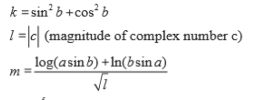 a=15
b=pi
c=e^(i)(pi)
how do I write these functions as a command in MatLab?
k =sin? b +cos 1 = c(magnitude of complex number c) _log(asin b) +ln(bsina)
a=15
b=pi
c=e^(i)(pi)
how do I write these functions as a command in MatLab?
k =sin? b +cos 1 = c(magnitude of complex number c) _log(asin b) +ln(bsina)
Using Matlab; Please show written program to execute and instructions to create plot: 1. Create a...
Using Matlab; Please show written program to execute and instructions to create plot: 1. Create a vector of x values from 0 to 20 pi, with an increment of pi/100. y=x sin (x) and z= x cos (x) a) create a figure window with two subplots. In first subplot create an x versus y plot and in the second subplot create an y versus z plot. b) create a polar plot of x and y. Add title and labels to...
Need help converting the following code from Matlab into Python: N=2048; fs=4.9; t=0:1/fs:(N-1)/fs; fs1=200; t1=0:1/fs1:(N-1)/fs1; x2=0.5+0.6366.*cos(2.*pi.*t1)+0.1273.*cos(10.*pi.*t1)-0.0909.*cos(14.*pi.*t1);...
Need help converting the following code from Matlab into Python: N=2048; fs=4.9; t=0:1/fs:(N-1)/fs; fs1=200; t1=0:1/fs1:(N-1)/fs1; x2=0.5+0.6366.*cos(2.*pi.*t1)+0.1273.*cos(10.*pi.*t1)-0.0909.*cos(14.*pi.*t1); x=0.5+0.6366.*cos(2.*pi.*t)+0.1273.*cos(10.*pi.*t)-0.0909.*cos(14.*pi.*t); X=fftshift(fft(x)); f=linspace(-fs/2,fs/2,N); plot(f,abs(X)./N); xlabel('f'); ylabel('|F(f)|'); title('magnitude spectrum of sampled signal'); x1=ifft(fftshift(X)); figure plot(t(1:100),x1(1:100)); xlabel('t'); ylabel('f(t)'); title('f(t) obtained by inverse transform'); figure plot(t1(1:1000),x2(1:1000)); xlabel('t'); ylabel('f(t)'); title('original f(t)');
 *18% 8:30 Working with Phasors and Using Complex Polar Notation in MATLAB By default, MATLAB accepts complex numbers only in rectangular form. Use i or j to represent the imaginary number. Type the following expressions >> in Matlab and print out the results ans = >> 5+41 ans = A number in polar form, such as (2245), can be entered using complex exponential notation. The angle must be converted to radians when entering numbers in complex exponential form: >> X...
 Results for this submission Entered Answer Preview Result (3/2)+(6/pi)*cos(x) e + cos(2) correct (3/2)+(6/pi)*cos(x)-(2/pi)*cos(3*x) 3 6 st-ce 2 s(3x) correct (3/2)+(6/pi)*cos(x)-(2/pi)*cos(3*x)+(6/5)*pi*cos(5*x) it coule) = _ cou(30) + * cos(52) incorrect A correct f(x) f(x) correct At least one of the answers above is NOT correct. 1 (1 point) (a) Suppose you're given the following Fourier coefficients for a function on the interval (-1,7): a 3 6 6 6 = , ai = –, az = -2,25 = = and 22,...
 Exercise 1: Use Matlab command to obtain the following a) Extract the fourth row of the matrix generated by magic(6) b) Show the results of 'x' multiply by 'y' and 'y' divides by 'x'. Given x = [0:0.1:1.1] and y=[10:21] c) Generate random matrix 'r' of size 4 by 5 with number varying between -8 and 9 Exercise 2: Use MATLAB commands to get exactly as the figure shown below x=pi/2:pi/10:2*pi; y=sin(x); z=cos (x);
 MATLAB
code starts here ---------
clear
T0=2;
w0=2*pi/T0;
f0=1/T0;
Tmax=4;
Nmax=15;
%---
i=1;
for t=-Tmax: .01:Tmax
T(i)=t;
if t>=(T0/2)
while (t>T0/2)
t=t-T0;
end
elseif t<=-(T0/2)
while (t<=-T0/2)
t=t+T0;
end
end
if abs(t)<=(T0/4)
y(i)=1;
else
y(i)=0;
end
i=i+1;
end
plot(T,y),grid, xlabel('Time (sec)'); title('y(t) square wave');
shg
disp('Hit return..');
pause
%---
a0=1/2;
F(1)=0; %dc freq
C(1)=a0;
for n=1:Nmax
a(n)=(2/(n*pi))*sin((n*pi)/2);
b(n)=0;
C(n+1)=sqrt(a(n)^2+b(n)^2);
F(n+1)=n*f0;
end
stem(F,abs,(C)), grid, title(['Line Spectrum: Harmonics = '
num2str(Nmax)]);
xlabel('Freq(Hz)'), ylabel('Cn'), shg
disp('Hit return...');
pause
%---
yest=a0*ones(1,length(T));
for n=1:Nmax
yest=yest+a(n)*cos(2*n*pi*T/T0)+b(n)*sin(2*n*pi*T/T0);...
MATLAB
code starts here ---------
clear
T0=2;
w0=2*pi/T0;
f0=1/T0;
Tmax=4;
Nmax=15;
%---
i=1;
for t=-Tmax: .01:Tmax
T(i)=t;
if t>=(T0/2)
while (t>T0/2)
t=t-T0;
end
elseif t<=-(T0/2)
while (t<=-T0/2)
t=t+T0;
end
end
if abs(t)<=(T0/4)
y(i)=1;
else
y(i)=0;
end
i=i+1;
end
plot(T,y),grid, xlabel('Time (sec)'); title('y(t) square wave');
shg
disp('Hit return..');
pause
%---
a0=1/2;
F(1)=0; %dc freq
C(1)=a0;
for n=1:Nmax
a(n)=(2/(n*pi))*sin((n*pi)/2);
b(n)=0;
C(n+1)=sqrt(a(n)^2+b(n)^2);
F(n+1)=n*f0;
end
stem(F,abs,(C)), grid, title(['Line Spectrum: Harmonics = '
num2str(Nmax)]);
xlabel('Freq(Hz)'), ylabel('Cn'), shg
disp('Hit return...');
pause
%---
yest=a0*ones(1,length(T));
for n=1:Nmax
yest=yest+a(n)*cos(2*n*pi*T/T0)+b(n)*sin(2*n*pi*T/T0);...
 a=15
b=pi
c=e^(i)(pi)
how do I write these functions as a command in MatLab?
k =sin? b +cos 1 = c(magnitude of complex number c) _log(asin b) +ln(bsina)
a=15
b=pi
c=e^(i)(pi)
how do I write these functions as a command in MatLab?
k =sin? b +cos 1 = c(magnitude of complex number c) _log(asin b) +ln(bsina)
Most questions answered within 3 hours.
-
Where is the error in this code sequence?
String s1 = "Hello";
String s2 = "ello";...
asked 10 months ago -
Financial data for Joel de Paris, Inc., for last year
follow:
Joel de Paris, Inc.
Balance...
asked 10 months ago -
Consider this reaction:
Al2(SO4)3 (aq)+ BaCl3
(aq) Al2Cl6 (aq)- +
3BaSO4(s) . What is the...
asked 10 months ago -
Suppose that Savneet is considering increasing her
recent random sample from 20 car rentals to 40...
asked 10 months ago -
Trucks arrive at an unloading terminal at an average rate of 120
per hour.
Trucks arrive...
asked 10 months ago -
Why are methanol and ethanol completely soluble in water while
octanol is not very little soluble....
asked 10 months ago -
A facilities manager at a university reads in a research report
that the mean amount of...
asked 10 months ago -
When the CuSO4 is rehydrated by adding water to the anhydrous
compound, is this an endothermic...
asked 10 months ago -
A ray of sunlight is passing from diamond into crown glass; the
angle of incidence is...
asked 10 months ago -
A block of mass 0.249 kg is placed on top of a light, vertical
spring of...
asked 10 months ago -
how do the kidneys compensate in the presences of acidosis
a) trigger hyperventilate
b) reserve acid...
asked 10 months ago -
Question 501 pts
The rental rate of capital to the firm increases. Which of the
following...
asked 10 months ago