Example 23-8 depicts the following scenario. The lightbulb in the circuit shown in the figure has a resistance of 10 Ω and consumes 4.9 W of power; the rod is 1.15 m long and moves to the left with a constant speed of 2.8 m/s . The strength of the magnetic field is 2.2 T .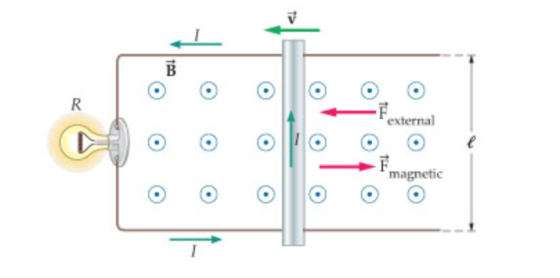
Part A: Find the current that flows in the circuit.
Part B:What speed must the rod have if the current in the circuit is to be 1.2 A ?
Homework Answers

Add Answer to:
Example 23-8 depicts the following scenario. The lightbulb in the circuit shown in the figure has...
The lightbulb in the circuit shown in the figure(Figure 1) has a resistance of 14? and...
The lightbulb in the circuit shown in the figure(Figure 1) has a resistance of 14? and consumes 9.7W of power; the rod is 1.20m long and moves to the left with a constant speed. The strength of the magnetic field is 1.8T . find current in the circuit. (I) find speed of the rod (m/s)
The conducting rod shown in the accompanying figure moves alongparallel metal rails that are 25-cm...
 The conducting rod shown in the accompanying figure moves along
parallel metal rails that are 25-cm apart. The system is in a
uniform magnetic field of strength 10 T, which is directed into the
page. The resistances of the rod and the rails are negligible, but
the section PQ has a resistance of 0.25Ω. The rod moves at a
constant speed of 5 m/s. Find:a) The current that flows through the resistanceb) The power supplied by the resistancec) The force...
The conducting rod shown in the accompanying figure moves along
parallel metal rails that are 25-cm apart. The system is in a
uniform magnetic field of strength 10 T, which is directed into the
page. The resistances of the rod and the rails are negligible, but
the section PQ has a resistance of 0.25Ω. The rod moves at a
constant speed of 5 m/s. Find:a) The current that flows through the resistanceb) The power supplied by the resistancec) The force...
A conducting rod with a length of 25 cm is placed on a U-shaped metal wire that has a resistance R of 8.0 Ω as shown in the figure.
A conducting rod with a length of 25 cm is placed on a U-shaped metal wire that has a resistance R of 8.0 Ω as shown in the figure. The wire and the rod are placed in the plane of the paper. A constant magnetic field of strength 0.40 T is applied perpendicular into the paper. An applied force moves the rod to the right with a constant speed of 6.0 m/s. What is the magnitude and direction of the...
23. As shown in the figure below, a conducting bar of length - 20 em is pulled to the left on frictionlessrails at...
 23. As shown in the figure below, a conducting bar of length - 20 em is pulled to the left on frictionlessrails at a constant speed of y 20 m/s. A uniform magnetic field directed out of the page has a magnitude of B-O1T If the rails are connected to a resistor of resistance R-4.0 Ω andan ideal battery of emf e-1.6V, find the magnitude and direction of the current flowing in the circuit formed. Assume that the bar and...
A conducting rod whose length is l = 30 cm is placed on a U-shaped metal wire that is connected to a light bulb having a resistance of 5.0 s as shown in the figure.
 A conducting rod whose length is l = 30 cm is placed on a U-shaped metal wire that is connected to a light bulb having a resistance of 5.0 s as shown in the figure. The wire and the rod are in the plane of the page. A constant uniform magnetic field of strength 0.50 T is applied perpendicular to and out of the paper. An external applied force moves the rod to the left with a constant speed of...
The conducting rod shown in the accompanying figure moves along parallel metal rails that are 25-cm apart.
 The conducting rod shown in the accompanying figure moves along parallel metal rails that are 25-cm apart. The system is in a uniform magnetic field of strength 0.75 T, which is directed into the page. The resistances of the rod and the rails are negligible, but the section PQ has a resistance of 0.25 Ω. (a) What is the emf induced in the rod when it is moving to the right with a speed of 5.0 m/s? (b) What force is required to...
The figure below shows a circuit consisting of a flashlight bulb, rated 3.0 V and 1.5...
 The figure below shows a circuit consisting of a flashlight bulb, rated 3.0 V and 1.5 W. Assume the wires are ideal and have no resistance. The right wire of the circuit, the rod, is 12 cm long and is pulled at constant speed v through a perpendicular magnetic field of strength 0.25T (directed into the page). What current has to flow through the bulb for it to shine at the full brightness? What speed must the moving rod have...
consider the apparatus shown in the figure to the right in which a conducting bar can...
 consider the apparatus shown in the figure to the right in
which a conducting bar can be moved along two rails connect
0,206N X X X Consider the apparatus shown in the fig- ure to the right in which a conducting bar can be moved along two rails connected to a lightbulb. The whole system is im- mersed in a magnetic field fof magnitude B = 0.400 T perpendicular and into the page. The distance between the horizon- tal rails...
consider the apparatus shown in the figure to the right in
which a conducting bar can be moved along two rails connect
0,206N X X X Consider the apparatus shown in the fig- ure to the right in which a conducting bar can be moved along two rails connected to a lightbulb. The whole system is im- mersed in a magnetic field fof magnitude B = 0.400 T perpendicular and into the page. The distance between the horizon- tal rails...
A 8.0-cm -long wire is pulled along a U-shaped conducting rail in a perpendicular magnetic field....
A 8.0-cm -long wire is pulled along a U-shaped conducting rail in a perpendicular magnetic field. The total resistance of the wire and rail is 0.31 Ω . Pulling the wire with a force of 1.2 N causes 4.5 W of power to be dissipated in the circuit. Part A What is the speed of the wire when pulled with 1.2 N ? Express your answer in meters per second. VV = nothing m/s Part B What is the strength...
The conducting rod shown in the figure has length L and is being pulled along horizontal, frictio...
 The conducting rod shown in the figure has length L and is being pulled along horizontal, frictionless, conducting rails at a constant velocity. The rails are connected at one end with a metal strip. A uniform magnetic field, directed out of the page, fills the region in which the rod moves. Assume that L 8.3 cm, the speed of the rod is v = 4.4 m/s, and the magnitude of the magnetic field is B = 1.0 T. (a) what...
 The conducting rod shown in the accompanying figure moves along
parallel metal rails that are 25-cm apart. The system is in a
uniform magnetic field of strength 10 T, which is directed into the
page. The resistances of the rod and the rails are negligible, but
the section PQ has a resistance of 0.25Ω. The rod moves at a
constant speed of 5 m/s. Find:a) The current that flows through the resistanceb) The power supplied by the resistancec) The force...
The conducting rod shown in the accompanying figure moves along
parallel metal rails that are 25-cm apart. The system is in a
uniform magnetic field of strength 10 T, which is directed into the
page. The resistances of the rod and the rails are negligible, but
the section PQ has a resistance of 0.25Ω. The rod moves at a
constant speed of 5 m/s. Find:a) The current that flows through the resistanceb) The power supplied by the resistancec) The force...
 23. As shown in the figure below, a conducting bar of length - 20 em is pulled to the left on frictionlessrails at a constant speed of y 20 m/s. A uniform magnetic field directed out of the page has a magnitude of B-O1T If the rails are connected to a resistor of resistance R-4.0 Ω andan ideal battery of emf e-1.6V, find the magnitude and direction of the current flowing in the circuit formed. Assume that the bar and...
 The figure below shows a circuit consisting of a flashlight bulb, rated 3.0 V and 1.5 W. Assume the wires are ideal and have no resistance. The right wire of the circuit, the rod, is 12 cm long and is pulled at constant speed v through a perpendicular magnetic field of strength 0.25T (directed into the page). What current has to flow through the bulb for it to shine at the full brightness? What speed must the moving rod have...
 consider the apparatus shown in the figure to the right in
which a conducting bar can be moved along two rails connect
0,206N X X X Consider the apparatus shown in the fig- ure to the right in which a conducting bar can be moved along two rails connected to a lightbulb. The whole system is im- mersed in a magnetic field fof magnitude B = 0.400 T perpendicular and into the page. The distance between the horizon- tal rails...
consider the apparatus shown in the figure to the right in
which a conducting bar can be moved along two rails connect
0,206N X X X Consider the apparatus shown in the fig- ure to the right in which a conducting bar can be moved along two rails connected to a lightbulb. The whole system is im- mersed in a magnetic field fof magnitude B = 0.400 T perpendicular and into the page. The distance between the horizon- tal rails...
 The conducting rod shown in the figure has length L and is being pulled along horizontal, frictionless, conducting rails at a constant velocity. The rails are connected at one end with a metal strip. A uniform magnetic field, directed out of the page, fills the region in which the rod moves. Assume that L 8.3 cm, the speed of the rod is v = 4.4 m/s, and the magnitude of the magnetic field is B = 1.0 T. (a) what...
Most questions answered within 3 hours.
-
Where is the error in this code sequence?
String s1 = "Hello";
String s2 = "ello";...
asked 10 months ago -
Financial data for Joel de Paris, Inc., for last year
follow:
Joel de Paris, Inc.
Balance...
asked 10 months ago -
Consider this reaction:
Al2(SO4)3 (aq)+ BaCl3
(aq) Al2Cl6 (aq)- +
3BaSO4(s) . What is the...
asked 10 months ago -
Suppose that Savneet is considering increasing her
recent random sample from 20 car rentals to 40...
asked 10 months ago -
Trucks arrive at an unloading terminal at an average rate of 120
per hour.
Trucks arrive...
asked 10 months ago -
Why are methanol and ethanol completely soluble in water while
octanol is not very little soluble....
asked 10 months ago -
A facilities manager at a university reads in a research report
that the mean amount of...
asked 10 months ago -
When the CuSO4 is rehydrated by adding water to the anhydrous
compound, is this an endothermic...
asked 10 months ago -
A ray of sunlight is passing from diamond into crown glass; the
angle of incidence is...
asked 10 months ago -
A block of mass 0.249 kg is placed on top of a light, vertical
spring of...
asked 10 months ago -
how do the kidneys compensate in the presences of acidosis
a) trigger hyperventilate
b) reserve acid...
asked 10 months ago -
Question 501 pts
The rental rate of capital to the firm increases. Which of the
following...
asked 10 months ago