
Homework Answers

Add Answer to:
23. As shown in the figure below, a conducting bar of length - 20 em is pulled to the left on frictionlessrails at...
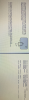
In the figure below, a metal bar sitting on two parallel conducting rails, connected to each other by a resistor, is pulled to the right at a constant speed.
 A vertical bar and two parallel horizontal rails lie in the
plane of the page. The parallel rails run from left to right, with
one a distance ℓ above the other. The left ends of the rails are
connected by a vertical wire containing a resistor R. The
vertical bar lies across the rails to the right of the wire. Force
vector Fapp points from the bar toward
the right.In the figure below, a metal bar sitting on two parallel...
A vertical bar and two parallel horizontal rails lie in the
plane of the page. The parallel rails run from left to right, with
one a distance ℓ above the other. The left ends of the rails are
connected by a vertical wire containing a resistor R. The
vertical bar lies across the rails to the right of the wire. Force
vector Fapp points from the bar toward
the right.In the figure below, a metal bar sitting on two parallel...
The conducting rod shown in the figure has length L and is being pulled along horizontal, frictio...
 The conducting rod shown in the figure has length L and is being pulled along horizontal, frictionless, conducting rails at a constant velocity. The rails are connected at one end with a metal strip. A uniform magnetic field, directed out of the page, fills the region in which the rod moves. Assume that L 8.3 cm, the speed of the rod is v = 4.4 m/s, and the magnitude of the magnetic field is B = 1.0 T. (a) what...
A 1.10-m-long metal bar is pulled to the right at a steady 4.0 m/s perpendicular to...
A 1.10-m-long metal bar is pulled to the right at a steady 4.0 m/s perpendicular to a uniform, 0.790-T magnetic field. The bar rides on parallel metal rails connected through R = 25.5-Ω, as shown in the figure (Figure 1), so the apparatus makes a complete circuit. You can ignore the resistance of the bar and the rails. A) Calculate the magnitude of the emf induced in the circuit. Express your answer using two significant figures. B)Find the direction of...
A 0.392 m long metal bar is pulled to the left by an force F ....
A 0.392 m long metal bar is pulled to the left by an force F . The bar rides on parallel metal rails connected through a 48.4 Ω resistor, as shown in the following figure(Figure 1), so the apparatus makes a complete circuit. You can ignore the resistance of the bar and rails. The circuit is in a uniform 0.638 T magnetic field that is directed out of the plane of the figure. At the instant when the bar is...
As shown in the figure below, a metal rod is pulled to the right at constant...
 As shown in the figure below, a metal rod is pulled to the right at constant speed v, perpendicular to a uniform magnetic field directed out of the screen. The bar rides on frictionless metal rails connected through a resistor forming a complete circuit. The length of the bar between the rails is 5 cm, the magnitude of the magnetic field is 0.4 T, the resistor has a value of 102. What speed of the rod is required to produce...
15) A rectangular conducting loop of length and with w and total resistance is being pulled...
 15) A rectangular conducting loop of length and with w and total resistance is being pulled out of a region of magnetic field. If the loop is moving with a constant speed, what is the electric current (magnitude and direction) in the loop? 15) - 0.12 0.22 0.340,- 1.25 Tinte page=876 A) 401 A Clockwise B) 401 A Court Clockwise 15.30 A, Cockwise D) 530 A, Counter Clockwise 1) 7.09 A Clockwise F) 7.00 A. Counter Clochy G) 632 A...
A 0.344 m long metal bar is pulled to the left by an applied force F
 A 0.344 m long metal bar is pulled to the left by an applied force F. The bar rides on parallel metal rails connected through a 44.1 2 resistor, as shown in the following figure(Figure 1), so the apparatus makes a complete circuit. You can ignore the resistance of the bar and rails. The circuit is in a uniform 0.602 T magnetic field that is directed out of the plane of the figure. Part A At the instant when the bar is...
Two parallel conducting rails with negligible resistance are41.0 {\rm cm} apart and are connected together...
 Two parallel conducting rails with negligible resistance are
41.0 cm apart and are connected together at one end by an
18.8Ω resistor. A conducting bar, also with negligible
resistance, is free to slide along the rails. The system is in a
region where a 315 mT magnetic field points perpendicular to
the plane of the rails, as shown in (Figure 1). If the bar is
pulled along the rails at 5.69 m/s, what's the current in the
circuit comprising the...
Two parallel conducting rails with negligible resistance are
41.0 cm apart and are connected together at one end by an
18.8Ω resistor. A conducting bar, also with negligible
resistance, is free to slide along the rails. The system is in a
region where a 315 mT magnetic field points perpendicular to
the plane of the rails, as shown in (Figure 1). If the bar is
pulled along the rails at 5.69 m/s, what's the current in the
circuit comprising the...
A 1.50-m-long metal bar is pulled to the right at a steady 4.0 m/s perpendicular to a uniform
 A 1.50-m-long metal bar is pulled to the right at a steady 4.0 m/s perpendicular to a uniform, 0.5T magnetic field. The bar rides on parallel metal rails connected through R = 24.0Ω, as shown in the figure below, so the apparatus makes a complete circuit. You can ignore the resistance of the bar and the rails. a) (5.0 pts) Calculate the magnitude of the emf induced in the circuit. b) (5.0 pts) Find the direction of the current induced in the...
Question 15 5 pts In the arrangement shown, a conducting bar of negligible resistance and length-...
 Question 15 5 pts In the arrangement shown, a conducting bar of negligible resistance and length- 65.1 cm slides along horizontal, parallel, frictionless conducting rails connected, as shown, to a 5.0 Q resistor. 5.0 A uniform 2.99 T magnetic field is perpendicular to the plane of the paper. What force is required on the bar to generate enough current to dissipate an electrical power of 5.68 W in the resistor? Please give your answer in mN.
 A vertical bar and two parallel horizontal rails lie in the
plane of the page. The parallel rails run from left to right, with
one a distance ℓ above the other. The left ends of the rails are
connected by a vertical wire containing a resistor R. The
vertical bar lies across the rails to the right of the wire. Force
vector Fapp points from the bar toward
the right.In the figure below, a metal bar sitting on two parallel...
A vertical bar and two parallel horizontal rails lie in the
plane of the page. The parallel rails run from left to right, with
one a distance ℓ above the other. The left ends of the rails are
connected by a vertical wire containing a resistor R. The
vertical bar lies across the rails to the right of the wire. Force
vector Fapp points from the bar toward
the right.In the figure below, a metal bar sitting on two parallel...
 The conducting rod shown in the figure has length L and is being pulled along horizontal, frictionless, conducting rails at a constant velocity. The rails are connected at one end with a metal strip. A uniform magnetic field, directed out of the page, fills the region in which the rod moves. Assume that L 8.3 cm, the speed of the rod is v = 4.4 m/s, and the magnitude of the magnetic field is B = 1.0 T. (a) what...
 As shown in the figure below, a metal rod is pulled to the right at constant speed v, perpendicular to a uniform magnetic field directed out of the screen. The bar rides on frictionless metal rails connected through a resistor forming a complete circuit. The length of the bar between the rails is 5 cm, the magnitude of the magnetic field is 0.4 T, the resistor has a value of 102. What speed of the rod is required to produce...
 15) A rectangular conducting loop of length and with w and total resistance is being pulled out of a region of magnetic field. If the loop is moving with a constant speed, what is the electric current (magnitude and direction) in the loop? 15) - 0.12 0.22 0.340,- 1.25 Tinte page=876 A) 401 A Clockwise B) 401 A Court Clockwise 15.30 A, Cockwise D) 530 A, Counter Clockwise 1) 7.09 A Clockwise F) 7.00 A. Counter Clochy G) 632 A...
 Two parallel conducting rails with negligible resistance are
41.0 cm apart and are connected together at one end by an
18.8Ω resistor. A conducting bar, also with negligible
resistance, is free to slide along the rails. The system is in a
region where a 315 mT magnetic field points perpendicular to
the plane of the rails, as shown in (Figure 1). If the bar is
pulled along the rails at 5.69 m/s, what's the current in the
circuit comprising the...
Two parallel conducting rails with negligible resistance are
41.0 cm apart and are connected together at one end by an
18.8Ω resistor. A conducting bar, also with negligible
resistance, is free to slide along the rails. The system is in a
region where a 315 mT magnetic field points perpendicular to
the plane of the rails, as shown in (Figure 1). If the bar is
pulled along the rails at 5.69 m/s, what's the current in the
circuit comprising the...
 Question 15 5 pts In the arrangement shown, a conducting bar of negligible resistance and length- 65.1 cm slides along horizontal, parallel, frictionless conducting rails connected, as shown, to a 5.0 Q resistor. 5.0 A uniform 2.99 T magnetic field is perpendicular to the plane of the paper. What force is required on the bar to generate enough current to dissipate an electrical power of 5.68 W in the resistor? Please give your answer in mN.
Most questions answered within 3 hours.
-
Where is the error in this code sequence?
String s1 = "Hello";
String s2 = "ello";...
asked 10 months ago -
Financial data for Joel de Paris, Inc., for last year
follow:
Joel de Paris, Inc.
Balance...
asked 10 months ago -
Consider this reaction:
Al2(SO4)3 (aq)+ BaCl3
(aq) Al2Cl6 (aq)- +
3BaSO4(s) . What is the...
asked 10 months ago -
Suppose that Savneet is considering increasing her
recent random sample from 20 car rentals to 40...
asked 10 months ago -
Trucks arrive at an unloading terminal at an average rate of 120
per hour.
Trucks arrive...
asked 10 months ago -
Why are methanol and ethanol completely soluble in water while
octanol is not very little soluble....
asked 10 months ago -
A facilities manager at a university reads in a research report
that the mean amount of...
asked 10 months ago -
When the CuSO4 is rehydrated by adding water to the anhydrous
compound, is this an endothermic...
asked 10 months ago -
A ray of sunlight is passing from diamond into crown glass; the
angle of incidence is...
asked 10 months ago -
A block of mass 0.249 kg is placed on top of a light, vertical
spring of...
asked 10 months ago -
how do the kidneys compensate in the presences of acidosis
a) trigger hyperventilate
b) reserve acid...
asked 10 months ago -
Question 501 pts
The rental rate of capital to the firm increases. Which of the
following...
asked 10 months ago