A thin spherical shell with a weight of 34 N and radius 0.57 m rotates for 31 minutes, starting at 12 rad/s.
A thin spherical shell with a weight of 34 N and radius 0.57 m rotates for 31 minutes, starting at 12 rad/s. If it has an angular displacement of 76260 radians:
A) What is the final angular velocity
B) What is the initial angular momentum
C) What is the final angular momentum
D) What is the angular acceleration
E) What is the torque applied
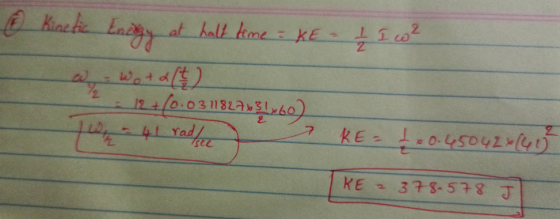
F) What is the kinetic energy at half the time
Homework Answers

Add Answer to:
A thin spherical shell with a weight of 34 N and radius 0.57 m rotates for 31 minutes, starting at 12 rad/s.
A 25 kg weight is swung in a horizontal circle with a tension of 1250 N in the cord holding it.
1 A 25 kg weight is swung in a horizontal circle with a tension of 1250 N in the cord holding it. A) What is the centripetal acceleration? B) What is the linear velocity if the radius is 135 cm? C) What is the linear displacement traveled after 32 revolutions? 2 A thin spherical shell with a weight of 76 N and radius 0.8 m rotates for 14 minutes, starting at 60 rad/s. If it has an angular displacement of 88200 radians: A) What is...
A hollow spherical shell has mass 8.20 kg and radius 0.205 m . It is initially...
A hollow spherical shell has mass 8.20 kg and radius 0.205 m . It is initially at rest and then rotates about a stationary axis that lies along a diameter with a constant acceleration of 0.880 rad/s2 . a)What is the kinetic energy of the shell after it has turned through 5.75 rev ? Express your answer with the appropriate units.
1.A solid uniform sphere of mass 3.7 kg and radius 0.051 m rotates with angular velocity...
1.A solid uniform sphere of mass 3.7 kg and radius 0.051 m rotates with angular velocity 7.3 rad/s about an axis through its center. Find the sphere’s rotational kinetic energy. 2.A certain pulley is a uniform disk of mass 2.7 kg and radius 0.25 m. A rope applies a constant torque to the pulley, which is free to rotate without friction, resulting in an angular acceleration of 0.12 rad/s2. The pulley starts at rest at time t = 0 s....
Given • Hollow hoop has a mass M and radius R. It is free to rotate...
 Given
• Hollow hoop has a mass M and radius R. It is free to rotate about
an axis perpendicular to the page and the edge of the hoop.
Released frm rest, passes through horizontal in final state, and
rotates right
Question
A. Direction of final angular velocity and acceleration
vector?
B. Rotational inertia of hoop about axis before it is released
Do the following increase, decrease,, or remain the
same (Between final and initial)
C. Magnitude of gravitational PE...
Given
• Hollow hoop has a mass M and radius R. It is free to rotate about
an axis perpendicular to the page and the edge of the hoop.
Released frm rest, passes through horizontal in final state, and
rotates right
Question
A. Direction of final angular velocity and acceleration
vector?
B. Rotational inertia of hoop about axis before it is released
Do the following increase, decrease,, or remain the
same (Between final and initial)
C. Magnitude of gravitational PE...
A disk with moment of inertia 9.15 × 10⁻³ kg∙m^2 initially rotates about its center at...
A disk with moment of inertia 9.15 × 10⁻³ kg∙m^2 initially rotates about its center at angular velocity 5.32 rad/s. A non-rotating ring with moment of inertia 4.86 × 10⁻³ kg∙m^2 right above the disk’s center is suddenly dropped onto the disk. Finally, the two objects rotate at the same angular velocity ?? about the same axis. There is no external torque acting on the system during the collision. Please compute the system’s quantities below. 1. Initial angular momentum ??...
(3) A disk with moment of inertia 9.15 × 10⁻³ kg∙m 2 initially rotates about its...
(3) A disk with moment of inertia 9.15 × 10⁻³ kg∙m 2 initially rotates about its center at angular velocity 5.32 rad/s. A non-rotating ring with moment of inertia 4.86 × 10⁻³ kg∙m 2 right above the disk’s center is suddenly dropped onto the disk. Finally, the two objects rotate at the same angular velocity ?? about the same axis. There is no external torque acting on the system during the collision. Please compute the system’s quantities below. 1. Initial...
a four-bar mechanism. Link 2 rotates counterclockwise at a constant 10 rad/s. The weight of links...
a four-bar mechanism. Link 2 rotates counterclockwise at a constant 10 rad/s. The weight of links 2 and 3 is negligible, and link 4 is 17 kg. The radius of gyration of link 4 relative to the center of gravity is 45 mm. Determine the following: 1. The linear acceleration of the center of gravity of link 4, 2. The angular acceleration of link 4, 3. The inertial force and torque of link Using relative velocity method
A solid disk of mass m = 9.2 kg and radius R = 0.2 m is...
 A solid disk of mass m = 9.2 kg and radius R = 0.2 m is rotating with a constant angular velocity of w = 38 rad/s. A thin rectangular rod with mass m2 = 3.7 kg and length L = 2R = 0.4 m begins at rest above the disk and is dropped on the disk where it begins to spin with the disk. 1) What is the initial angular momentum of the rod and disk system? kg-m2/s Submit...
Thanks so much ahead of time! A spherical shell of radius 0.43 m and mass 27...
 Thanks so much ahead of time!
A spherical shell of radius 0.43 m and mass 27 kg initially rolls without slipping towards an incline at a linear speed of 9.1 m/s. If the ball rolls up an incline (inclined 35 degrees above the horizontal) without sliding. How high will it go? A professor holding a spinning wheel used for a demonstration brings the wheel to a stop by applying a constant, tangential friction force to the edge (his hand). The...
Thanks so much ahead of time!
A spherical shell of radius 0.43 m and mass 27 kg initially rolls without slipping towards an incline at a linear speed of 9.1 m/s. If the ball rolls up an incline (inclined 35 degrees above the horizontal) without sliding. How high will it go? A professor holding a spinning wheel used for a demonstration brings the wheel to a stop by applying a constant, tangential friction force to the edge (his hand). The...
please help A uniform disk of radius 0.65 m rotates clockwise about its central axis and...
 please help
A uniform disk of radius 0.65 m rotates clockwise about its central axis and accelerates with constant angular acceleration. At time 1-0 it is rotating at 34 rad/s, at timeに15 s later, its angular speed is 13 rad/s. (Recall 2π rad-1 rev). a. What is the direction of the angular velocity? b. What is the direction of the angular acceleration? c. Calculate the magnitude of the angular acceleration d. Through how many radians has the disk turned in...
please help
A uniform disk of radius 0.65 m rotates clockwise about its central axis and accelerates with constant angular acceleration. At time 1-0 it is rotating at 34 rad/s, at timeに15 s later, its angular speed is 13 rad/s. (Recall 2π rad-1 rev). a. What is the direction of the angular velocity? b. What is the direction of the angular acceleration? c. Calculate the magnitude of the angular acceleration d. Through how many radians has the disk turned in...
 Given
• Hollow hoop has a mass M and radius R. It is free to rotate about
an axis perpendicular to the page and the edge of the hoop.
Released frm rest, passes through horizontal in final state, and
rotates right
Question
A. Direction of final angular velocity and acceleration
vector?
B. Rotational inertia of hoop about axis before it is released
Do the following increase, decrease,, or remain the
same (Between final and initial)
C. Magnitude of gravitational PE...
Given
• Hollow hoop has a mass M and radius R. It is free to rotate about
an axis perpendicular to the page and the edge of the hoop.
Released frm rest, passes through horizontal in final state, and
rotates right
Question
A. Direction of final angular velocity and acceleration
vector?
B. Rotational inertia of hoop about axis before it is released
Do the following increase, decrease,, or remain the
same (Between final and initial)
C. Magnitude of gravitational PE...
 A solid disk of mass m = 9.2 kg and radius R = 0.2 m is rotating with a constant angular velocity of w = 38 rad/s. A thin rectangular rod with mass m2 = 3.7 kg and length L = 2R = 0.4 m begins at rest above the disk and is dropped on the disk where it begins to spin with the disk. 1) What is the initial angular momentum of the rod and disk system? kg-m2/s Submit...
 Thanks so much ahead of time!
A spherical shell of radius 0.43 m and mass 27 kg initially rolls without slipping towards an incline at a linear speed of 9.1 m/s. If the ball rolls up an incline (inclined 35 degrees above the horizontal) without sliding. How high will it go? A professor holding a spinning wheel used for a demonstration brings the wheel to a stop by applying a constant, tangential friction force to the edge (his hand). The...
Thanks so much ahead of time!
A spherical shell of radius 0.43 m and mass 27 kg initially rolls without slipping towards an incline at a linear speed of 9.1 m/s. If the ball rolls up an incline (inclined 35 degrees above the horizontal) without sliding. How high will it go? A professor holding a spinning wheel used for a demonstration brings the wheel to a stop by applying a constant, tangential friction force to the edge (his hand). The...
 please help
A uniform disk of radius 0.65 m rotates clockwise about its central axis and accelerates with constant angular acceleration. At time 1-0 it is rotating at 34 rad/s, at timeに15 s later, its angular speed is 13 rad/s. (Recall 2π rad-1 rev). a. What is the direction of the angular velocity? b. What is the direction of the angular acceleration? c. Calculate the magnitude of the angular acceleration d. Through how many radians has the disk turned in...
please help
A uniform disk of radius 0.65 m rotates clockwise about its central axis and accelerates with constant angular acceleration. At time 1-0 it is rotating at 34 rad/s, at timeに15 s later, its angular speed is 13 rad/s. (Recall 2π rad-1 rev). a. What is the direction of the angular velocity? b. What is the direction of the angular acceleration? c. Calculate the magnitude of the angular acceleration d. Through how many radians has the disk turned in...
Most questions answered within 3 hours.
-
Where is the error in this code sequence?
String s1 = "Hello";
String s2 = "ello";...
asked 10 months ago -
Financial data for Joel de Paris, Inc., for last year
follow:
Joel de Paris, Inc.
Balance...
asked 10 months ago -
Consider this reaction:
Al2(SO4)3 (aq)+ BaCl3
(aq) Al2Cl6 (aq)- +
3BaSO4(s) . What is the...
asked 10 months ago -
Suppose that Savneet is considering increasing her
recent random sample from 20 car rentals to 40...
asked 10 months ago -
Trucks arrive at an unloading terminal at an average rate of 120
per hour.
Trucks arrive...
asked 10 months ago -
Why are methanol and ethanol completely soluble in water while
octanol is not very little soluble....
asked 10 months ago -
A facilities manager at a university reads in a research report
that the mean amount of...
asked 10 months ago -
When the CuSO4 is rehydrated by adding water to the anhydrous
compound, is this an endothermic...
asked 10 months ago -
A ray of sunlight is passing from diamond into crown glass; the
angle of incidence is...
asked 10 months ago -
A block of mass 0.249 kg is placed on top of a light, vertical
spring of...
asked 10 months ago -
how do the kidneys compensate in the presences of acidosis
a) trigger hyperventilate
b) reserve acid...
asked 10 months ago -
Question 501 pts
The rental rate of capital to the firm increases. Which of the
following...
asked 10 months ago