93. Consider the reaction
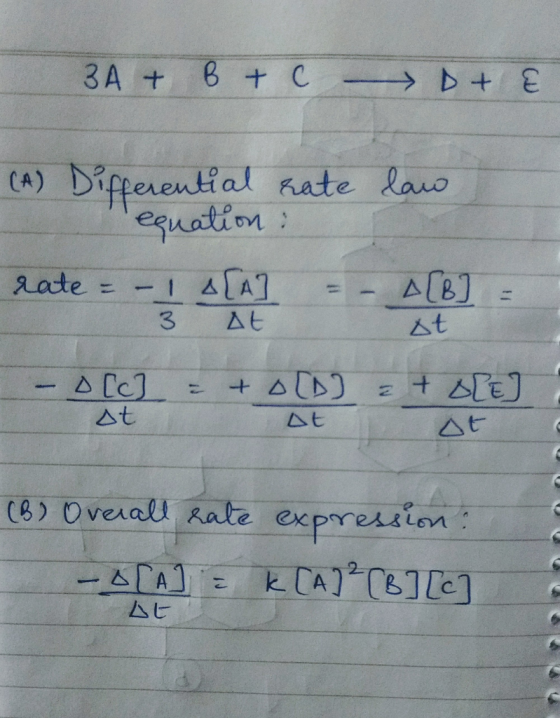
3 A+B+C ⟶ D+E
where the rate law is defined as
-Δ[A]/Δt = k[A]²[B][C]
An experiment is carried out where [B]₀=[C]₀=1.00 M and [A]₀=1.00 × 10⁻⁴ M.
a. If after 3.00 min,[A]=3.26 × 10⁻⁵ M, calculate the value of k.
Homework Answers
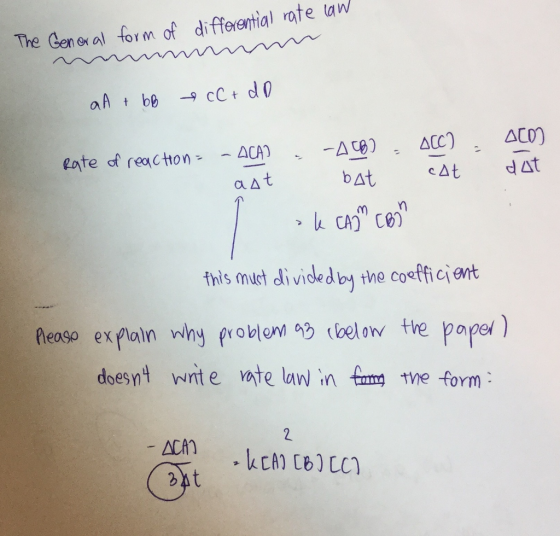
- Differential rate law and overall rate has different expressions for a chemical reaction.
- Differential rate law gives us the rate with respect to the appearance or dissappearance of any reactant/product.
- The whole differential rate is with respect to just one constituent of the equation and hence it is divided by its co-efficient to equate all the constituents.
- The overall rate expression cannot be formed just by looking at the equation. It has to be calculated using methods like steady-state approximation.
- The overall equation is not with respect to just one constituents.
Calculate concentration of A and B This question has multiple pa Consider the reaction SA+B+C D+E...
 Calculate concentration of A and B
This question has multiple pa Consider the reaction SA+B+C D+E where the rate law is defined as AA ABIC An experiment is carried out where [Blo-|Clo 1.00 M and [A],-1.00 x 10⁻⁴ M If after 3.00 min, [A] - 3.21 x 10⁻⁵ M, caleulate the value of k. k-12.5 L/mol b Calculate the half life of A for this experiment. Half-life= 85 Calculate the c tion of B and the concentration of A after...
Calculate concentration of A and B
This question has multiple pa Consider the reaction SA+B+C D+E where the rate law is defined as AA ABIC An experiment is carried out where [Blo-|Clo 1.00 M and [A],-1.00 x 10⁻⁴ M If after 3.00 min, [A] - 3.21 x 10⁻⁵ M, caleulate the value of k. k-12.5 L/mol b Calculate the half life of A for this experiment. Half-life= 85 Calculate the c tion of B and the concentration of A after...
2) 16 marks] Consider the reaction 4A+ B+ 2C D +3E where the rate law is...
 2) 16 marks] Consider the reaction 4A+ B+ 2C D +3E where the rate law is defined as d[B] k[A][B][C]3 dt An experiment is carried out where [A]o = [C]o = 2.00 M and [Blo = 1.00 x 10³ M If after 200. seconds, [B] = 2.35 x 10⁻⁵ M. (a) Calculate the value of k (b) Calculate the half-time for this experiment.
2) 16 marks] Consider the reaction 4A+ B+ 2C D +3E where the rate law is defined...
2) 16 marks] Consider the reaction 4A+ B+ 2C D +3E where the rate law is defined as d[B] k[A][B][C]3 dt An experiment is carried out where [A]o = [C]o = 2.00 M and [Blo = 1.00 x 10³ M If after 200. seconds, [B] = 2.35 x 10⁻⁵ M. (a) Calculate the value of k (b) Calculate the half-time for this experiment.
2) 16 marks] Consider the reaction 4A+ B+ 2C D +3E where the rate law is defined...
Consider the hypothetical reaction: A + B + 2 + 2D + E where the rate...
 Consider the hypothetical reaction: A + B + 2 + 2D + E where the rate law is Rate = -444 = k[A][B An experiment is carried out where [A] = 6.9 x 10 M, (B) = 2.4 M and (C) = 4.0 M. The reaction is started, and after 10.7 seconds, the concentration of A is 4.9 x 10 M. Calculate the value of k for this reaction in units of M's Answer:
Consider the hypothetical reaction: A + B +2C -------> 2D + 3E, where the rate law...
Consider the hypothetical reaction: A + B +2C -------> 2D + 3E, where the rate law is: Rate = -delta[A] / delta t = k[A][B]^2. An experiment is carried out where [A]0 = 1.0*10^-2M, [B]0 = 3.0M, [C]0 = 2.0M. The reaction is started, and after 8.0 seconds, the concentration of A is 3.8*10^-3M. a) Calculate the value of k for the reaction. b) Calculate the half-life for this experiment. c) Calculate the concentration of A after 13.0 seconds d)...
Consider the reaction A + B ? products From the following data obtained at a certain...
Consider the reaction A + B ? products From the following data obtained at a certain temperature, determine the rate law, the order of the reaction, and calculate the rate constant k. Experiment 1: [A] = 1.50 M; [B] = 1.50 M; Initial Rate = 3.20 x 10⁻¹ M/s Experiment 2: [A] = 1.50 M; [B] = 2.50 M; Initial Rate = 3.20 x 10⁻¹ M/s Experiment 3: [A] = 3.00 M; [B] = 1.50 M; Initial Rate = 6.40...
Consider the following reaction at 327 K. 2 A + 2 B + C + D...
 Consider the following reaction at 327 K. 2 A + 2 B + C + D where rate = rate=k[A]?[B]. An experiment was performed for a certain number of seconds where [A]. = 1.91 M and [B]. = 0.000683 M. A plot of In[B] vs time had a slope of -8.87. What will the rate of this reaction be if a new experiment is preformed when [A] = [B] = 0.979 M? rate (M/s)=
Consider the reaction: A(g)+12B(g)→2C(g). rate=−Δ[A]Δt=−2Δ[B]Δt=1/2Δ[C]Δt PART B: When C is increasing at a rate of 4.0×10⁻²...
Consider the reaction: A(g)+12B(g)→2C(g). rate=−Δ[A]Δt=−2Δ[B]Δt=1/2Δ[C]Δt PART B: When C is increasing at a rate of 4.0×10⁻² M⋅s−1, how fast is B decreasing? PART C: How fast is A decreasing?
Consider the reaction A ⟶ Products. The rate law for this reaction is rate = k[A]...
Consider the reaction A ⟶ Products. The rate law for this reaction is rate = k[A] where k= 3.00 X × 10-3 s-1 at a particular temperature. If the initial [A] = 0.500 M, what will be the concentration of A after 2.00 minutes
For the reaction A+B+C→D+E the initial reaction rate was measured for various initial concentrations of reactants....
For the reaction A+B+C→D+E the initial reaction rate was measured for various initial concentrations of reactants. The following data were collected: Trial [A] (M) [B] (M) [C] (M) Initial rate (M/s) 1 0.50 0.50 0.50 1.5×10⁻⁴ 2 0.50 0.50 1.50 4.5×10⁻⁴ 3 1.00 0.50 0.50 6.0×10⁻⁴ 4 1.00 1.00 0.50 6.0×10⁻⁴ What is the value of the rate constant k for this reaction?
Question 1 2 pts Attempt due: Mar 21 Minutes, 3 Consider the below reaction: A+B -->C+D...
 Question 1 2 pts Attempt due: Mar 21 Minutes, 3 Consider the below reaction: A+B -->C+D Experimental evidence indicates that the reaction proceeds according to the below mechanism: 2A --> C+E (slow) B+E -->D+A (fast) Which represents the rate law of this reaction? Rate = k[A]2 Rate = k[A][B] Rate = k*2A Rate = K[B][E] Rate = k[A] Question 2 2 pts Which integrated rate law would you utilize based on your rate law in question 1? 1/[A]t = kt...
 Calculate concentration of A and B
This question has multiple pa Consider the reaction SA+B+C D+E where the rate law is defined as AA ABIC An experiment is carried out where [Blo-|Clo 1.00 M and [A],-1.00 x 10⁻⁴ M If after 3.00 min, [A] - 3.21 x 10⁻⁵ M, caleulate the value of k. k-12.5 L/mol b Calculate the half life of A for this experiment. Half-life= 85 Calculate the c tion of B and the concentration of A after...
Calculate concentration of A and B
This question has multiple pa Consider the reaction SA+B+C D+E where the rate law is defined as AA ABIC An experiment is carried out where [Blo-|Clo 1.00 M and [A],-1.00 x 10⁻⁴ M If after 3.00 min, [A] - 3.21 x 10⁻⁵ M, caleulate the value of k. k-12.5 L/mol b Calculate the half life of A for this experiment. Half-life= 85 Calculate the c tion of B and the concentration of A after...
 2) 16 marks] Consider the reaction 4A+ B+ 2C D +3E where the rate law is defined as d[B] k[A][B][C]3 dt An experiment is carried out where [A]o = [C]o = 2.00 M and [Blo = 1.00 x 10³ M If after 200. seconds, [B] = 2.35 x 10⁻⁵ M. (a) Calculate the value of k (b) Calculate the half-time for this experiment.
2) 16 marks] Consider the reaction 4A+ B+ 2C D +3E where the rate law is defined...
2) 16 marks] Consider the reaction 4A+ B+ 2C D +3E where the rate law is defined as d[B] k[A][B][C]3 dt An experiment is carried out where [A]o = [C]o = 2.00 M and [Blo = 1.00 x 10³ M If after 200. seconds, [B] = 2.35 x 10⁻⁵ M. (a) Calculate the value of k (b) Calculate the half-time for this experiment.
2) 16 marks] Consider the reaction 4A+ B+ 2C D +3E where the rate law is defined...
 Consider the hypothetical reaction: A + B + 2 + 2D + E where the rate law is Rate = -444 = k[A][B An experiment is carried out where [A] = 6.9 x 10 M, (B) = 2.4 M and (C) = 4.0 M. The reaction is started, and after 10.7 seconds, the concentration of A is 4.9 x 10 M. Calculate the value of k for this reaction in units of M's Answer:
 Consider the following reaction at 327 K. 2 A + 2 B + C + D where rate = rate=k[A]?[B]. An experiment was performed for a certain number of seconds where [A]. = 1.91 M and [B]. = 0.000683 M. A plot of In[B] vs time had a slope of -8.87. What will the rate of this reaction be if a new experiment is preformed when [A] = [B] = 0.979 M? rate (M/s)=
 Question 1 2 pts Attempt due: Mar 21 Minutes, 3 Consider the below reaction: A+B -->C+D Experimental evidence indicates that the reaction proceeds according to the below mechanism: 2A --> C+E (slow) B+E -->D+A (fast) Which represents the rate law of this reaction? Rate = k[A]2 Rate = k[A][B] Rate = k*2A Rate = K[B][E] Rate = k[A] Question 2 2 pts Which integrated rate law would you utilize based on your rate law in question 1? 1/[A]t = kt...
Most questions answered within 3 hours.
-
Where is the error in this code sequence?
String s1 = "Hello";
String s2 = "ello";...
asked 10 months ago -
Financial data for Joel de Paris, Inc., for last year
follow:
Joel de Paris, Inc.
Balance...
asked 10 months ago -
Consider this reaction:
Al2(SO4)3 (aq)+ BaCl3
(aq) Al2Cl6 (aq)- +
3BaSO4(s) . What is the...
asked 10 months ago -
Suppose that Savneet is considering increasing her
recent random sample from 20 car rentals to 40...
asked 10 months ago -
Trucks arrive at an unloading terminal at an average rate of 120
per hour.
Trucks arrive...
asked 10 months ago -
Why are methanol and ethanol completely soluble in water while
octanol is not very little soluble....
asked 10 months ago -
A facilities manager at a university reads in a research report
that the mean amount of...
asked 10 months ago -
When the CuSO4 is rehydrated by adding water to the anhydrous
compound, is this an endothermic...
asked 10 months ago -
A ray of sunlight is passing from diamond into crown glass; the
angle of incidence is...
asked 10 months ago -
A block of mass 0.249 kg is placed on top of a light, vertical
spring of...
asked 10 months ago -
how do the kidneys compensate in the presences of acidosis
a) trigger hyperventilate
b) reserve acid...
asked 10 months ago -
Question 501 pts
The rental rate of capital to the firm increases. Which of the
following...
asked 10 months ago