
Homework Answers
Add Answer to:
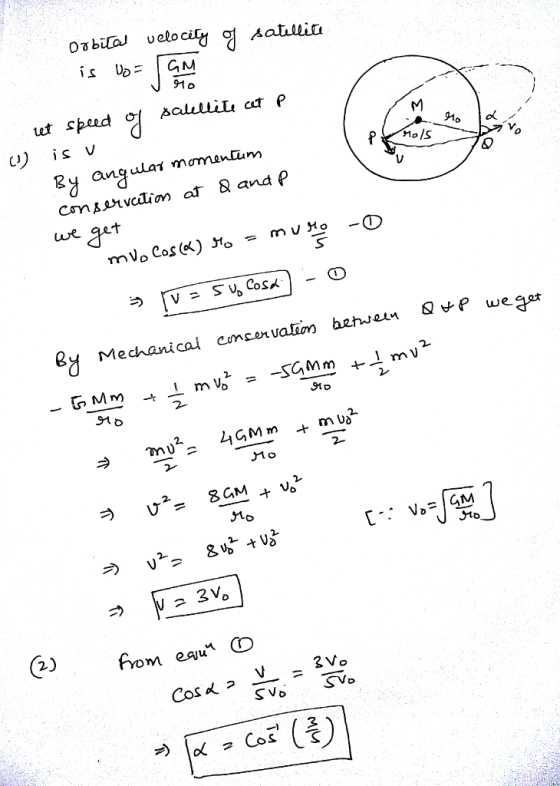
A satellite of mass m is traveling at speed vo in a circular orbit of radius...
2) A satellite of mass m is in circular orbit of radius ro in a potential...
 2) A satellite of mass m is in circular orbit of radius ro in a potential of the form V(r) --kr-3/2 (a) Use the Viral Theorem to find the orbital speed of the satellite. (b) What is the value of the one-dimensional effective potential at ro, Vefr(ro), for this situation? (c) Sketch Velf as a function of r for this potential, labeling your axes carefully, The satellite is now given an impulse which increases its kinetic energy by 20%. (d)...
A satellite is orbiting around a planet in a circular orbit. The radius of the orbit,...
A satellite is orbiting around a planet in a circular orbit. The radius of the orbit, measured from the center of the planet is R = 1.7 × 10⁷ m. The mass of the planet is M = 10 × 1024 kg. A) Express the magnitude of the gravitational force F in terms of M, R, the gravitational constant G, and the mass m of the satellite. B) Express the magnitude of the centripetal acceleration ac of the satellite in terms...
A satellite of mass m is in a circular orbit of radius r about a planet...
 A satellite of mass m is in a circular orbit of radius r about a planet of mass M. The period of the satellite's orbit is T. A second satellite of mass 2m is in a circular orbit of radius 2r around the same planet. The period of orbit for the second satellite is 2T 8T O2T OT O 4T
A spacecraft of mass m = 1900 kg is moving on a circular orbit about the...
 A spacecraft of mass m = 1900 kg is moving on a circular orbit about the earth at a constant speed v = 5.12 km/s. [Given: Mass of the earth M = 5.98 times 10^24 kg, radius of the earth R = 6.37 times10^6 m, gravitational constant G = 6.67 times 10^-11 N.m^2/kg^2.] a. Determine the radius r of the circular orbit. b. What is the period T of the orbit? c. The satellite, by firing its engines, moves to...
Satellite A has mass MA 1997 kg and moves in a circular orbit of radius RA...
 Satellite A has mass MA 1997 kg and moves in a circular orbit of radius RA - 10.3x10 m around a planet (measured from its center). The mass of the planet is M - 6x10 kg and the universal gravitational constant is G = 6.67 x 10⁻¹¹ NmⓇ/kg. 1) What is the speed V of the satellite ? OV - 7605 m/s OV- 13152 m/s OV - 6233 m/s OV-5109 m/s OV-8976 m/s Submit 2) Satellite B moves in a...
A satellite is placed in an elongated elliptical (not circular) orbit around the Earth. At the...
A satellite is placed in an elongated elliptical (not circular) orbit around the Earth. At the point in its orbit where it is closest to the Earth, it is a distance of 1.00 × 10⁶ m from the surface (not the center) of the Earth, and is moving at a velocity of 5.14 km/s. At the point in its orbit when it is furthest from the Earth it is a distance of 2.00×10⁶ m from the surface of the Earth....
The planet shown has a mass of M, and the satellite is in a circular orbit...
The planet shown has a mass of M, and the satellite is in a circular orbit of radius r. a) In terms of M, r, and the universal gravitational constant G, what is the period Tof the satellite? Derive the formula. b) By what factor would the period change if the mass of the planet doubled? c) By what factor would the period change if the radius of the orbit doubled?
3. Earth's orbit. The Earth, with mass m and angular momentum L, moves around the Sun in arn elli...
 Accidently uploaded the photo in a recent question and need help
solving this one.
3. Earth's orbit. The Earth, with mass m and angular momentum L, moves around the Sun in arn elliptic orbit of eccentricity e. The equation of trajectory is given by, r=p1+ecoso 1+e where p is the distance of the closest approach to the Sun (perihelion) (a) Find the two components of the velocity as functions ofQie, v,(9) and vo(9). (8 marks) (b) Prove that the angle...
Accidently uploaded the photo in a recent question and need help
solving this one.
3. Earth's orbit. The Earth, with mass m and angular momentum L, moves around the Sun in arn elliptic orbit of eccentricity e. The equation of trajectory is given by, r=p1+ecoso 1+e where p is the distance of the closest approach to the Sun (perihelion) (a) Find the two components of the velocity as functions ofQie, v,(9) and vo(9). (8 marks) (b) Prove that the angle...
An object of mass m moves at a constant speed v in a circular path of radius r.
An object of mass m moves at a constant speed v in a circular path of radius r. The force required to produce the centripetal component of acceleration is called the centripetal force and is given by F=mv2/r. Newton's Law of Universal Gravitation is given by F=GMm/d2, where d is the distance between the centers of the two bodies of masses M and m, and G is a gravitational constant. The speed required for circular motion is v= √(GM/r). Use the...
A small satellite of mass m is in circular orbit of radius r around a planet of mass M and radius...
A small satellite of mass m is in circular orbit of radius r around a planet of mass M and radius R, where M>>m. a) For full marks, derive the potential, kinetic, and total energy of the satellite in terms of G, M, m, and r assuming that the potential energy is zero at r=infinity. b) What is the minimum amount of energy that the booster rockets must provide for the satellite to escape? c) Now we take into accouny...
 2) A satellite of mass m is in circular orbit of radius ro in a potential of the form V(r) --kr-3/2 (a) Use the Viral Theorem to find the orbital speed of the satellite. (b) What is the value of the one-dimensional effective potential at ro, Vefr(ro), for this situation? (c) Sketch Velf as a function of r for this potential, labeling your axes carefully, The satellite is now given an impulse which increases its kinetic energy by 20%. (d)...
 A satellite of mass m is in a circular orbit of radius r about a planet of mass M. The period of the satellite's orbit is T. A second satellite of mass 2m is in a circular orbit of radius 2r around the same planet. The period of orbit for the second satellite is 2T 8T O2T OT O 4T
 A spacecraft of mass m = 1900 kg is moving on a circular orbit about the earth at a constant speed v = 5.12 km/s. [Given: Mass of the earth M = 5.98 times 10^24 kg, radius of the earth R = 6.37 times10^6 m, gravitational constant G = 6.67 times 10^-11 N.m^2/kg^2.] a. Determine the radius r of the circular orbit. b. What is the period T of the orbit? c. The satellite, by firing its engines, moves to...
 Satellite A has mass MA 1997 kg and moves in a circular orbit of radius RA - 10.3x10 m around a planet (measured from its center). The mass of the planet is M - 6x10 kg and the universal gravitational constant is G = 6.67 x 10⁻¹¹ NmⓇ/kg. 1) What is the speed V of the satellite ? OV - 7605 m/s OV- 13152 m/s OV - 6233 m/s OV-5109 m/s OV-8976 m/s Submit 2) Satellite B moves in a...
 Accidently uploaded the photo in a recent question and need help
solving this one.
3. Earth's orbit. The Earth, with mass m and angular momentum L, moves around the Sun in arn elliptic orbit of eccentricity e. The equation of trajectory is given by, r=p1+ecoso 1+e where p is the distance of the closest approach to the Sun (perihelion) (a) Find the two components of the velocity as functions ofQie, v,(9) and vo(9). (8 marks) (b) Prove that the angle...
Accidently uploaded the photo in a recent question and need help
solving this one.
3. Earth's orbit. The Earth, with mass m and angular momentum L, moves around the Sun in arn elliptic orbit of eccentricity e. The equation of trajectory is given by, r=p1+ecoso 1+e where p is the distance of the closest approach to the Sun (perihelion) (a) Find the two components of the velocity as functions ofQie, v,(9) and vo(9). (8 marks) (b) Prove that the angle...
Most questions answered within 3 hours.
-
Where is the error in this code sequence?
String s1 = "Hello";
String s2 = "ello";...
asked 11 months ago -
Financial data for Joel de Paris, Inc., for last year
follow:
Joel de Paris, Inc.
Balance...
asked 11 months ago -
Consider this reaction:
Al2(SO4)3 (aq)+ BaCl3
(aq) Al2Cl6 (aq)- +
3BaSO4(s) . What is the...
asked 11 months ago -
Suppose that Savneet is considering increasing her
recent random sample from 20 car rentals to 40...
asked 11 months ago -
Trucks arrive at an unloading terminal at an average rate of 120
per hour.
Trucks arrive...
asked 11 months ago -
Why are methanol and ethanol completely soluble in water while
octanol is not very little soluble....
asked 11 months ago -
A facilities manager at a university reads in a research report
that the mean amount of...
asked 11 months ago -
When the CuSO4 is rehydrated by adding water to the anhydrous
compound, is this an endothermic...
asked 11 months ago -
A ray of sunlight is passing from diamond into crown glass; the
angle of incidence is...
asked 11 months ago -
A block of mass 0.249 kg is placed on top of a light, vertical
spring of...
asked 11 months ago -
how do the kidneys compensate in the presences of acidosis
a) trigger hyperventilate
b) reserve acid...
asked 11 months ago -
Question 501 pts
The rental rate of capital to the firm increases. Which of the
following...
asked 11 months ago