
Homework Answers
a) The Viral Theorem indicates the following:
 (1)
(1)
Where
< T>: is the average kinetic energy on k particles
vec{F_{k}: is the force of attraction between the particles
vec{r_{k}}:is the radial distance between the particles
In our case, we have one particle, then
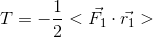 (2)
(2)
The radial force exerted on the satellite is expressed as a function of the potential
 (3)
(3)
Where
 (4)
(4)
In magnitude
 (5)
(5)
but the satellite position vector and the radial force are opposite, therefore when making the dot product between these vectors, the angle is 180 degrees
 (6)
(6)
 (7)
(7)
Now
 (8)
(8)

Therefore
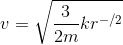
b)The effective potential is defined as the potential due to the radial force, plus the potential due to the centrifugal force, whose force moves the satellite away from the mass that attracts it
 (9)
(9)
Where:
l: is the angular momentum
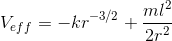
Adding the fractions of the previous equation we have:
 (10)
(10)
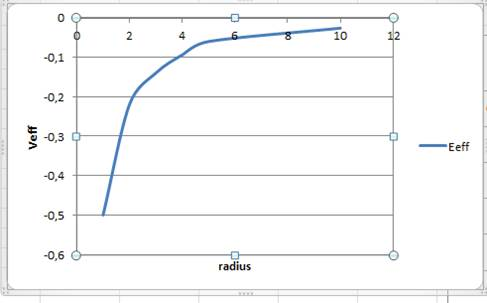
c)
For the realization of the previous graph we assume from equation 10, the following:


 (11)
(11)
when graphing expression 11, we have:
Add Answer to:
2) A satellite of mass m is in circular orbit of radius ro in a potential...
A small satellite of mass m is in circular orbit of radius r around a planet of mass M and radius...
A small satellite of mass m is in circular orbit of radius r around a planet of mass M and radius R, where M>>m. a) For full marks, derive the potential, kinetic, and total energy of the satellite in terms of G, M, m, and r assuming that the potential energy is zero at r=infinity. b) What is the minimum amount of energy that the booster rockets must provide for the satellite to escape? c) Now we take into accouny...
A satellite of mass m (where m ≪ Me) is initially in a circular orbit around...
A satellite of mass m (where m ≪ Me) is initially in a circular orbit around the Earth at a height of 410 km above the Earth’s equator. Its operators would like to move it into a geosynchronous orbit using a Hohmann transfer orbit. Assume a spherical Earth with radius 6371 km. (a) Sketch the satellite’s Hohmann transfer orbit. (b) Find the satellite’s initial (circular) orbital speed according to an inertial observer. (c) Find the maximum height of the satellite...
Let a satellite orbits a planet of mass M at circular orbit of radius R. Find...
Let a satellite orbits a planet of mass M at circular orbit of radius R. Find the orbital period T. Express your answer in terms of G, M, R, and π If the mass of the planet is 5.98 x 1024 kg, calculate the ratio of T2 to R3.
A 100kg satellite is in circular orbit meaning that it experiences a universal gravitational force. It...
A 100kg satellite is in circular orbit meaning that it experiences a universal gravitational force. It takes 100 minutes for it to complete 1 orbit. Mass of the Earth is 5.97 * 10 24 kg. G is 6.67 * 10 -11 m3/s2 kg. a) How far is the satellite from the center of the Earth? b) Using your result from part a, determine the gravitational potential energy of the satellite? c) What is the kinetic energy of the satellite? d)...
A spacecraft of mass m = 1900 kg is moving on a circular orbit about the...
 A spacecraft of mass m = 1900 kg is moving on a circular orbit about the earth at a constant speed v = 5.12 km/s. [Given: Mass of the earth M = 5.98 times 10^24 kg, radius of the earth R = 6.37 times10^6 m, gravitational constant G = 6.67 times 10^-11 N.m^2/kg^2.] a. Determine the radius r of the circular orbit. b. What is the period T of the orbit? c. The satellite, by firing its engines, moves to...
5) A satellite in a circular orbit of radius R around planet X has an orbital...
5) A satellite in a circular orbit of radius R around planet X has an orbital period T. If Planet X had one-fourth as much mass, the orbital period of this satellite in an orbit of the same radius would be: A) 2T B) T square root(2) C) T/4 D) T/2 E) 4
A satellite is in a circular Earth orbit of radius r. The area A enclosed by...
A satellite is in a circular Earth orbit of radius r. The area A enclosed by the orbit depends on r2 because A = ?r2. Determine how the following properties of the satellite depend on r. In each case, give the power of r, i.e., if the dependence goes as rn, give n. If there is no dependence, then n = 0. (a) period, (b) kinetic energy, (c) angular momentum, and (d) speed.
A satellite is in a circular Earth orbit of radius r. The area A enclosed by the orbit depends on r2 because A = πr2. D...
A satellite is in a circular Earth orbit of radius r. The area A enclosed by the orbit depends on r2 because A = πr2. Determine how the following properties of the satellite depend on r. In each case, give the power of r, i.e., if the dependence goes as rn, give n. If there is no dependence, then n = 0. (a) period, (b) kinetic energy, (c) angular momentum, and (d) speed.
2. Consider a system consisting of the Sun, Earth, and a satellite in a circular orbit...
 2. Consider a system consisting of the Sun, Earth, and a satellite in a circular orbit about the Earth. (a) Plot the gravitational acceleration of the satellite due to Earth's gravity as a function of the altitude of the satellite as measured from the surface of the Earth. Scale your plot so that the altitude goes from 0 km to 104 km. (b) Assume that the satellite instantaneously lies on the line between the Earth and the Sun. Make two...
Two stars, each of mass M, orbit around their center of mass. The radius of their...
 Two stars, each of mass M, orbit around
their center of mass. The radius of their common orbit is r (their
separation is 2r).
A planetoid of mass m (<< M) happens to move along the
axis of the system (the line perpendicular to the orbital plane
which
intersects the center of mass) as shown in the figure.
a. Calculate directly the force on the planetoid if it is
displaced a distance z from the
center of mass (you’ll need...
Two stars, each of mass M, orbit around
their center of mass. The radius of their common orbit is r (their
separation is 2r).
A planetoid of mass m (<< M) happens to move along the
axis of the system (the line perpendicular to the orbital plane
which
intersects the center of mass) as shown in the figure.
a. Calculate directly the force on the planetoid if it is
displaced a distance z from the
center of mass (you’ll need...
 A spacecraft of mass m = 1900 kg is moving on a circular orbit about the earth at a constant speed v = 5.12 km/s. [Given: Mass of the earth M = 5.98 times 10^24 kg, radius of the earth R = 6.37 times10^6 m, gravitational constant G = 6.67 times 10^-11 N.m^2/kg^2.] a. Determine the radius r of the circular orbit. b. What is the period T of the orbit? c. The satellite, by firing its engines, moves to...
 2. Consider a system consisting of the Sun, Earth, and a satellite in a circular orbit about the Earth. (a) Plot the gravitational acceleration of the satellite due to Earth's gravity as a function of the altitude of the satellite as measured from the surface of the Earth. Scale your plot so that the altitude goes from 0 km to 104 km. (b) Assume that the satellite instantaneously lies on the line between the Earth and the Sun. Make two...
 Two stars, each of mass M, orbit around
their center of mass. The radius of their common orbit is r (their
separation is 2r).
A planetoid of mass m (<< M) happens to move along the
axis of the system (the line perpendicular to the orbital plane
which
intersects the center of mass) as shown in the figure.
a. Calculate directly the force on the planetoid if it is
displaced a distance z from the
center of mass (you’ll need...
Two stars, each of mass M, orbit around
their center of mass. The radius of their common orbit is r (their
separation is 2r).
A planetoid of mass m (<< M) happens to move along the
axis of the system (the line perpendicular to the orbital plane
which
intersects the center of mass) as shown in the figure.
a. Calculate directly the force on the planetoid if it is
displaced a distance z from the
center of mass (you’ll need...
Most questions answered within 3 hours.
-
Where is the error in this code sequence?
String s1 = "Hello";
String s2 = "ello";...
asked 11 months ago -
Financial data for Joel de Paris, Inc., for last year
follow:
Joel de Paris, Inc.
Balance...
asked 11 months ago -
Consider this reaction:
Al2(SO4)3 (aq)+ BaCl3
(aq) Al2Cl6 (aq)- +
3BaSO4(s) . What is the...
asked 11 months ago -
Suppose that Savneet is considering increasing her
recent random sample from 20 car rentals to 40...
asked 11 months ago -
Trucks arrive at an unloading terminal at an average rate of 120
per hour.
Trucks arrive...
asked 11 months ago -
Why are methanol and ethanol completely soluble in water while
octanol is not very little soluble....
asked 11 months ago -
A facilities manager at a university reads in a research report
that the mean amount of...
asked 11 months ago -
When the CuSO4 is rehydrated by adding water to the anhydrous
compound, is this an endothermic...
asked 11 months ago -
A ray of sunlight is passing from diamond into crown glass; the
angle of incidence is...
asked 11 months ago -
A block of mass 0.249 kg is placed on top of a light, vertical
spring of...
asked 11 months ago -
how do the kidneys compensate in the presences of acidosis
a) trigger hyperventilate
b) reserve acid...
asked 11 months ago -
Question 501 pts
The rental rate of capital to the firm increases. Which of the
following...
asked 11 months ago