![[3] A thin metal rod of length L is rotating counterclockwise with an angular velocity Co on the plane of the paper about an axis through one of its ends, as shown in the Figure. A uniform magnetic field Bo points into the plane in the region where the rod is rotating (A) Calculate the magnitude and direction of the magnetic force FB that acts on the rods charge carriers, resulting in the accumulation of opposite charges at the two ends of the rod. (B) Sketch the rod and show the positive and negative ends. This separation of charges sets up an E in the rod. (c)What is the direction of E? (D) The E grows until F -Fa Equating the two forces, calculate the magnitude of the electric field. (E) Finally, calculate the potential difference between the two ends of the rod in terms of a, L, and Bo by recognizing that AV EMF EL](http://img.homeworklib.com/questions/bea318b0-74c8-11ec-abe1-b5a639e21524.png?x-oss-process=image/resize,w_560)
Homework Answers
A)
Using right hand rule of cross product and Lorentz force we can find that charge carriers that electrons will have force F= q(v x B) = -e(v x B) towards the center of the circle as shown in the below figure.
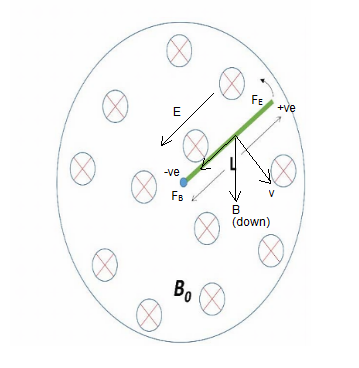
Thus the magnetic force FB on electron will be towards the center of the circle.
B)
C)
Electric field direction is from +ve charges to negative charges. Thus E is shown in the above figure away from the center.
D)
FE = - FB = - q(v x B) = -[-e(v x B)] = evB
E = FE/e = vB
Since v=wL
E = wBL
E)
?V = EMF = EL = wB0L ^2
Add Answer to:
A thin metal rod of length L is rotating counterclockwise with an angular velocity omega on...
In the figure, a conducting rod of length L= 27.0 cm moves in a magnetic field B of magnitude 0.370 T directed into the plane of the figure
 In the figure, a conducting rod of length L= 27.0 cm moves in a magnetic field B of magnitude 0.370 T directed into the plane of the figure. The rod moves with speed v = 7.00 m/s in the direction shown. (Figure 1) A. When the charges in the rod are in equilibrium, what is the
magnitude E of the electric field within the rod?B. What is the magnitude Vba of the potential difference
between the ends of the rod?C. What...
In the figure, a conducting rod of length L= 27.0 cm moves in a magnetic field B of magnitude 0.370 T directed into the plane of the figure. The rod moves with speed v = 7.00 m/s in the direction shown. (Figure 1) A. When the charges in the rod are in equilibrium, what is the
magnitude E of the electric field within the rod?B. What is the magnitude Vba of the potential difference
between the ends of the rod?C. What...
In the figure, a conducting rod of length L = 31.0 cm moves in a magnetic field B of magnitude 0.460 T directed into the plane of the figure
 In the figure, a conducting rod of length L = 31.0 cm moves in a magnetic field B of magnitude 0.460 T directed into the plane of the figure. The rod moves with speed v = 6.00 m/s in the direction shown. (Figure 1) Part C When the charges in the rod are in equilibrium, what is the magnitude of the electric field within the rod? Part F What is the magnitude E of the motional emf induced in the rod?
A uniform thin rod of length 0.97 m and mass 2.2 kg lies in a horizontal...
A uniform thin rod of length 0.97 m and mass 2.2 kg lies in a horizontal plane and rotates in that plane about a pivot at one of its ends. The rod makes one rotation every 0.29 second and rotates clockwise as viewed from above its plane of rotation. the magnitude of the rod's angular momentum about its rotation axis, is 14.95 kg m2/s. 1. choose the correct direction of the angular momentum vector for the situation described above a....
In the figure (Figure 1) a conducting rod of length L = 33.0 cm moves in a magnetic field B of magnitude 0.480 T
 In the figure (Figure 1) a conducting rod of length L = 33.0 cm moves in a magnetic field B of magnitude 0.480 T directed into the plane of the figure. The rod moves with speed v=5.90 m/s in the direction shown. Part A What is the potential difference between the ends of the rod? Part B Which point, a or b, is at higher potential? Part C When the charges in the rod are in equilibrium, what is the magnitude of the electric field? Part D What...
A metal rod with a length of 30.0 cm lies in the xy-plane and makes an...
A metal rod with a length of 30.0 cm lies in the xy-plane and makes an angle of 33.6 ∘ with the positive x-axis and an angle of 56.4 ∘ with the positive y-axis. The rod is moving in the +x-direction with a speed of 6.80 m/s . The rod is in a uniform magnetic field B⃗ =(0.100T)i^−(0.300T)j^−(0.0800T )k^. What is the magnitude of the emf induced in the rod?
A metal rod with a length of 30.0 cm lies in the xy-plane and makes an...
 A metal rod with a length of 30.0 cm lies in the xy-plane and makes an angle of 37.1 ° with the positive x-axis and an angle of 52.9° with the positive y-axis. The rod is moving in the +x-direction with a speed of 6.80 m/s. The rod is in a uniform magnetic field B = (0.110T)2 – (0.240T)j – (0.0800T )k. Part A What is the magnitude of the emf induced in the rod?
please help 2. A metal rod with a length of 25.0 cm lies in the xz-plane and makes an angle of 15.00 with the positive x-axis and an angle of 75.0° with the positive z-axis. The rod is moving in t...
 please help
2. A metal rod with a length of 25.0 cm lies in the xz-plane and makes an angle of 15.00 with the positive x-axis and an angle of 75.0° with the positive z-axis. The rod is moving in the plane at a direction perpendicular to its length with a speed of 7.50 m/s. The rod is in a uniform magnetic field of B3(0.120T)/^ + (0.260T)/^-(0.0500T)k". what is the magnitude of the emf induced in the rod? Start with...
please help
2. A metal rod with a length of 25.0 cm lies in the xz-plane and makes an angle of 15.00 with the positive x-axis and an angle of 75.0° with the positive z-axis. The rod is moving in the plane at a direction perpendicular to its length with a speed of 7.50 m/s. The rod is in a uniform magnetic field of B3(0.120T)/^ + (0.260T)/^-(0.0500T)k". what is the magnitude of the emf induced in the rod? Start with...
Part A A metal rod with a length of 22.0 cm lies in the xy-plane and...
 Part A A metal rod with a length of 22.0 cm lies in the xy-plane and makes an angle of 38.4 ° with the positive x-axis and an angle of 51.6° with the positive y-axis. The rod is moving in the +x-direction with a speed of 6.80 m/s. The rod is in a uniform magnetic field B = (0.130T) i – (0.210T) Î – (0.0200T )Â. What is the magnitude of the emf induced in the rod? ΑΣΦ ? E...
Constants A metal rod with a length of 22.0 cm lies in the xy-plane and makes...
Constants A metal rod with a length of 22.0 cm lies in the xy-plane and makes an angle of 32.0 ∘ with the positive x-axis and an angle of 58.0 ∘ with the positive y-axis. The rod is moving in the +x-direction with a speed of 6.80 m/s . The rod is in a uniform magnetic field B⃗ =(0.200T)i^−(0.250T)j^−(0.0700T )k^. Part A What is the magnitude of the emf induced in the rod?
Part A metal rod with a length of 25.0 cm lies in the ry-plane and makes...
 Part A metal rod with a length of 25.0 cm lies in the ry-plane and makes an angle of 33.4 with the positive r-axis and an angle of 56.6 with the positive axis. The rod is moving in the +a-direction with a speed of 6.80 m/s. The rod is in a uniform magnetic field What is the magnitude of the emf induced in the rod? B (0.160T)i (0.250T)j (0.0300T)k Submit My Answers Give Up
 A metal rod with a length of 30.0 cm lies in the xy-plane and makes an angle of 37.1 ° with the positive x-axis and an angle of 52.9° with the positive y-axis. The rod is moving in the +x-direction with a speed of 6.80 m/s. The rod is in a uniform magnetic field B = (0.110T)2 – (0.240T)j – (0.0800T )k. Part A What is the magnitude of the emf induced in the rod?
 please help
2. A metal rod with a length of 25.0 cm lies in the xz-plane and makes an angle of 15.00 with the positive x-axis and an angle of 75.0° with the positive z-axis. The rod is moving in the plane at a direction perpendicular to its length with a speed of 7.50 m/s. The rod is in a uniform magnetic field of B3(0.120T)/^ + (0.260T)/^-(0.0500T)k". what is the magnitude of the emf induced in the rod? Start with...
please help
2. A metal rod with a length of 25.0 cm lies in the xz-plane and makes an angle of 15.00 with the positive x-axis and an angle of 75.0° with the positive z-axis. The rod is moving in the plane at a direction perpendicular to its length with a speed of 7.50 m/s. The rod is in a uniform magnetic field of B3(0.120T)/^ + (0.260T)/^-(0.0500T)k". what is the magnitude of the emf induced in the rod? Start with...
 Part A A metal rod with a length of 22.0 cm lies in the xy-plane and makes an angle of 38.4 ° with the positive x-axis and an angle of 51.6° with the positive y-axis. The rod is moving in the +x-direction with a speed of 6.80 m/s. The rod is in a uniform magnetic field B = (0.130T) i – (0.210T) Î – (0.0200T )Â. What is the magnitude of the emf induced in the rod? ΑΣΦ ? E...
 Part A metal rod with a length of 25.0 cm lies in the ry-plane and makes an angle of 33.4 with the positive r-axis and an angle of 56.6 with the positive axis. The rod is moving in the +a-direction with a speed of 6.80 m/s. The rod is in a uniform magnetic field What is the magnitude of the emf induced in the rod? B (0.160T)i (0.250T)j (0.0300T)k Submit My Answers Give Up
Most questions answered within 3 hours.
-
Where is the error in this code sequence?
String s1 = "Hello";
String s2 = "ello";...
asked 11 months ago -
Financial data for Joel de Paris, Inc., for last year
follow:
Joel de Paris, Inc.
Balance...
asked 11 months ago -
Consider this reaction:
Al2(SO4)3 (aq)+ BaCl3
(aq) Al2Cl6 (aq)- +
3BaSO4(s) . What is the...
asked 11 months ago -
Suppose that Savneet is considering increasing her
recent random sample from 20 car rentals to 40...
asked 11 months ago -
Trucks arrive at an unloading terminal at an average rate of 120
per hour.
Trucks arrive...
asked 11 months ago -
Why are methanol and ethanol completely soluble in water while
octanol is not very little soluble....
asked 11 months ago -
A facilities manager at a university reads in a research report
that the mean amount of...
asked 11 months ago -
When the CuSO4 is rehydrated by adding water to the anhydrous
compound, is this an endothermic...
asked 11 months ago -
A ray of sunlight is passing from diamond into crown glass; the
angle of incidence is...
asked 11 months ago -
A block of mass 0.249 kg is placed on top of a light, vertical
spring of...
asked 11 months ago -
how do the kidneys compensate in the presences of acidosis
a) trigger hyperventilate
b) reserve acid...
asked 11 months ago -
Question 501 pts
The rental rate of capital to the firm increases. Which of the
following...
asked 11 months ago