
Homework Answers
Hope this will be helpful
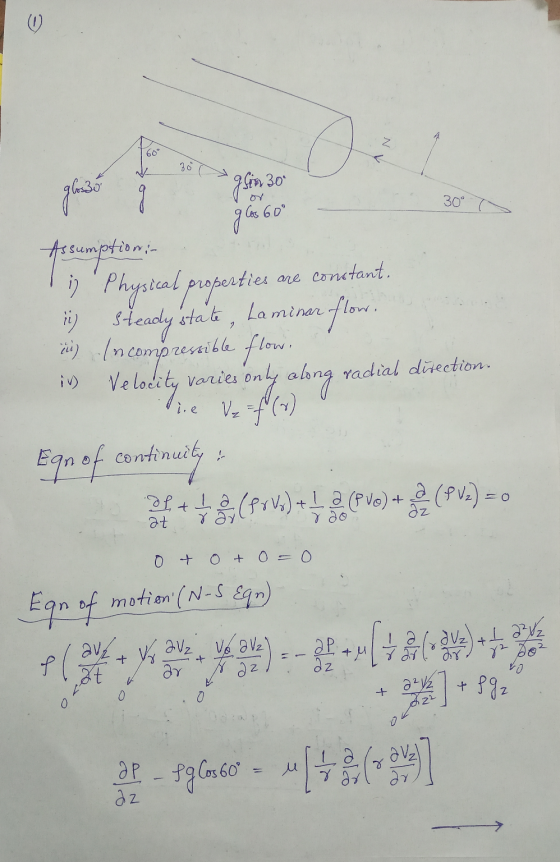
Page2
 page3
page3
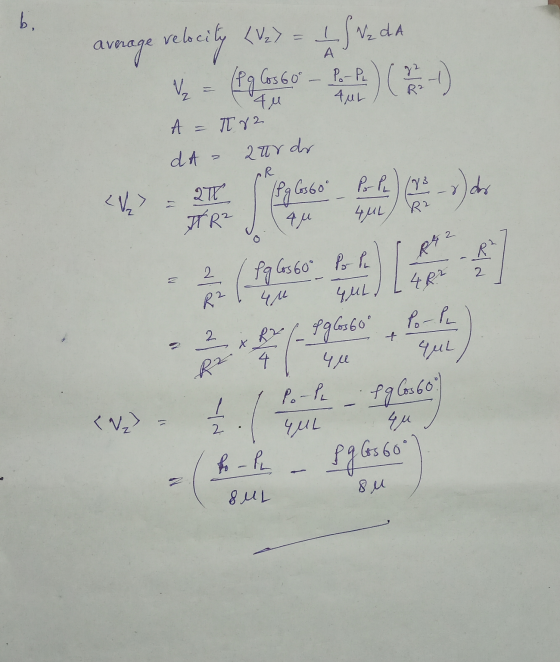
Please Give ur feedback :)
Add Answer to:
2. In the figure below a cylindrical pipe with radius R and length L is shown....
The laminar flow of a permanent incompressible Newtonian fluid in a long cylindrical pipe with a...
The laminar flow of a permanent incompressible Newtonian fluid in a long cylindrical pipe with a diameter D in vertical position is considered. Gravitational effects are taken into account, flow is carried out with a constant pressure gradient and gravity effect in the z- direction. a. Express the problem on the figure, write the given and accepted. b. Find the velocity profile in the fluid. c. Develop the relations that express the volumetric flow and shear stress in the pipe...
4. An incompressible fluid with viscosity u and density p was contained in pipe of length...
 4. An incompressible fluid with viscosity u and density p was contained in pipe of length L and radius R. Initially the fluid is in rest. At t=0, a pressure difference of AP is applied across the pipe length which induces the fluid flow in axial direction (V2) Only varies with time (t) and pipe radius (r). There is no effect of gravity. To describe the fluid flow characteristics, after the pressure gradient is applied, answer the following questions: a)...
HW 8 Poiseuille flow: Fully developed laminar pipe flow (in cylindrical coordinate) - The simplified z-momentum...
 HW 8 Poiseuille flow: Fully developed laminar pipe flow (in cylindrical coordinate) - The simplified z-momentum equation - The boundary conditions = No slip at r=R The Navier-Stokes equation for 2D (x,y) incompressible flow DV P -Op+uv2V + pg dt - Assumptions: 1. 2. 3. 4. 5. 6. Finite velocity at r=0 - Final velocity solution of Poiseuille flow - The rz component of the NS equation (in cylindrical coordinate) - Volume flow rate (Q = ſ vedA)
Step by step solution please A 16-inch gasoline pipe line is transport gasoline at a flow...
 Step by step solution please
A 16-inch gasoline pipe line is transport gasoline at a flow rate of 200 gallon per minute. Please calculate how much pressure gradient dp/dx is needed, using the N-S equation provided in below? (Hint: Assuming the flow in the pipe line is laminar so you can use the Poisson flow to solve the problem. Dynamic viscosity of gasoline is 0.0006 N/m*2 second; density of gasoline is 0.77 kg/L.) Cylindrical coordinates (r.0,2) We consider an incompressible,...
Step by step solution please
A 16-inch gasoline pipe line is transport gasoline at a flow rate of 200 gallon per minute. Please calculate how much pressure gradient dp/dx is needed, using the N-S equation provided in below? (Hint: Assuming the flow in the pipe line is laminar so you can use the Poisson flow to solve the problem. Dynamic viscosity of gasoline is 0.0006 N/m*2 second; density of gasoline is 0.77 kg/L.) Cylindrical coordinates (r.0,2) We consider an incompressible,...
L 2. Steady statemass balance: Water is flowing at steady state in a 0.1 meter-diameter pipe...
 L 2. Steady statemass balance: Water is flowing at steady state in a 0.1 meter-diameter pipe with a maximum velocity (turbulent profile) of 0.3 meters/sec. The pipe then goes through an expansion, to where it is then flowing in a 0.5 meter-diameter pipe, and the flow regime has changed from turbulent to laminar. In the second section of pipe, calculate the velocity as (a) block flow profile (Vavg), and (b) maximum velocity in laminar flow profile? HINT: you will need...
A long, cylindrical non-conductor of radius R and length L is placed with it long axis...
 A long, cylindrical non-conductor of radius R and length L is placed with it long axis along the Z-axis as shown The cylinder has a total charge Q distributed non-uniformly thrpughout its volume. The charge density is only a function of the radial distance "r" from the cylinder axis and varies as ρ(r):- where α is a constant Vr. 2 +9R2 c) What coordinate system will you use? L (xy,z), (p,o,Z), (,o,)) d) What variables will the magnitude of the...
A cylindrical conductor of area A and length L has a conductivity (σ-1/R) that varies as...
 A cylindrical conductor of area A and length L has a conductivity (σ-1/R) that varies as ơ -now Find an algebraic relationship between the current density (VA), ơo, L and A if the conductor is connected to V volts DC
The figure below is a section of a conducting rod of radius R1=1.30mm and length L=11.00mm...
The figure below is a section of a conducting rod of radius R1=1.30mm and length L=11.00mm inside a thick-walled coaxial conducting cylindrical shell of radius R2=10.0R1 and the (same) length L. The net charge on the rod is Q1=-4.30∗10−12C that on the shell is Q2=-4.00Q1. a) What is the magnitude E of the electric field at a radial distance of r = 2.50R2? b) What is the direction of the electric field at the radial distance (inward, outward, or zero)? Give...
A cylindrical cork of radius R and length L is floating in a liquid such that...
 A cylindrical cork of radius R and length L is floating in a liquid such that its axis of symmetry is vertical and half of the length of the cork is below the fluid (the density of the fluid is p), as in Figure 2. For this problem, ignore any effects from friction, drag and the viscosity of the fluid (a) Show that the density of the cork, Pe is half that of the fluid (Pe ps) (b) If the...
4. Consider upwards, laminar flow in a vertical pipe of length L. (a) Starting with the...
 4. Consider upwards, laminar flow in a vertical pipe of length L. (a) Starting with the NS equations given in 6.128 c. simplify the eq'ns, state the BCs in the coordinate system shown, solve for vír), wall shear stress tw, and the average flow speed V=Q/rR; (b) rearrange your result into the form , like EB CV relation, (AP/pg +1)=f* (LD)V/(29) for arbitrary length L, and show that the friction factor f= C2/Rc and evaluate C2 as a number. Follow...
 4. An incompressible fluid with viscosity u and density p was contained in pipe of length L and radius R. Initially the fluid is in rest. At t=0, a pressure difference of AP is applied across the pipe length which induces the fluid flow in axial direction (V2) Only varies with time (t) and pipe radius (r). There is no effect of gravity. To describe the fluid flow characteristics, after the pressure gradient is applied, answer the following questions: a)...
 HW 8 Poiseuille flow: Fully developed laminar pipe flow (in cylindrical coordinate) - The simplified z-momentum equation - The boundary conditions = No slip at r=R The Navier-Stokes equation for 2D (x,y) incompressible flow DV P -Op+uv2V + pg dt - Assumptions: 1. 2. 3. 4. 5. 6. Finite velocity at r=0 - Final velocity solution of Poiseuille flow - The rz component of the NS equation (in cylindrical coordinate) - Volume flow rate (Q = ſ vedA)
 Step by step solution please
A 16-inch gasoline pipe line is transport gasoline at a flow rate of 200 gallon per minute. Please calculate how much pressure gradient dp/dx is needed, using the N-S equation provided in below? (Hint: Assuming the flow in the pipe line is laminar so you can use the Poisson flow to solve the problem. Dynamic viscosity of gasoline is 0.0006 N/m*2 second; density of gasoline is 0.77 kg/L.) Cylindrical coordinates (r.0,2) We consider an incompressible,...
Step by step solution please
A 16-inch gasoline pipe line is transport gasoline at a flow rate of 200 gallon per minute. Please calculate how much pressure gradient dp/dx is needed, using the N-S equation provided in below? (Hint: Assuming the flow in the pipe line is laminar so you can use the Poisson flow to solve the problem. Dynamic viscosity of gasoline is 0.0006 N/m*2 second; density of gasoline is 0.77 kg/L.) Cylindrical coordinates (r.0,2) We consider an incompressible,...
 L 2. Steady statemass balance: Water is flowing at steady state in a 0.1 meter-diameter pipe with a maximum velocity (turbulent profile) of 0.3 meters/sec. The pipe then goes through an expansion, to where it is then flowing in a 0.5 meter-diameter pipe, and the flow regime has changed from turbulent to laminar. In the second section of pipe, calculate the velocity as (a) block flow profile (Vavg), and (b) maximum velocity in laminar flow profile? HINT: you will need...
 A long, cylindrical non-conductor of radius R and length L is placed with it long axis along the Z-axis as shown The cylinder has a total charge Q distributed non-uniformly thrpughout its volume. The charge density is only a function of the radial distance "r" from the cylinder axis and varies as ρ(r):- where α is a constant Vr. 2 +9R2 c) What coordinate system will you use? L (xy,z), (p,o,Z), (,o,)) d) What variables will the magnitude of the...
 A cylindrical conductor of area A and length L has a conductivity (σ-1/R) that varies as ơ -now Find an algebraic relationship between the current density (VA), ơo, L and A if the conductor is connected to V volts DC
 A cylindrical cork of radius R and length L is floating in a liquid such that its axis of symmetry is vertical and half of the length of the cork is below the fluid (the density of the fluid is p), as in Figure 2. For this problem, ignore any effects from friction, drag and the viscosity of the fluid (a) Show that the density of the cork, Pe is half that of the fluid (Pe ps) (b) If the...
 4. Consider upwards, laminar flow in a vertical pipe of length L. (a) Starting with the NS equations given in 6.128 c. simplify the eq'ns, state the BCs in the coordinate system shown, solve for vír), wall shear stress tw, and the average flow speed V=Q/rR; (b) rearrange your result into the form , like EB CV relation, (AP/pg +1)=f* (LD)V/(29) for arbitrary length L, and show that the friction factor f= C2/Rc and evaluate C2 as a number. Follow...
Most questions answered within 3 hours.
-
Where is the error in this code sequence?
String s1 = "Hello";
String s2 = "ello";...
asked 10 months ago -
Financial data for Joel de Paris, Inc., for last year
follow:
Joel de Paris, Inc.
Balance...
asked 10 months ago -
Consider this reaction:
Al2(SO4)3 (aq)+ BaCl3
(aq) Al2Cl6 (aq)- +
3BaSO4(s) . What is the...
asked 10 months ago -
Suppose that Savneet is considering increasing her
recent random sample from 20 car rentals to 40...
asked 10 months ago -
Trucks arrive at an unloading terminal at an average rate of 120
per hour.
Trucks arrive...
asked 10 months ago -
Why are methanol and ethanol completely soluble in water while
octanol is not very little soluble....
asked 10 months ago -
A facilities manager at a university reads in a research report
that the mean amount of...
asked 10 months ago -
When the CuSO4 is rehydrated by adding water to the anhydrous
compound, is this an endothermic...
asked 10 months ago -
A ray of sunlight is passing from diamond into crown glass; the
angle of incidence is...
asked 10 months ago -
A block of mass 0.249 kg is placed on top of a light, vertical
spring of...
asked 10 months ago -
how do the kidneys compensate in the presences of acidosis
a) trigger hyperventilate
b) reserve acid...
asked 10 months ago -
Question 501 pts
The rental rate of capital to the firm increases. Which of the
following...
asked 10 months ago