
Homework Answers


Add Answer to:
A cylindrical conductor of area A and length L has a conductivity (σ-1/R) that varies as...
A solid conductor of circular cross section with a radius of 5 mm has a conductivity...
A solid conductor of circular cross section with a radius of 5 mm has a conductivity (σ) that varies with radius. The conductor is 20 m long, and there is a potential difference of 0.1 V between its two ends. Within the conductor, H̀ = 10⁵r² ǿ A/m. Find σ as a function of r.
A cylindrical conductor has inner radius 'a and outer radius 'b'. conductor is I, distributed so ...
 1172
A cylindrical conductor has inner radius 'a and outer radius 'b'. conductor is I, distributed so that the current per unit cross- sectional area is constant. Find the magnetic flux density at any radius r, where a<r<b, in terms of I, r, a, b. The total current in the 1172 (a) (b) Suppose that the current density in (a) above is not uniform but (Amp/m2), where k is a constant. Find the flux varies as J-k density at any...
1172
A cylindrical conductor has inner radius 'a and outer radius 'b'. conductor is I, distributed so that the current per unit cross- sectional area is constant. Find the magnetic flux density at any radius r, where a<r<b, in terms of I, r, a, b. The total current in the 1172 (a) (b) Suppose that the current density in (a) above is not uniform but (Amp/m2), where k is a constant. Find the flux varies as J-k density at any...
A long, cylindrical non-conductor of radius R and length L is placed with it long axis...
 A long, cylindrical non-conductor of radius R and length L is placed with it long axis along the Z-axis as shown The cylinder has a total charge Q distributed non-uniformly thrpughout its volume. The charge density is only a function of the radial distance "r" from the cylinder axis and varies as ρ(r):- where α is a constant Vr. 2 +9R2 c) What coordinate system will you use? L (xy,z), (p,o,Z), (,o,)) d) What variables will the magnitude of the...
4) Figure 5 illustrates a solid cylindrical conductor having length L and uniform X-sectional area A....
 4) Figure 5 illustrates a solid cylindrical conductor having length L and uniform X-sectional area A. The resistivity p of the cylinder is non-uniform and described by the function P(x) = Cx where is a constant and x is position measured along the length of the cylinder such that x = 0 at the left end and x = L at the right end. The terminals of an ideal Figures battery having emfE are connected to the opposing ends of...
An infinitely long cylindrical conductor with radius R has a uniform surface charge density ơ on...
 An infinitely long cylindrical conductor with radius R has a uniform surface charge density ơ on its surface. From symmetry, we know that the electric field is pointing radially outward: E-EO)r. where r is the distance to the central axis of the cylinder, and f is the unit vector pointing radially outward from the central axis of the cylinder. 3. (10 points) (10 points) (a) Apply Gauss's law to find E(r) (b) Show that at r-R+ δ with δ σ/a)....
2. Consider a conical conductor of length L, radius a at one end and b at...
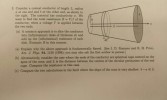 2. Consider a conical conductor of length L, radius a at one end and b at the other end, as shown to the right. The material has conductivity σ. We want to find the total resisitance R V/I of the conductor, when a voltage V is applied between the two ends. (a) A common approach is to slice the conductor into (infinitesimal) disks of thickness dz and add up the (infinitesimal) resistance of each disk. Evaluate R in this manner....
2072 A hollow cylindrical conductor of length L (like the insulation around a pipe) has inside...
 2072 A hollow cylindrical conductor of length L (like the insulation around a pipe) has inside radius a and outside radius b. The inside surface temperature is T, and the outside surface temperature is T T, and T, remain fixed. Unlikely as it seems, the conductivity of the insulating material is not constant but increases as the square of the radius, according to K(r) K,r , where K, is a constant. Find the heat flow rate ( in cal/sec), in...
Two machine parts are connected by a cylindrical rod of length L, thermal conductivity k, and...
Two machine parts are connected by a cylindrical rod of length L, thermal conductivity k, and circular cross sectional radius R. If this rod is replaced by another one of the same length, but with thermal conductivity 2k and a square cross section with side length 2R, by what factor does the rate of heat conduction increase?
A hollow, circular cylindrical conductor in freespace of infinite length. The inner and outer radius are...
A hollow, circular cylindrical conductor in freespace of infinite length. The inner and outer radius are b and c respectively, from the center z axis. It carries a current I in z direction. (a) Find the vector current density J. (b) Use Ampere's Law to find the magnetic field B and H outside the conductor(r>c). (c) Find B inside the hollow interior(r<b). (d) Find B in the conductor(b<r<c).
(1 point) [DL:2/5] A cylindrical conductor of radius R = 0.85 m is centred on the...
 (1 point) [DL:2/5] A cylindrical conductor of radius R = 0.85 m is centred on the z-axis. The current density in the conductor is given in cylindrical coordinates: J = 16e (1-p/R)a, A/m? 'a, A/m² Find the total current passing through the plane z = 0. 146.8/e
 1172
A cylindrical conductor has inner radius 'a and outer radius 'b'. conductor is I, distributed so that the current per unit cross- sectional area is constant. Find the magnetic flux density at any radius r, where a<r<b, in terms of I, r, a, b. The total current in the 1172 (a) (b) Suppose that the current density in (a) above is not uniform but (Amp/m2), where k is a constant. Find the flux varies as J-k density at any...
1172
A cylindrical conductor has inner radius 'a and outer radius 'b'. conductor is I, distributed so that the current per unit cross- sectional area is constant. Find the magnetic flux density at any radius r, where a<r<b, in terms of I, r, a, b. The total current in the 1172 (a) (b) Suppose that the current density in (a) above is not uniform but (Amp/m2), where k is a constant. Find the flux varies as J-k density at any...
 A long, cylindrical non-conductor of radius R and length L is placed with it long axis along the Z-axis as shown The cylinder has a total charge Q distributed non-uniformly thrpughout its volume. The charge density is only a function of the radial distance "r" from the cylinder axis and varies as ρ(r):- where α is a constant Vr. 2 +9R2 c) What coordinate system will you use? L (xy,z), (p,o,Z), (,o,)) d) What variables will the magnitude of the...
 4) Figure 5 illustrates a solid cylindrical conductor having length L and uniform X-sectional area A. The resistivity p of the cylinder is non-uniform and described by the function P(x) = Cx where is a constant and x is position measured along the length of the cylinder such that x = 0 at the left end and x = L at the right end. The terminals of an ideal Figures battery having emfE are connected to the opposing ends of...
 An infinitely long cylindrical conductor with radius R has a uniform surface charge density ơ on its surface. From symmetry, we know that the electric field is pointing radially outward: E-EO)r. where r is the distance to the central axis of the cylinder, and f is the unit vector pointing radially outward from the central axis of the cylinder. 3. (10 points) (10 points) (a) Apply Gauss's law to find E(r) (b) Show that at r-R+ δ with δ σ/a)....
 2. Consider a conical conductor of length L, radius a at one end and b at the other end, as shown to the right. The material has conductivity σ. We want to find the total resisitance R V/I of the conductor, when a voltage V is applied between the two ends. (a) A common approach is to slice the conductor into (infinitesimal) disks of thickness dz and add up the (infinitesimal) resistance of each disk. Evaluate R in this manner....
 2072 A hollow cylindrical conductor of length L (like the insulation around a pipe) has inside radius a and outside radius b. The inside surface temperature is T, and the outside surface temperature is T T, and T, remain fixed. Unlikely as it seems, the conductivity of the insulating material is not constant but increases as the square of the radius, according to K(r) K,r , where K, is a constant. Find the heat flow rate ( in cal/sec), in...
 (1 point) [DL:2/5] A cylindrical conductor of radius R = 0.85 m is centred on the z-axis. The current density in the conductor is given in cylindrical coordinates: J = 16e (1-p/R)a, A/m? 'a, A/m² Find the total current passing through the plane z = 0. 146.8/e
Most questions answered within 3 hours.
-
Where is the error in this code sequence?
String s1 = "Hello";
String s2 = "ello";...
asked 11 months ago -
Financial data for Joel de Paris, Inc., for last year
follow:
Joel de Paris, Inc.
Balance...
asked 11 months ago -
Consider this reaction:
Al2(SO4)3 (aq)+ BaCl3
(aq) Al2Cl6 (aq)- +
3BaSO4(s) . What is the...
asked 11 months ago -
Suppose that Savneet is considering increasing her
recent random sample from 20 car rentals to 40...
asked 11 months ago -
Trucks arrive at an unloading terminal at an average rate of 120
per hour.
Trucks arrive...
asked 11 months ago -
Why are methanol and ethanol completely soluble in water while
octanol is not very little soluble....
asked 11 months ago -
A facilities manager at a university reads in a research report
that the mean amount of...
asked 11 months ago -
When the CuSO4 is rehydrated by adding water to the anhydrous
compound, is this an endothermic...
asked 11 months ago -
A ray of sunlight is passing from diamond into crown glass; the
angle of incidence is...
asked 11 months ago -
A block of mass 0.249 kg is placed on top of a light, vertical
spring of...
asked 11 months ago -
how do the kidneys compensate in the presences of acidosis
a) trigger hyperventilate
b) reserve acid...
asked 11 months ago -
Question 501 pts
The rental rate of capital to the firm increases. Which of the
following...
asked 11 months ago