![22. The rate law for the chemical reaction shown below has been determined experimentally: Rate = k[O3][CI]. What is the over](http://img.homeworklib.com/questions/aa4f8280-7af7-11ec-8e34-4b15cc5b6ebc.png?x-oss-process=image/resize,w_560)
Homework Answers
Add Answer to:
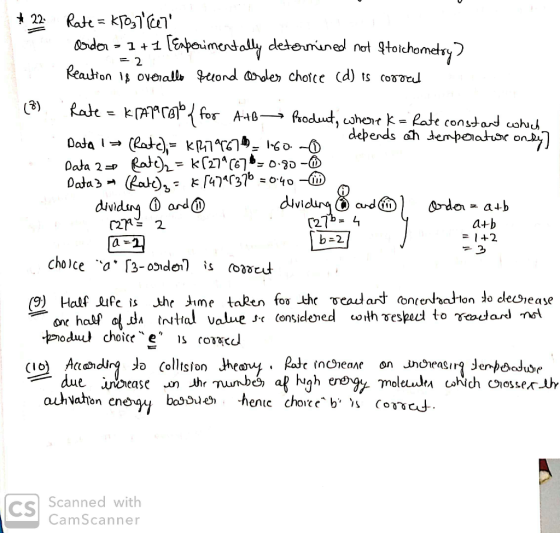
22. The rate law for the chemical reaction shown below has been determined experimentally: Rate =...
Integrated Rate Laws 1. The rate law expression for the reaction of sucrose in water C12H22O11 ...
Integrated Rate Laws 1. The rate law expression for the reaction of sucrose in water C12H22O11 + H2O ---> 2 C6H12O6 Is rate = k[C12H22O11]. a. What is the order with respect to each reactant? b. What is the overall order of the reaction? c. After 2.57 hours, 6.00g/L of C12H22O11 has decreased to 5.40g/L. Express these concentrations in units of M. d. What is the value and units for k given the information in part c? e. Knowing the...
As the temperature of a reaction is increased, the rate of the reaction increases because the...
 As the temperature of a reaction is increased, the rate of the reaction increases because the A) reactant molecules collide less frequently and with greater energy per collision B) reactant molecules collide with greater energy per collision C) reactant molecules collide less frequently D) activation energy is lowered E) reactant molecules collide more frequently with less energy per collision
6. For the reaction: C2H4Br2 3 KI C2H4+2 KBr + KI3 Initial rate data at 60...
 6. For the reaction: C2H4Br2 3 KI C2H4+2 KBr + KI3 Initial rate data at 60 "C are 0.500 0.500 1.50 1.80 7.20 1.80 0.269 1.08 0.807 The rate law is A) rate-kKI B) rate-C2H4Br2l G) rate KI2 D) rate- kKIIC2H4Br2] E) rate kIKIIC2H4Br2 7. Choose the INCORRECT answer. The rate of a chemical reaction: A) usually is increased when the concentration of one of the reactants is increased B) is dependent on temperature C) may be increased by certain...
.In general, the rate of a chemical reaction depends on: a. The temperature b. Collision orientation...
.In general, the rate of a chemical reaction depends on: a. The temperature b. Collision orientation c. Activation energy d. All of the above
chem ll Select all quantities that are involved in an integrated rate law. time temperature activation...
 chem ll
Select all quantities that are involved in an integrated rate law. time temperature activation energy concentration of reactant rate overall order rate constant intermediates half-life
chem ll
Select all quantities that are involved in an integrated rate law. time temperature activation energy concentration of reactant rate overall order rate constant intermediates half-life
14) In an exothermic reaction, heat can be considered a A) reactant B) product C) rate...
 14) In an exothermic reaction, heat can be considered a A) reactant B) product C) rate D) catalyst E) determinant 15) Any reaction that absorbs 150 kcal of energy can be classified as A) endothermic B) exothermic C) activated D) reduction E) oxidation 16) The is the energy difference between reactants and products in a chemical reaction. A) transition energy B) activation energy C) product energy D) overall energy E) heat of reaction 17) For the reaction of carbon with...
Class Practice C152-02 Chapter 16 Practice 2 - Rate Law Consider a chemical reaction between compounds...
 Class Practice C152-02 Chapter 16 Practice 2 - Rate Law Consider a chemical reaction between compounds A and B that is first order with respect to A, first order with respect to B. and second order overall. From the information given below, fill in the blanks Initial Rate Initial (A) Initial [B] Experiment (Mrs) (M) (M) 1 4.0 x 100 .20 0.050 2 1 .6 x 102 0.050 3 3.28 10² 0.40 T Consider the following rate data for the...
The chemical reaction shown was performed and the concentration of HCI was measured over time. CI,(g)...
 The chemical reaction shown was performed and the concentration of HCI was measured over time. CI,(g) + CHCI,(g) HC(g) +CCI,(8) The (HCI) after 25 s was 0.153 mol/L. After 132 s, the (HCI) was 0.374 mol/L. Calculate the rate of reaction. rate of reaction: mol HCIL Which definition best describes the term activation energy? O the minimum kinetic energy that particles must possess for a chemical reaction to occur O the energy required to remove an electron from a gaseous...
Reaction Rates Assessment Question 04 Select all of the factors which affect the rates of chemical...
 Reaction Rates Assessment Question 04 Select all of the factors which affect the rates of chemical reactions. temperature stoichiometry of the reaction O nature of the reactants O contact between the reactants O concentration of the reactants O catalysts relative energy of the products and the reactants Reaction Rate Laws Assessment Question 04 If the reaction rate doubles when the concentration of a reactant is doubled, the reaction is order with respect to that reactant. Reaction Rate Laws Assessment Question...
10. Consider the reaction A + 2B → C ne rate law for this reaction is...
 10. Consider the reaction A + 2B → C ne rate law for this reaction is on der in and and order in B if the rate constant at 25°C is 1.25x 10⁵ , find the rate of reaction when the concentration of A is 0.27M and the concentration of B is 0.32 M UMA 21 11. Consider the reaction A +2B C + D. The rate law for this reaction is first order in A and zeroth order in...
 As the temperature of a reaction is increased, the rate of the reaction increases because the A) reactant molecules collide less frequently and with greater energy per collision B) reactant molecules collide with greater energy per collision C) reactant molecules collide less frequently D) activation energy is lowered E) reactant molecules collide more frequently with less energy per collision
 6. For the reaction: C2H4Br2 3 KI C2H4+2 KBr + KI3 Initial rate data at 60 "C are 0.500 0.500 1.50 1.80 7.20 1.80 0.269 1.08 0.807 The rate law is A) rate-kKI B) rate-C2H4Br2l G) rate KI2 D) rate- kKIIC2H4Br2] E) rate kIKIIC2H4Br2 7. Choose the INCORRECT answer. The rate of a chemical reaction: A) usually is increased when the concentration of one of the reactants is increased B) is dependent on temperature C) may be increased by certain...
 chem ll
Select all quantities that are involved in an integrated rate law. time temperature activation energy concentration of reactant rate overall order rate constant intermediates half-life
chem ll
Select all quantities that are involved in an integrated rate law. time temperature activation energy concentration of reactant rate overall order rate constant intermediates half-life
 14) In an exothermic reaction, heat can be considered a A) reactant B) product C) rate D) catalyst E) determinant 15) Any reaction that absorbs 150 kcal of energy can be classified as A) endothermic B) exothermic C) activated D) reduction E) oxidation 16) The is the energy difference between reactants and products in a chemical reaction. A) transition energy B) activation energy C) product energy D) overall energy E) heat of reaction 17) For the reaction of carbon with...
 Class Practice C152-02 Chapter 16 Practice 2 - Rate Law Consider a chemical reaction between compounds A and B that is first order with respect to A, first order with respect to B. and second order overall. From the information given below, fill in the blanks Initial Rate Initial (A) Initial [B] Experiment (Mrs) (M) (M) 1 4.0 x 100 .20 0.050 2 1 .6 x 102 0.050 3 3.28 10² 0.40 T Consider the following rate data for the...
 The chemical reaction shown was performed and the concentration of HCI was measured over time. CI,(g) + CHCI,(g) HC(g) +CCI,(8) The (HCI) after 25 s was 0.153 mol/L. After 132 s, the (HCI) was 0.374 mol/L. Calculate the rate of reaction. rate of reaction: mol HCIL Which definition best describes the term activation energy? O the minimum kinetic energy that particles must possess for a chemical reaction to occur O the energy required to remove an electron from a gaseous...
 Reaction Rates Assessment Question 04 Select all of the factors which affect the rates of chemical reactions. temperature stoichiometry of the reaction O nature of the reactants O contact between the reactants O concentration of the reactants O catalysts relative energy of the products and the reactants Reaction Rate Laws Assessment Question 04 If the reaction rate doubles when the concentration of a reactant is doubled, the reaction is order with respect to that reactant. Reaction Rate Laws Assessment Question...
 10. Consider the reaction A + 2B → C ne rate law for this reaction is on der in and and order in B if the rate constant at 25°C is 1.25x 10⁵ , find the rate of reaction when the concentration of A is 0.27M and the concentration of B is 0.32 M UMA 21 11. Consider the reaction A +2B C + D. The rate law for this reaction is first order in A and zeroth order in...
Most questions answered within 3 hours.
-
Where is the error in this code sequence?
String s1 = "Hello";
String s2 = "ello";...
asked 11 months ago -
Financial data for Joel de Paris, Inc., for last year
follow:
Joel de Paris, Inc.
Balance...
asked 11 months ago -
Consider this reaction:
Al2(SO4)3 (aq)+ BaCl3
(aq) Al2Cl6 (aq)- +
3BaSO4(s) . What is the...
asked 11 months ago -
Suppose that Savneet is considering increasing her
recent random sample from 20 car rentals to 40...
asked 11 months ago -
Trucks arrive at an unloading terminal at an average rate of 120
per hour.
Trucks arrive...
asked 11 months ago -
Why are methanol and ethanol completely soluble in water while
octanol is not very little soluble....
asked 11 months ago -
A facilities manager at a university reads in a research report
that the mean amount of...
asked 11 months ago -
When the CuSO4 is rehydrated by adding water to the anhydrous
compound, is this an endothermic...
asked 11 months ago -
A ray of sunlight is passing from diamond into crown glass; the
angle of incidence is...
asked 11 months ago -
A block of mass 0.249 kg is placed on top of a light, vertical
spring of...
asked 11 months ago -
how do the kidneys compensate in the presences of acidosis
a) trigger hyperventilate
b) reserve acid...
asked 11 months ago -
Question 501 pts
The rental rate of capital to the firm increases. Which of the
following...
asked 11 months ago