Assume the absolute zero apparatus is initially open to the air. The volume of a sphere...
Assume the absolute zero apparatus is initially open to the air. The volume of a sphere is: V = 4πr3/3
a) Assume that air pressure is Po = 1.00 atm and the air temperature is To = 22.8o C. How many moles of air will the sphere hold?
n air = ___ moles
b) Suppose now that the apparatus, initially open, is now sealed with the air inside. If the apparatus is now heated to to 665o C, find the pressure inside the apparatus now.
P = ___ atm
c) Assume now that, while maintaining a temperature of 665o, the sphere is injected with another 0.029 moles of air. What is the new pressure inside the ball?
P = ___ atm
Homework Answers
a)
we know that
PV = nRT
n = PV/RT
n = 4πr3/3 (1/0.082x295.8
b)
here v=cosnrant
so
P2/P1 = T2/T1
P2 = 3.17atm
c)
P2/P1 = T2 x n2/T1 n1
Add Answer to:
Assume the absolute zero apparatus is initially open to the air.
The volume of a sphere...
Air is pumped into a bicycle tire. The air initially in the tire has a volume...
Air is pumped into a bicycle tire. The air initially in the tire has a volume of 2695 cm3, a temperature of 22.0° C, and a gauge pressure of 2.00 atm. How many molecules of air must be pumped into the tire in order to raise the gauge pressure to 5.00 atm? Assume that the volume and temperature of the air inside the tire are approximately constant
Air is pumped into a bicycle tire. The 14 moles of air initially in the tire have a gauge pressure of 3 atm
Air is pumped into a bicycle tire. The 14 moles of air initially in the tire have a gauge pressure of 3 atm. How many moles of air must be pumped into the tire in order to raise the gauge pressure to 4 atm? Assume that the volume and temperature of the air inside the tire are approximately constant.
Problem 17.39 A 3700 mL flask is initially open in a room containing air at 1.00...
Problem 17.39 A 3700 mL flask is initially open in a room containing air at 1.00 atm and 20 ∘C. The flask is then closed and immersed in boiling water. When the air in the flask has reached thermodynamic equilibrium, the flask is opened and air is allowed to escape. The flask is then closed and cooled back to 20 ∘C. Part A: Find the maximum pressure reached in the flask. Express your answer with the appropriate units. p_max =...
A 3-m long cylinder has three compartments with two and each compartment has a volume of...
 A 3-m long cylinder has three compartments with two and each compartment has a volume of 45 L. Initially, the separators arc held in place and each compartment is open to the air, with the pressure in the room at 760 torr (1.0 atm), and the temperature at 0 degree C. Assume that the air is an ideal gas How many moles of gas are in each compartment? The connections from the compartments to the room are sealed off and:...
A tank in a room at 19 degree C is initially open to the atmosphere on...
 A tank in a room at 19 degree C is initially open to the atmosphere on a day when the barometric pressure is 102 kPa. A block of dry ice (solid CO_2) with a mass of 15.7 kg is dropped into the tank, which is then sealed. The reading on the tank pressure gauge initially rises very quickly, then much more slowly, eventually reaching a value of 3.27 MPa. Assume T_final = 19 degree C. How many moles of air...
What is the volume of the sphere in Procedure 2 in units of cm3? Express your...
 What is the volume of the sphere in Procedure 2 in units of
cm3? Express your answer to two significant figures.
LAB 14: IDEAL GAS LAW BASIC CONCEPTS TEXTBOOK: SECTIONS 15.2, YOUNG, 10TH EDITION DEFINITIONS Volume: The space taken up by an object, measured in cubic meters (m"). Pressure: For an enclosed gas, pressure is defined as the force exerted per area by the gas on the container walls, measured in Pascal (1 N/m) Temperature: A measure of the average...
What is the volume of the sphere in Procedure 2 in units of
cm3? Express your answer to two significant figures.
LAB 14: IDEAL GAS LAW BASIC CONCEPTS TEXTBOOK: SECTIONS 15.2, YOUNG, 10TH EDITION DEFINITIONS Volume: The space taken up by an object, measured in cubic meters (m"). Pressure: For an enclosed gas, pressure is defined as the force exerted per area by the gas on the container walls, measured in Pascal (1 N/m) Temperature: A measure of the average...
1. A rigid (constant volume) tank sealed by a valve initially contains 100 kg of air...
 1. A rigid (constant volume) tank sealed by a valve initially contains 100 kg of air at a pressure of 100 kPa and 300 K. At time t = 0, the valve for the air tank is opened in a controlled manner and air leaks out isothermally (constant temperature) of the tank at a constant mass flow rate of 1 kg/s. The valve is closed after 75 seconds. Answer the following questions: Assuming air is an ideal gas, what is...
A piston–cylinder device initially contains air at 150 kPa and 27 °C. In this state, the...
A piston–cylinder device initially contains air at 150 kPa and 27 °C. In this state, the piston is resting on a pair of stops, and the enclosed volume is 400 litres. The mass of the piston is such that a 200 kPa pressure is required to move it. The air is now heated until its volume has doubled. Sketch the process on a P-V diagram and determine (a) the mass of air and the final temperature, (b) the work done...
Assume air can be modeled as an ideal, diatomic gas. Given n moles of air at...
Assume air can be modeled as an ideal, diatomic gas. Given n moles of air at temperature T0 and pressure p0, how much energy must be expended as work to compress it to one tenth of its original volume, if a) the compression occurs along an isotherm? b) the compression occurs along a reversible adiabatic path? c) Evaluate your results to parts (a) and (b) for n = 5.00 mol, T0 = 20.0 ◦C, and p0 = 1.00 atm. Express...
Flying Circus of Physics Adiabatic wind. The normal airflow over the Rocky Mountains is west to east. The air loses muc...
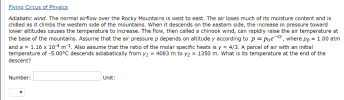 Flying Circus of Physics Adiabatic wind. The normal airflow over the Rocky Mountains is west to east. The air loses much of its moisture content and is chilled as it climbs the western side of the mountains. When it descends on the eastern side, the increase in pressure toward lower altitudes causes the temperature to increase. The flow, then called a chinook wind, can rapidly raise the air temperature at the base of the mountains. Assume that the air pressure...
 A 3-m long cylinder has three compartments with two and each compartment has a volume of 45 L. Initially, the separators arc held in place and each compartment is open to the air, with the pressure in the room at 760 torr (1.0 atm), and the temperature at 0 degree C. Assume that the air is an ideal gas How many moles of gas are in each compartment? The connections from the compartments to the room are sealed off and:...
 A tank in a room at 19 degree C is initially open to the atmosphere on a day when the barometric pressure is 102 kPa. A block of dry ice (solid CO_2) with a mass of 15.7 kg is dropped into the tank, which is then sealed. The reading on the tank pressure gauge initially rises very quickly, then much more slowly, eventually reaching a value of 3.27 MPa. Assume T_final = 19 degree C. How many moles of air...
 What is the volume of the sphere in Procedure 2 in units of
cm3? Express your answer to two significant figures.
LAB 14: IDEAL GAS LAW BASIC CONCEPTS TEXTBOOK: SECTIONS 15.2, YOUNG, 10TH EDITION DEFINITIONS Volume: The space taken up by an object, measured in cubic meters (m"). Pressure: For an enclosed gas, pressure is defined as the force exerted per area by the gas on the container walls, measured in Pascal (1 N/m) Temperature: A measure of the average...
What is the volume of the sphere in Procedure 2 in units of
cm3? Express your answer to two significant figures.
LAB 14: IDEAL GAS LAW BASIC CONCEPTS TEXTBOOK: SECTIONS 15.2, YOUNG, 10TH EDITION DEFINITIONS Volume: The space taken up by an object, measured in cubic meters (m"). Pressure: For an enclosed gas, pressure is defined as the force exerted per area by the gas on the container walls, measured in Pascal (1 N/m) Temperature: A measure of the average...
 1. A rigid (constant volume) tank sealed by a valve initially contains 100 kg of air at a pressure of 100 kPa and 300 K. At time t = 0, the valve for the air tank is opened in a controlled manner and air leaks out isothermally (constant temperature) of the tank at a constant mass flow rate of 1 kg/s. The valve is closed after 75 seconds. Answer the following questions: Assuming air is an ideal gas, what is...
 Flying Circus of Physics Adiabatic wind. The normal airflow over the Rocky Mountains is west to east. The air loses much of its moisture content and is chilled as it climbs the western side of the mountains. When it descends on the eastern side, the increase in pressure toward lower altitudes causes the temperature to increase. The flow, then called a chinook wind, can rapidly raise the air temperature at the base of the mountains. Assume that the air pressure...
Most questions answered within 3 hours.
-
Where is the error in this code sequence?
String s1 = "Hello";
String s2 = "ello";...
asked 10 months ago -
Financial data for Joel de Paris, Inc., for last year
follow:
Joel de Paris, Inc.
Balance...
asked 10 months ago -
Consider this reaction:
Al2(SO4)3 (aq)+ BaCl3
(aq) Al2Cl6 (aq)- +
3BaSO4(s) . What is the...
asked 10 months ago -
Suppose that Savneet is considering increasing her
recent random sample from 20 car rentals to 40...
asked 10 months ago -
Trucks arrive at an unloading terminal at an average rate of 120
per hour.
Trucks arrive...
asked 10 months ago -
Why are methanol and ethanol completely soluble in water while
octanol is not very little soluble....
asked 10 months ago -
A facilities manager at a university reads in a research report
that the mean amount of...
asked 10 months ago -
When the CuSO4 is rehydrated by adding water to the anhydrous
compound, is this an endothermic...
asked 10 months ago -
A ray of sunlight is passing from diamond into crown glass; the
angle of incidence is...
asked 10 months ago -
A block of mass 0.249 kg is placed on top of a light, vertical
spring of...
asked 10 months ago -
how do the kidneys compensate in the presences of acidosis
a) trigger hyperventilate
b) reserve acid...
asked 10 months ago -
Question 501 pts
The rental rate of capital to the firm increases. Which of the
following...
asked 10 months ago