
Homework Answers
Add Answer to:
l. A CT system with input x(1) and output y(1) Is described by ler the relationship...
A CT system having input x(t) and output y(t) is described in terms of its impulse...
 A CT system having input x(t) and output y(t) is described in terms of its impulse response (t-1-1/2 h(t,0) e, where I is a positive finite real number. Determine the output T/2 y(t) when x(n)=rect( )
7. For a linear system whose input-output relations is represented as: v n]=x[n]+0.5x[n-l]-0.25x[n-2]·(x r input. y[n] output) We also assume this system is originally at rest, ie. yln] -0 ifnco. (a)...
 7. For a linear system whose input-output relations is represented as: v n]=x[n]+0.5x[n-l]-0.25x[n-2]·(x r input. y[n] output) We also assume this system is originally at rest, ie. yln] -0 ifnco. (a) Write the transfer function of this systenm (b) Determine the first five samples of its impulse response. (c) Is this system a stable system? (d) Write down the input-output relation the causal inverse system of this system (e) Use Matlab to finds zeros and poles of the transfer function...
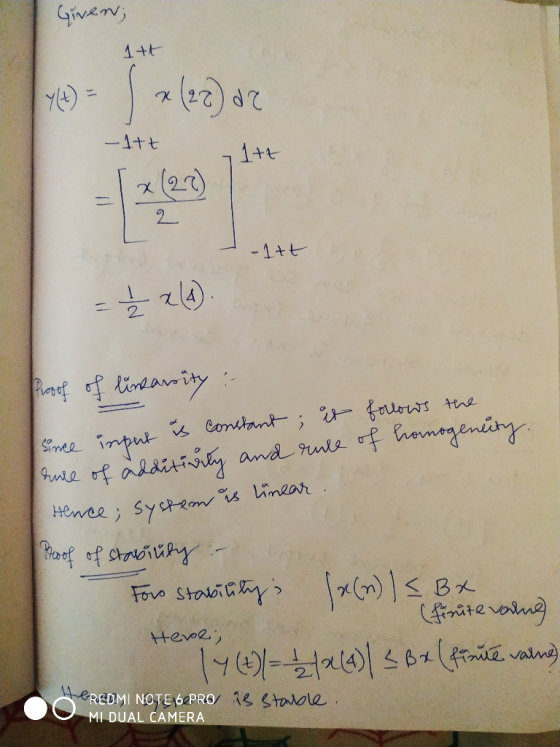
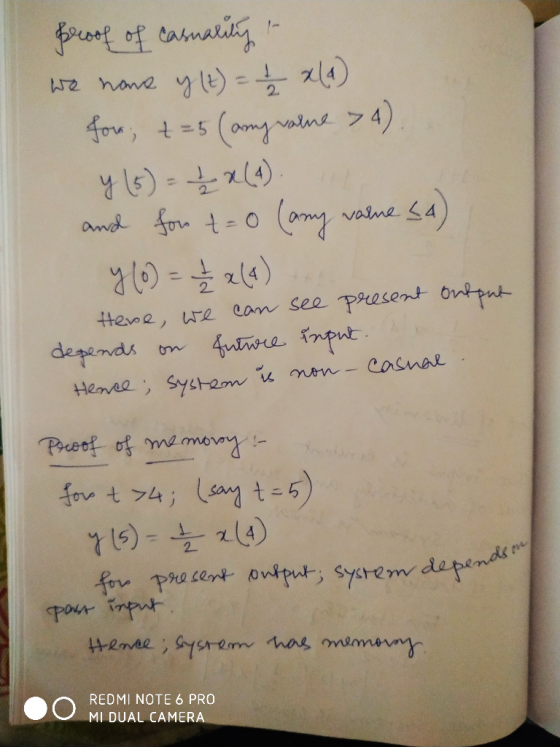
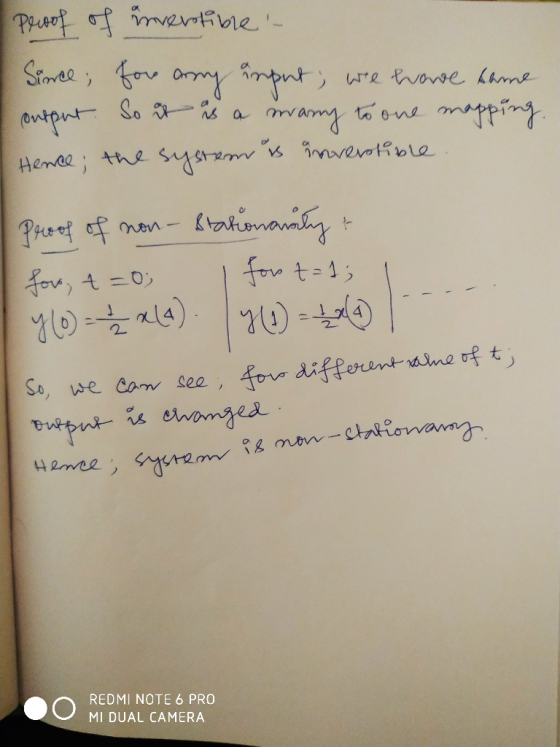
Memory less ? Causal ? Bounded input bounded output stable ? Is the system invertible ?...
 Memory less ?
Causal ?
Bounded input bounded output stable ?
Is the system invertible ?
Linear ?
Time invariant?
Question (1) ls the system S, given by (6 Marka y(t) = 3x(t-1)-2 a) Memoryless?
Memory less ?
Causal ?
Bounded input bounded output stable ?
Is the system invertible ?
Linear ?
Time invariant?
Question (1) ls the system S, given by (6 Marka y(t) = 3x(t-1)-2 a) Memoryless?
3.1 The relationship between the input x(t) and output y(t) of described by the indicated differential...
 3.1 The relationship between the input x(t) and output y(t) of described by the indicated differential equation given below: a causal system is dx(t) dse)+540+6y(t) = x(t) +T Assuming that the initial conditions are zero and using the Laplace transform determine [5 Marks] 15 Marks the following: a- Transfer function H(s) of the system. b- Impulse response h(t) of the system. Y (s) X(s)
A system with input x(t) and output y(t) is described by y(t) = 5 sin(x(t)). Identify...
 A system with input x(t) and output y(t) is described by y(t) = 5 sin(x(t)). Identify the properties of the given system. Select one: a. Non-linear, time invariant, BIBO stable, memoryless, and causal b. Non-linear, time invariant, unstable, memoryless, and non-causal c. Linear, time varying, unstable, not memoryless, and non-causal d. Linear, time invariant, BIBO stable, not memoryless, and non-causal e. Linear, time invariant, BIBO stable, memoryless, and non-causal 0
The input-output relationship for a system is ¨y(t) + ˙y(t) = x(t). (a) Find the impulse...
The input-output relationship for a system is ¨y(t) + ˙y(t) = x(t). (a) Find the impulse response of the system. (b) Find the zero-state response when the input is a unit step. (c) Find the zero-state response when the input is x(t) = 1.6u(t) − 0.6u(t − 1).
1. For a system described in Figure 1. x(t) - input voltage, y(t) - output voltage....
 1. For a system described in Figure 1. x(t) - input voltage, y(t) - output voltage. (a) Determine Continuous Time (C.T.) "Math Model" when R = 1/3 121, L = 1/2 [F], and C = 1 [F]. (b) Fine "Zero Input Response". y zit. for the C.T.system. when y(0) = 1 [V], y'(0) = 2 IV (c) Draw "Zero Input Response". y_zi(t) with respect to time 1 (2-D graph) (d) Find impulse response, h(!). of the Continuous Time (C.T.) system....
Consider the discrete-time system with input x[n] and output y[n] described by : y[n]=x[n]u[2-n] Which of the...
Consider the discrete-time system with input x[n] and output y[n] described by : y[n]=x[n]u[2-n] Which of the following properties does this system possess? Justify your answer in each case. Do not use Laplace transforms a) Memoryless b)Time-invariant c) Linear d)Casual e) Stable
3. (l’+2° +1²=4') Topic: Laplace transform, CT system described by differential equations, LTI system properties. Consider...
 3. (l’+2° +1²=4') Topic: Laplace transform, CT system described by differential equations, LTI system properties. Consider a differential equation system for which the input x(t) and output y(t) are related by the differential equation d’y(t) dy(t) -6y(t) = 5x(t). dt dt Assume that the system is initially at rest. a) Determine the transfer function. b) Specify the ROC of H(s) and justify it. c) Determine the system impulse response h(t).
Consider a DT system with input x[n] and output y[n] described by the difference equation 4y[n+1]...
 Consider a DT system with input x[n] and output y[n] described
by the difference equation 4y[n+1]+y[n-1]=8x[n+1]+8x[n]
73 Consider a DT system with input xin and output yin] described by the difference equation (a) What is the order of this system? (b) Determine the characteristic mode(s) of the system (c) Determine a closed-form expression for the system's impulse response hln].
73 Consider a DT system with input xin and output yin] described by the difference equation (a) What is the order...
Consider a DT system with input x[n] and output y[n] described
by the difference equation 4y[n+1]+y[n-1]=8x[n+1]+8x[n]
73 Consider a DT system with input xin and output yin] described by the difference equation (a) What is the order of this system? (b) Determine the characteristic mode(s) of the system (c) Determine a closed-form expression for the system's impulse response hln].
73 Consider a DT system with input xin and output yin] described by the difference equation (a) What is the order...
 A CT system having input x(t) and output y(t) is described in terms of its impulse response (t-1-1/2 h(t,0) e, where I is a positive finite real number. Determine the output T/2 y(t) when x(n)=rect( )
 7. For a linear system whose input-output relations is represented as: v n]=x[n]+0.5x[n-l]-0.25x[n-2]·(x r input. y[n] output) We also assume this system is originally at rest, ie. yln] -0 ifnco. (a) Write the transfer function of this systenm (b) Determine the first five samples of its impulse response. (c) Is this system a stable system? (d) Write down the input-output relation the causal inverse system of this system (e) Use Matlab to finds zeros and poles of the transfer function...
 Memory less ?
Causal ?
Bounded input bounded output stable ?
Is the system invertible ?
Linear ?
Time invariant?
Question (1) ls the system S, given by (6 Marka y(t) = 3x(t-1)-2 a) Memoryless?
Memory less ?
Causal ?
Bounded input bounded output stable ?
Is the system invertible ?
Linear ?
Time invariant?
Question (1) ls the system S, given by (6 Marka y(t) = 3x(t-1)-2 a) Memoryless?
 3.1 The relationship between the input x(t) and output y(t) of described by the indicated differential equation given below: a causal system is dx(t) dse)+540+6y(t) = x(t) +T Assuming that the initial conditions are zero and using the Laplace transform determine [5 Marks] 15 Marks the following: a- Transfer function H(s) of the system. b- Impulse response h(t) of the system. Y (s) X(s)
 A system with input x(t) and output y(t) is described by y(t) = 5 sin(x(t)). Identify the properties of the given system. Select one: a. Non-linear, time invariant, BIBO stable, memoryless, and causal b. Non-linear, time invariant, unstable, memoryless, and non-causal c. Linear, time varying, unstable, not memoryless, and non-causal d. Linear, time invariant, BIBO stable, not memoryless, and non-causal e. Linear, time invariant, BIBO stable, memoryless, and non-causal 0
 1. For a system described in Figure 1. x(t) - input voltage, y(t) - output voltage. (a) Determine Continuous Time (C.T.) "Math Model" when R = 1/3 121, L = 1/2 [F], and C = 1 [F]. (b) Fine "Zero Input Response". y zit. for the C.T.system. when y(0) = 1 [V], y'(0) = 2 IV (c) Draw "Zero Input Response". y_zi(t) with respect to time 1 (2-D graph) (d) Find impulse response, h(!). of the Continuous Time (C.T.) system....
 3. (l’+2° +1²=4') Topic: Laplace transform, CT system described by differential equations, LTI system properties. Consider a differential equation system for which the input x(t) and output y(t) are related by the differential equation d’y(t) dy(t) -6y(t) = 5x(t). dt dt Assume that the system is initially at rest. a) Determine the transfer function. b) Specify the ROC of H(s) and justify it. c) Determine the system impulse response h(t).
 Consider a DT system with input x[n] and output y[n] described
by the difference equation 4y[n+1]+y[n-1]=8x[n+1]+8x[n]
73 Consider a DT system with input xin and output yin] described by the difference equation (a) What is the order of this system? (b) Determine the characteristic mode(s) of the system (c) Determine a closed-form expression for the system's impulse response hln].
73 Consider a DT system with input xin and output yin] described by the difference equation (a) What is the order...
Consider a DT system with input x[n] and output y[n] described
by the difference equation 4y[n+1]+y[n-1]=8x[n+1]+8x[n]
73 Consider a DT system with input xin and output yin] described by the difference equation (a) What is the order of this system? (b) Determine the characteristic mode(s) of the system (c) Determine a closed-form expression for the system's impulse response hln].
73 Consider a DT system with input xin and output yin] described by the difference equation (a) What is the order...
Most questions answered within 3 hours.
-
Where is the error in this code sequence?
String s1 = "Hello";
String s2 = "ello";...
asked 10 months ago -
Financial data for Joel de Paris, Inc., for last year
follow:
Joel de Paris, Inc.
Balance...
asked 10 months ago -
Consider this reaction:
Al2(SO4)3 (aq)+ BaCl3
(aq) Al2Cl6 (aq)- +
3BaSO4(s) . What is the...
asked 10 months ago -
Suppose that Savneet is considering increasing her
recent random sample from 20 car rentals to 40...
asked 10 months ago -
Trucks arrive at an unloading terminal at an average rate of 120
per hour.
Trucks arrive...
asked 10 months ago -
Why are methanol and ethanol completely soluble in water while
octanol is not very little soluble....
asked 10 months ago -
A facilities manager at a university reads in a research report
that the mean amount of...
asked 10 months ago -
When the CuSO4 is rehydrated by adding water to the anhydrous
compound, is this an endothermic...
asked 10 months ago -
A ray of sunlight is passing from diamond into crown glass; the
angle of incidence is...
asked 10 months ago -
A block of mass 0.249 kg is placed on top of a light, vertical
spring of...
asked 10 months ago -
how do the kidneys compensate in the presences of acidosis
a) trigger hyperventilate
b) reserve acid...
asked 10 months ago -
Question 501 pts
The rental rate of capital to the firm increases. Which of the
following...
asked 10 months ago