1. identify and describe it including its scientific name of sea nails . 2. describe habitat...
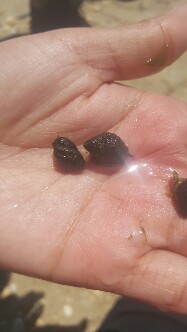
1. identify and describe it including its scientific
name of sea nails .
2. describe habitat of organism
3. describe it's ecological niche
Homework Answers
1. Sea snails range from small to large size. This is a type of sea snails with scientific name Semicassis granulata. Color of shell is dark brown or chocolate color with strips in the shell surface all around.
2. They are marine found in shallow sandy sea water mostly in tropical and subtropical oceans.
3. They are predators who eat other echinoderms found in shallow sand water.
Add Answer to:
1. identify and describe it including its scientific
name of sea nails .
2. describe habitat...
Describe Diabetes Mellitus and identify the types (including the SYMPTOMS of diabetes. (2 paragraphs) 1. gestational...
 Describe Diabetes Mellitus and identify the types (including the SYMPTOMS of diabetes. (2 paragraphs) 1. gestational diabetes). Also describe 2. What is the relationship of insulin to diabetes mellitus? (1 paragraph)
1. Describe Frederick Taylor’s theory of scientific management and its impact on worker productivity. 2. What is the...
1. Describe Frederick Taylor’s theory of scientific management and its impact on worker productivity. 2. What is the basic premise of Abraham Maslow’s hierarchy of needs theory and what levels comprise the hierarchy? 3. Describe William Ouchi’s Theory Z. 4. Compare and contrast these three theories and discuss your approach to motivating employees with your classmates.
1 Describe/diagram the evolutionary relationship of prokaryotes to eukaryotes (and bacteria to archaea) 2 Describe the...
1 Describe/diagram the evolutionary relationship of prokaryotes to eukaryotes (and bacteria to archaea) 2 Describe the variation in modes of nutrition among prokaryotes 3 Describe the processes of prokaryotic reproduction, including both vertical and horizontal gene transfer 4 Described the ecological importance of prokaryotes (including positive and negative impacts on humans)
Section 15.1 Identify a carbonyl group and describe its polarity and shape Section 15.2 Name or...
Section 15.1 Identify a carbonyl group and describe its polarity and shape Section 15.2 Name or identify aldehydes or ketones given a strucure or a name Section 15.3 Describe the polarity, hydrogen bonding, boiling points, and water solubility of aldehydes and keotnes Section 15.5 Identify the products formed by the oxidation of aldehydes or ketones Section 15.6 Identify the products formed by the reduction of aldehydes or ketones
Answer one of these three questions. 1] Name and describe the 3 major evolutionary models, including...
 Answer one of these three questions. 1] Name and describe the 3 major evolutionary models, including their associated researchers, species, locations, evidence, time line etc. 2] Describe 3 traits unique to the crania, dentition and post crania for these species; Australopithecus aferensis, Homo erectus, Homo heidelbergensis, Homo neandertalensis and Homo sapiens. 3] Describe in detail the environmental situation and cultural inventions and capabilities concerning Homo erectus leaving Africa.
1] Name and describe the 3 major evolutionary models, including their associated researchers. species, locations, evidence,...
 1] Name and describe the 3 major evolutionary models, including their associated researchers. species, locations, evidence, time line etc. 2] Describe 3 traits unique to the crania, dentition and post crania for these species; Australopithecus aferensis. Homo erectus, Homo heidelbergensis, Homo neandertalensis and Homo sapiens. 3] Describe in detail the environmental situation and cultural inventions and capabilities concerning Homo erectus leaving Africa.
1. Describe the World Trade Organization including its function and the number of members. 2. Explain...
1. Describe the World Trade Organization including its function and the number of members. 2. Explain Globalization
1. Please click on "One Species At A Time Podcast e." 2. Pick and listen to...
 1. Please click on "One Species At A Time Podcast e." 2. Pick and listen to a podcast of a topic of your interest. Each podcast will last about 5 minutes and you can download the transcript 3. Please look up more information about the main organism discussed in the podcast and write a report about the organism. Include scientific name(s) of the organism(s). If there are more than one organism described, please choose only one, but summarize the podcast...
List 7 viral infectious diseases: 1. Causative agent: give the scientific name. 2. Description of pathogen:...
List 7 viral infectious diseases: 1. Causative agent: give the scientific name. 2. Description of pathogen: what type of microorganism, if it is a bacterium, its gram reaction and shape. 3. Reservoir/ where the pathogen is found: 4. Name of disease: 5. Major symptoms: give the 3-5 main symptoms. 6. Treatment: 7. How transmitted.
1. A. Name the three planes and the positions they each describe to identify a unique...
1. A. Name the three planes and the positions they each describe to identify a unique position in the human body. B. Name the two major ventral body cavities plus the major organs found in them. C. Name the cavities that the heart and lungs reside in. D. Finally, list the six levels of organization in nature. 2. A. Describe the three components of an atom in terms of charge and location. Define atomic mass and atomic number. B. For...
 Describe Diabetes Mellitus and identify the types (including the SYMPTOMS of diabetes. (2 paragraphs) 1. gestational diabetes). Also describe 2. What is the relationship of insulin to diabetes mellitus? (1 paragraph)
 Answer one of these three questions. 1] Name and describe the 3 major evolutionary models, including their associated researchers, species, locations, evidence, time line etc. 2] Describe 3 traits unique to the crania, dentition and post crania for these species; Australopithecus aferensis, Homo erectus, Homo heidelbergensis, Homo neandertalensis and Homo sapiens. 3] Describe in detail the environmental situation and cultural inventions and capabilities concerning Homo erectus leaving Africa.
 1] Name and describe the 3 major evolutionary models, including their associated researchers. species, locations, evidence, time line etc. 2] Describe 3 traits unique to the crania, dentition and post crania for these species; Australopithecus aferensis. Homo erectus, Homo heidelbergensis, Homo neandertalensis and Homo sapiens. 3] Describe in detail the environmental situation and cultural inventions and capabilities concerning Homo erectus leaving Africa.
 1. Please click on "One Species At A Time Podcast e." 2. Pick and listen to a podcast of a topic of your interest. Each podcast will last about 5 minutes and you can download the transcript 3. Please look up more information about the main organism discussed in the podcast and write a report about the organism. Include scientific name(s) of the organism(s). If there are more than one organism described, please choose only one, but summarize the podcast...
Most questions answered within 3 hours.
-
Where is the error in this code sequence?
String s1 = "Hello";
String s2 = "ello";...
asked 10 months ago -
Financial data for Joel de Paris, Inc., for last year
follow:
Joel de Paris, Inc.
Balance...
asked 10 months ago -
Consider this reaction:
Al2(SO4)3 (aq)+ BaCl3
(aq) Al2Cl6 (aq)- +
3BaSO4(s) . What is the...
asked 10 months ago -
Suppose that Savneet is considering increasing her
recent random sample from 20 car rentals to 40...
asked 10 months ago -
Trucks arrive at an unloading terminal at an average rate of 120
per hour.
Trucks arrive...
asked 10 months ago -
Why are methanol and ethanol completely soluble in water while
octanol is not very little soluble....
asked 10 months ago -
A facilities manager at a university reads in a research report
that the mean amount of...
asked 10 months ago -
When the CuSO4 is rehydrated by adding water to the anhydrous
compound, is this an endothermic...
asked 10 months ago -
A ray of sunlight is passing from diamond into crown glass; the
angle of incidence is...
asked 10 months ago -
A block of mass 0.249 kg is placed on top of a light, vertical
spring of...
asked 10 months ago -
how do the kidneys compensate in the presences of acidosis
a) trigger hyperventilate
b) reserve acid...
asked 10 months ago -
Question 501 pts
The rental rate of capital to the firm increases. Which of the
following...
asked 10 months ago