Given the following signal: s(t) = 10 + 10 cos(2π.300t) cos(2π.700t)
Given the following signal:
s(t) = 10 + 10 cos(2π.300t) cos(2π.700t)
Answer the following questions:
Use the following trigonometric identity and simplify s(t).
cos A.cosB = 1/2cos(A-B) + 1/2cos(A+B)
(a) Find the spectrum of the s(t) signal.
(b) Find the Bandwidth (B) of the s(t) signal.
Homework Answers

Add Answer to:
Given the following signal: s(t) = 10 + 10 cos(2π.300t) cos(2π.700t)
Q1) Given an analog signal X(t) = 3 cos (2π . 2000t) + 2 cos (2π...
Q1) Given an analog signal X(t) = 3 cos (2π . 2000t) + 2 cos (2π . 5500t) sampled at a rate of 10,000 Hz, a. Sketch the spectrum of the sampled signal up to 20 kHz; b. Sketch the recovered analog signal spectrum if an ideal lowpass filter with a cutoff frequency of 4 kHz is used to filter the sampled signal in order to recover the original signal ; c. Determine the frequency/frequencies of aliasing noise . Q2)...
Power Spectrum of AM A baseband message signal is given byWn (t)-5 cos 2π 2500t +...
 Power Spectrum of AM A baseband message signal is given byWn (t)-5 cos 2π 2500t + 4 cos 2π 5500. An AM waveform carrying this message g(t)-50[1 + μ m(t) mp]cos 2π5x 10⁹, where mp s the peak value of m(t a) Plot (by hand) the power spectrum S (f) of the AM waveform g(t) with 0.6 (You can get help with this from the handout A Power Spectrum Primer. See the section "Finding the Power Spectrum of a Periodic...
A modulated voltage signal is given as: s(t) = 10(1 + 0.5cos(10²πt)) cos(106πt) volts.
 A modulated voltage signal is given as: s(t) = 10(1 + 0.5cos(10²πt)) cos(106πt) volts. a) Plot the spectrum of the signal and calculate its bandwidth. b) Calculate the total signal power in dbm. c) If the message signal is a single-tone signal, explain if this is an AM-DSB-SC or an AM-DSB-C signal. What is the modulation efficiency? d) The signal s(t) is passed through the following system. Find the output mout(t) as a function of time and its Fourier transform, Mout(f).
Use the frequency-shift rule to find the spectrum of the signal x(t) = s(t) cos(2π(770, 000)t)...
Use the frequency-shift rule to find the spectrum of the signal x(t) = s(t) cos(2π(770, 000)t) , where s(t) = 7 − 3 cos(2π(1000)t + π/7). I know the relative "definition" of the frequency shift rule, I am just very confused as to how to apply it.
Question A modulated voltage signal is given as: s(t) = 10(1 + 0.5cos(10?rt)) cos(106mt) volts. Plot...
 Question A modulated voltage signal is given as: s(t) = 10(1 + 0.5cos(10?rt)) cos(106mt) volts. Plot the spectrum of the signal and calculate its bandwidth. b) Calculate the total signal power in dbm. c) If the message signal is a single-tone signal, explain if this is an AM-DSB-SC or an AM-DSB-C signal. What is the modulation efficiency? d) The signal s(t) is passed through the following system. Find the output mout(t) as a function of time and its Fourier transform,...
When the message signal m (t) =cos (2π fmt) and the carrier signal is c(t)=cos (2π fct) , fm<&...
 When the message signal m (t) =cos (2π fmt) and the
carrier signal is c(t)=cos (2π fct) ,
fm<< fc,
The modulated DSB-SC signal
SDSB-SC=m(t)cos(2πfct) is generated, and only
the upper sideband
To generate and transmit the SSB signal. As shown in the figure
below, the receiver is a local oscillator
cosine signal to the received signal and passes it through a
low-pass filter. Answer the following questions.
(a) Draw the waveform of DSB-SC modulated signal
SDSB-SC(t)
(b)Find the result...
When the message signal m (t) =cos (2π fmt) and the
carrier signal is c(t)=cos (2π fct) ,
fm<< fc,
The modulated DSB-SC signal
SDSB-SC=m(t)cos(2πfct) is generated, and only
the upper sideband
To generate and transmit the SSB signal. As shown in the figure
below, the receiver is a local oscillator
cosine signal to the received signal and passes it through a
low-pass filter. Answer the following questions.
(a) Draw the waveform of DSB-SC modulated signal
SDSB-SC(t)
(b)Find the result...
The exponential Fourier series of a certain periodic signal is given as f(t) (2+j2) exp(-j300t)+j...
 Please solve parts d and e
The exponential Fourier series of a certain periodic signal is given as f(t) (2+j2) exp(-j300t)+j2 exp(-j10t) +3 -j2 exp(j10t) + (2-j2) exp(300t) a. Find the compact trigonometric Fourier series of f(t). b. Find the bandwidth of the signal c. Find the Fourier Transform of f(t). d. Design a simple low pass filter (RC circuit) that reduces the amplitude of the highest frequency part of f(t) by at least 50%. Write down its H(o) and...
Please solve parts d and e
The exponential Fourier series of a certain periodic signal is given as f(t) (2+j2) exp(-j300t)+j2 exp(-j10t) +3 -j2 exp(j10t) + (2-j2) exp(300t) a. Find the compact trigonometric Fourier series of f(t). b. Find the bandwidth of the signal c. Find the Fourier Transform of f(t). d. Design a simple low pass filter (RC circuit) that reduces the amplitude of the highest frequency part of f(t) by at least 50%. Write down its H(o) and...
3(20%) Assume a message signal is given by m(t) = 4 cos(2π//) + cos(4π.t). Let x (t)-5m(t) cos(2t f t) + 5m(t) sin(...
 3(20%) Assume a message signal is given by m(t) = 4 cos(2π//) + cos(4π.t). Let x (t)-5m(t) cos(2t f t) + 5m(t) sin( 2 fct), where m(t) İs the Hilbert Transform of m(t). (10%) (a) Derive x(t) (10%) (b) Prove, by sketching the spectra, that x(t) is a lower-sideband SSB signal of m(t).
3(20%) Assume a message signal is given by m(t) = 4 cos(2π//) + cos(4π.t). Let x (t)-5m(t) cos(2t f t) + 5m(t) sin( 2 fct), where m(t)...
3(20%) Assume a message signal is given by m(t) = 4 cos(2π//) + cos(4π.t). Let x (t)-5m(t) cos(2t f t) + 5m(t) sin( 2 fct), where m(t) İs the Hilbert Transform of m(t). (10%) (a) Derive x(t) (10%) (b) Prove, by sketching the spectra, that x(t) is a lower-sideband SSB signal of m(t).
3(20%) Assume a message signal is given by m(t) = 4 cos(2π//) + cos(4π.t). Let x (t)-5m(t) cos(2t f t) + 5m(t) sin( 2 fct), where m(t)...
3(20%) Assume a message signal is given by m(t) = 4 cos(2π//) + cos(4π.t). Let x...
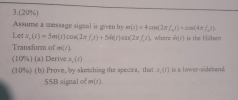 3(20%) Assume a message signal is given by m(t) = 4 cos(2π//) + cos(4π.t). Let x (t)-5m(t) cos(2t f t) + 5m(t) sin( 2 fct), where m(t) İs the Hilbert Transform of m(t). (10%) (a) Derive x(t) (10%) (b) Prove, by sketching the spectra, that x(t) is a lower-sideband SSB signal of m(t).
please answer all parts and write clearly thank you 4.5-1 A modulating signal m(t) is given...
 please answer all parts
and write clearly
thank you
4.5-1 A modulating signal m(t) is given by (a) m (t) = cos 1001 (b) m(t)cos 100r2 cos 300t (c) m(t)cos 100r cos 500 In each case: 1) Sketch the spectrum of mt) (ii) Find and sketch the spectrum of the DSB-SC signal 2m(t) cos 1000 ii) From the spectrum oblained in (ii), suppress the LSB spectrum to obtain the USB spectrum. (iv) Knowing the USB spectrum in (ii), write the...
please answer all parts
and write clearly
thank you
4.5-1 A modulating signal m(t) is given by (a) m (t) = cos 1001 (b) m(t)cos 100r2 cos 300t (c) m(t)cos 100r cos 500 In each case: 1) Sketch the spectrum of mt) (ii) Find and sketch the spectrum of the DSB-SC signal 2m(t) cos 1000 ii) From the spectrum oblained in (ii), suppress the LSB spectrum to obtain the USB spectrum. (iv) Knowing the USB spectrum in (ii), write the...
 Power Spectrum of AM A baseband message signal is given byWn (t)-5 cos 2π 2500t + 4 cos 2π 5500. An AM waveform carrying this message g(t)-50[1 + μ m(t) mp]cos 2π5x 10⁹, where mp s the peak value of m(t a) Plot (by hand) the power spectrum S (f) of the AM waveform g(t) with 0.6 (You can get help with this from the handout A Power Spectrum Primer. See the section "Finding the Power Spectrum of a Periodic...
 Question A modulated voltage signal is given as: s(t) = 10(1 + 0.5cos(10?rt)) cos(106mt) volts. Plot the spectrum of the signal and calculate its bandwidth. b) Calculate the total signal power in dbm. c) If the message signal is a single-tone signal, explain if this is an AM-DSB-SC or an AM-DSB-C signal. What is the modulation efficiency? d) The signal s(t) is passed through the following system. Find the output mout(t) as a function of time and its Fourier transform,...
 When the message signal m (t) =cos (2π fmt) and the
carrier signal is c(t)=cos (2π fct) ,
fm<< fc,
The modulated DSB-SC signal
SDSB-SC=m(t)cos(2πfct) is generated, and only
the upper sideband
To generate and transmit the SSB signal. As shown in the figure
below, the receiver is a local oscillator
cosine signal to the received signal and passes it through a
low-pass filter. Answer the following questions.
(a) Draw the waveform of DSB-SC modulated signal
SDSB-SC(t)
(b)Find the result...
When the message signal m (t) =cos (2π fmt) and the
carrier signal is c(t)=cos (2π fct) ,
fm<< fc,
The modulated DSB-SC signal
SDSB-SC=m(t)cos(2πfct) is generated, and only
the upper sideband
To generate and transmit the SSB signal. As shown in the figure
below, the receiver is a local oscillator
cosine signal to the received signal and passes it through a
low-pass filter. Answer the following questions.
(a) Draw the waveform of DSB-SC modulated signal
SDSB-SC(t)
(b)Find the result...
 Please solve parts d and e
The exponential Fourier series of a certain periodic signal is given as f(t) (2+j2) exp(-j300t)+j2 exp(-j10t) +3 -j2 exp(j10t) + (2-j2) exp(300t) a. Find the compact trigonometric Fourier series of f(t). b. Find the bandwidth of the signal c. Find the Fourier Transform of f(t). d. Design a simple low pass filter (RC circuit) that reduces the amplitude of the highest frequency part of f(t) by at least 50%. Write down its H(o) and...
Please solve parts d and e
The exponential Fourier series of a certain periodic signal is given as f(t) (2+j2) exp(-j300t)+j2 exp(-j10t) +3 -j2 exp(j10t) + (2-j2) exp(300t) a. Find the compact trigonometric Fourier series of f(t). b. Find the bandwidth of the signal c. Find the Fourier Transform of f(t). d. Design a simple low pass filter (RC circuit) that reduces the amplitude of the highest frequency part of f(t) by at least 50%. Write down its H(o) and...
 3(20%) Assume a message signal is given by m(t) = 4 cos(2π//) + cos(4π.t). Let x (t)-5m(t) cos(2t f t) + 5m(t) sin( 2 fct), where m(t) İs the Hilbert Transform of m(t). (10%) (a) Derive x(t) (10%) (b) Prove, by sketching the spectra, that x(t) is a lower-sideband SSB signal of m(t).
3(20%) Assume a message signal is given by m(t) = 4 cos(2π//) + cos(4π.t). Let x (t)-5m(t) cos(2t f t) + 5m(t) sin( 2 fct), where m(t)...
3(20%) Assume a message signal is given by m(t) = 4 cos(2π//) + cos(4π.t). Let x (t)-5m(t) cos(2t f t) + 5m(t) sin( 2 fct), where m(t) İs the Hilbert Transform of m(t). (10%) (a) Derive x(t) (10%) (b) Prove, by sketching the spectra, that x(t) is a lower-sideband SSB signal of m(t).
3(20%) Assume a message signal is given by m(t) = 4 cos(2π//) + cos(4π.t). Let x (t)-5m(t) cos(2t f t) + 5m(t) sin( 2 fct), where m(t)...
 3(20%) Assume a message signal is given by m(t) = 4 cos(2π//) + cos(4π.t). Let x (t)-5m(t) cos(2t f t) + 5m(t) sin( 2 fct), where m(t) İs the Hilbert Transform of m(t). (10%) (a) Derive x(t) (10%) (b) Prove, by sketching the spectra, that x(t) is a lower-sideband SSB signal of m(t).
 please answer all parts
and write clearly
thank you
4.5-1 A modulating signal m(t) is given by (a) m (t) = cos 1001 (b) m(t)cos 100r2 cos 300t (c) m(t)cos 100r cos 500 In each case: 1) Sketch the spectrum of mt) (ii) Find and sketch the spectrum of the DSB-SC signal 2m(t) cos 1000 ii) From the spectrum oblained in (ii), suppress the LSB spectrum to obtain the USB spectrum. (iv) Knowing the USB spectrum in (ii), write the...
please answer all parts
and write clearly
thank you
4.5-1 A modulating signal m(t) is given by (a) m (t) = cos 1001 (b) m(t)cos 100r2 cos 300t (c) m(t)cos 100r cos 500 In each case: 1) Sketch the spectrum of mt) (ii) Find and sketch the spectrum of the DSB-SC signal 2m(t) cos 1000 ii) From the spectrum oblained in (ii), suppress the LSB spectrum to obtain the USB spectrum. (iv) Knowing the USB spectrum in (ii), write the...
Most questions answered within 3 hours.
-
Where is the error in this code sequence?
String s1 = "Hello";
String s2 = "ello";...
asked 11 months ago -
Financial data for Joel de Paris, Inc., for last year
follow:
Joel de Paris, Inc.
Balance...
asked 11 months ago -
Consider this reaction:
Al2(SO4)3 (aq)+ BaCl3
(aq) Al2Cl6 (aq)- +
3BaSO4(s) . What is the...
asked 11 months ago -
Suppose that Savneet is considering increasing her
recent random sample from 20 car rentals to 40...
asked 11 months ago -
Trucks arrive at an unloading terminal at an average rate of 120
per hour.
Trucks arrive...
asked 11 months ago -
Why are methanol and ethanol completely soluble in water while
octanol is not very little soluble....
asked 11 months ago -
A facilities manager at a university reads in a research report
that the mean amount of...
asked 11 months ago -
When the CuSO4 is rehydrated by adding water to the anhydrous
compound, is this an endothermic...
asked 11 months ago -
A ray of sunlight is passing from diamond into crown glass; the
angle of incidence is...
asked 11 months ago -
A block of mass 0.249 kg is placed on top of a light, vertical
spring of...
asked 11 months ago -
how do the kidneys compensate in the presences of acidosis
a) trigger hyperventilate
b) reserve acid...
asked 11 months ago -
Question 501 pts
The rental rate of capital to the firm increases. Which of the
following...
asked 11 months ago