
Homework Answers
Add Answer to:
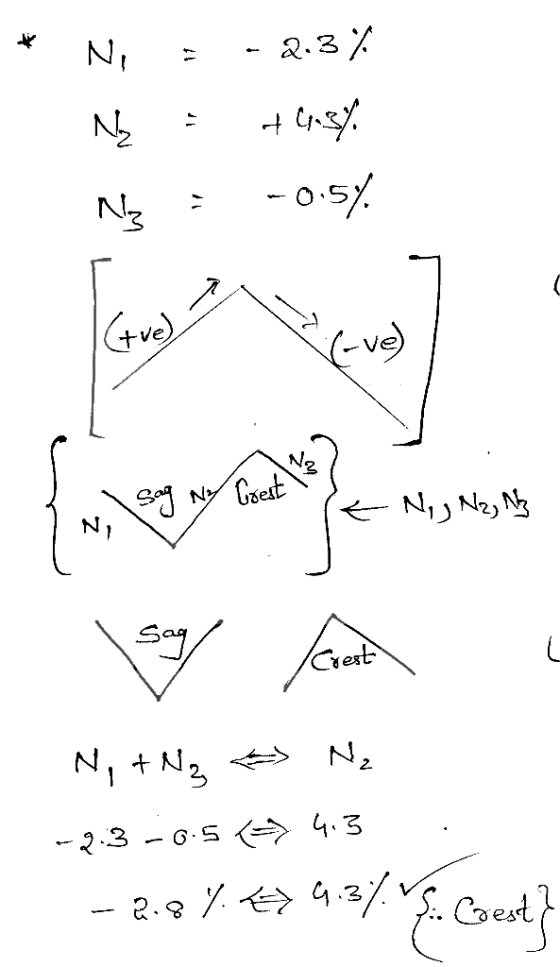
Identify the type of vertical curve (sag or crest) by the following rates of change in...
2. Given a sag vertical curve connecting a -1.5% grade with a +2.5% grade on a...
 2. Given a sag vertical curve connecting a -1.5% grade with a +2.5% grade on a rural arterial highway, use the rate of vertical curvature and a design speed of 70 mi/h to compute the elevation of the curve at 100 ft stations if the grades intersect at station (475+00) at an elevation of 300.00 ft. Identify the station and elevation of the low point.
a) a 200 m vertical crest curve is designed to connect a +4.5% tangent with a...
 a) a 200 m vertical crest curve is designed to connect a +4.5% tangent with a -2% tangent. What should the design speed be to provide ample stopping sight distance? SSD t Pra) [10 marks) b) A 300 m sag parabolic vertical curve has a PVC at station 2+600.000 and elevation 320.000 m. the initial grade is -4.0% and the final grade is +1.0%. Determine the stationing and elevation of PVI, PVT and the lowest point on the curve. Also...
9:381 LTE Problem 1 A crest vertical curve is to be designed to join a +2% grade with a-2% at a s...
 9:381 LTE Problem 1 A crest vertical curve is to be designed to join a +2% grade with a-2% at a section of a two-lane highway. Determine the minimum length of the curve if the design speed of the highway is 60 mph and SL. Assume that a-9.34 ftsec' and that the perception-reaction time is 2.5 sec. Problem2 A crest vertical curve is to be designed to join a +3% grade with a-2% grade at a section of a two-lane...
1. A vertical crest curve with a length of 400’ is to connect grades of +1%...
1. A vertical crest curve with a length of 400’ is to connect grades of +1% and -1.75%. The PVI is located at station 35 and has an elevation of 549.20’. What are the elevations of the PVC, PVT and at all full stations on the curve?
Question: An existing tunnel needs to be connected to a newly constructed bridge with sag and...
 Question: An existing tunnel needs to be connected to a newly constructed bridge with sag and crest vertical curves. The sag curve begins at station 0+00 and elevation 100 ft. and the crest curve ends at station 12+00 and elevation 140 ft. Station 12 +00, PVT Bridge deck elevation 140 ft Tunnel floor elevation 100 ft WURUK Station 0 + 00, PVC, Develop a vertical alignment to connect the tunnel and bridge by determining the highest possible common design speed...
A 200m equal tangent sag vertical curve has the PVC at station 3 + 700.000 and...
A 200m equal tangent sag vertical curve has the PVC at station 3 + 700.000 and elevation 321m. The initial grade is -3.5% and the final grade is 0.5%. Determine the elevation and stationing of the PVI, PVT, and lowest point on the curve.
Problem 4 A 500 ft long sag vertical curve passes under a bridge at station 82+45....
 Problem 4 A 500 ft long sag vertical curve passes under a bridge at station 82+45. The beginning of vertical curve (BVC) is at station 81+00. A-3.6% curve meets a +4.4% curve at the point of vertical intersection (PVI), which is at elevation 425.38 ft. What is the elevation of the point on the curve under the bridge? Problem 5 The grade into a vertical sag curve is -2%. The curve length is 1,400 ft. The grade out of the...
For a crest vertical curve, with the following data, Station of BVC: 10+50 Station of Vertex:...
For a crest vertical curve, with the following data, Station of BVC: 10+50 Station of Vertex: 18+00 Station of EVC: 20+50 Elevation of Vertex: 1000ft Beginning Grade: +3.50% Ending Grade: -3.50% a) At what station is the highest point located? b) What is the elevation of the high point? c) An information center is located at station 18+50.98, what is the elevation of the information center? d) What is the AASHTO K-value for the vertical curve?
A sag vertical curve has a 25% grade that intersects with a +3.1% grade at station...
 A sag vertical curve has a 25% grade that intersects with a +3.1% grade at station 352+52.8 and an elevation of 422.8. To provide proper cover for a culvert, the elevation at 349+30.00 be 434.6 or higher. A) What minimum length of vertical curve is necessary to provide the necessary cover and meet the other design requirements for a design speed of 70 mph? B) if a 1025-foot curve is used, determine the station and the elevation of the low...
An equal-tangent crest vertical curve was designed in 2012 (to 2011 AASHTO guidelines) for a design...
An equal-tangent crest vertical curve was designed in 2012 (to 2011 AASHTO guidelines) for a design speed of 70 mph to connect grades G1 = +1.2% and G2 = -2.1%. The curve is to be redesigned for a 70 mph design speed in the year 2025. Vehicle braking technology has advanced so that the recommended design deceleration rate is 25% greater than the 2011 value used in Table 3.1, but due to the higher percentage of older persons in the...
 2. Given a sag vertical curve connecting a -1.5% grade with a +2.5% grade on a rural arterial highway, use the rate of vertical curvature and a design speed of 70 mi/h to compute the elevation of the curve at 100 ft stations if the grades intersect at station (475+00) at an elevation of 300.00 ft. Identify the station and elevation of the low point.
 a) a 200 m vertical crest curve is designed to connect a +4.5% tangent with a -2% tangent. What should the design speed be to provide ample stopping sight distance? SSD t Pra) [10 marks) b) A 300 m sag parabolic vertical curve has a PVC at station 2+600.000 and elevation 320.000 m. the initial grade is -4.0% and the final grade is +1.0%. Determine the stationing and elevation of PVI, PVT and the lowest point on the curve. Also...
 9:381 LTE Problem 1 A crest vertical curve is to be designed to join a +2% grade with a-2% at a section of a two-lane highway. Determine the minimum length of the curve if the design speed of the highway is 60 mph and SL. Assume that a-9.34 ftsec' and that the perception-reaction time is 2.5 sec. Problem2 A crest vertical curve is to be designed to join a +3% grade with a-2% grade at a section of a two-lane...
 Question: An existing tunnel needs to be connected to a newly constructed bridge with sag and crest vertical curves. The sag curve begins at station 0+00 and elevation 100 ft. and the crest curve ends at station 12+00 and elevation 140 ft. Station 12 +00, PVT Bridge deck elevation 140 ft Tunnel floor elevation 100 ft WURUK Station 0 + 00, PVC, Develop a vertical alignment to connect the tunnel and bridge by determining the highest possible common design speed...
 Problem 4 A 500 ft long sag vertical curve passes under a bridge at station 82+45. The beginning of vertical curve (BVC) is at station 81+00. A-3.6% curve meets a +4.4% curve at the point of vertical intersection (PVI), which is at elevation 425.38 ft. What is the elevation of the point on the curve under the bridge? Problem 5 The grade into a vertical sag curve is -2%. The curve length is 1,400 ft. The grade out of the...
 A sag vertical curve has a 25% grade that intersects with a +3.1% grade at station 352+52.8 and an elevation of 422.8. To provide proper cover for a culvert, the elevation at 349+30.00 be 434.6 or higher. A) What minimum length of vertical curve is necessary to provide the necessary cover and meet the other design requirements for a design speed of 70 mph? B) if a 1025-foot curve is used, determine the station and the elevation of the low...
Most questions answered within 3 hours.
-
Where is the error in this code sequence?
String s1 = "Hello";
String s2 = "ello";...
asked 11 months ago -
Financial data for Joel de Paris, Inc., for last year
follow:
Joel de Paris, Inc.
Balance...
asked 11 months ago -
Consider this reaction:
Al2(SO4)3 (aq)+ BaCl3
(aq) Al2Cl6 (aq)- +
3BaSO4(s) . What is the...
asked 11 months ago -
Suppose that Savneet is considering increasing her
recent random sample from 20 car rentals to 40...
asked 11 months ago -
Trucks arrive at an unloading terminal at an average rate of 120
per hour.
Trucks arrive...
asked 11 months ago -
Why are methanol and ethanol completely soluble in water while
octanol is not very little soluble....
asked 11 months ago -
A facilities manager at a university reads in a research report
that the mean amount of...
asked 11 months ago -
When the CuSO4 is rehydrated by adding water to the anhydrous
compound, is this an endothermic...
asked 11 months ago -
A ray of sunlight is passing from diamond into crown glass; the
angle of incidence is...
asked 11 months ago -
A block of mass 0.249 kg is placed on top of a light, vertical
spring of...
asked 11 months ago -
how do the kidneys compensate in the presences of acidosis
a) trigger hyperventilate
b) reserve acid...
asked 11 months ago -
Question 501 pts
The rental rate of capital to the firm increases. Which of the
following...
asked 11 months ago