

Homework Answers
MATLAB:
1)
>> A=[1 2 3; 4 5 6; 7 8 9]
A =
1 2 3
4 5 6
7 8 9
2)
>> A(2,3)
ans = 6
3)
>> A(3,3)-9
ans = 0
4)
>> B=A(2:3,1:3)
B =
4 5 6
7 8 9
5)
>> B=A(2:3,:)
B =
4 5 6
7 8 9
6)
>> B(:,2)=[]
B =
4 6
7 9
7)
>> A=[1 2 3;4 5 6;7 8 9];
>> x=A(1,:)'
x =
1
2
3
8)
>> x*x'
ans =
1 2 3
2 4 6
3 6 9
>> x'*x
ans = 14
9)
>> A*x
ans =
14
32
50
10)
>> A^2
ans =
30 36 42
66 81 96
102 126 150
11)
>> A.^2
ans =
1 4 9
16 25 36
49 64 81
12)
>> eye(3)
ans =
Diagonal Matrix
1 0 0
0 1 0
0 0 1
13)
>> eye(4,6)
ans =
Diagonal Matrix
1 0 0 0 0 0
0 1 0 0 0 0
0 0 1 0 0 0
0 0 0 1 0 0
14)
>> zeros(3,5)
ans =
0 0 0 0 0
0 0 0 0 0
0 0 0 0 0
15)
>> ones(5,8)
ans =
1 1 1 1 1 1 1 1
1 1 1 1 1 1 1 1
1 1 1 1 1 1 1 1
1 1 1 1 1 1 1 1
1 1 1 1 1 1 1 1
16)
>> rand(4,4)
ans =
0.612710 0.872208 0.720667 0.570826
0.544332 0.556898 0.329526 0.529136
0.708312 0.665066 0.397935 0.717848
0.892258 0.995077 0.026875 0.834681
17)
>> K=[ones(3) zeros(3,2)]
K =
1 1 1 0 0
1 1 1 0 0
1 1 1 0 0
18)
>> K=[ones(3) zeros(3,2);zeros(2,3)
4*eye(2)]
K =
1 1 1 0 0
1 1 1 0 0
1 1 1 0 0
0 0 0 4 0
0 0 0 0 4
19)
>> diag(K)
ans =
1
1
1
4
4
20)
>> diag(K)'
ans =
1 1 1 4 4
Add Answer to:
on matlab
(1) Matrices are entered row-wise. Row commas. Enter 1 2 3 (2) Element A,...
Which of the following is an INCORRECT statement: 1) MATLAB command eye(n) makes an nxn identity...
 Which of the following is an INCORRECT statement: 1) MATLAB command eye(n) makes an nxn identity matrix 2) Identity matrix is square matrix with ones on main diagonal and zeros elsewhere 0 3) Matrix multiplication on any array with the identity matrix changes the array 4) Matrix B is the inverse of matrix A if matrix product of A and B is the identity matrix
in matlab 6. Create a big matrix with submatrices: The following matrix G is created by inserting the matrices A, B, an...
 in matlab
6. Create a big matrix with submatrices: The following matrix G is created by inserting the matrices A, B, and C from Exercise 3, together with zero matrices and 2 x 2 identity AY NOT llr SIIAIut. UMOADIT, SOLD Og1 DISTIunUTII》 THIS CONTENT IS PROTECTED AND M 019 2 CopprightQ Schoall of Mathercatical and Statistical Sceom Ariaona State Cniseesity matrices in the appropriate position. Create the matrix using submatrioes A, B, C, zeros and eye (that is, you...
in matlab
6. Create a big matrix with submatrices: The following matrix G is created by inserting the matrices A, B, and C from Exercise 3, together with zero matrices and 2 x 2 identity AY NOT llr SIIAIut. UMOADIT, SOLD Og1 DISTIunUTII》 THIS CONTENT IS PROTECTED AND M 019 2 CopprightQ Schoall of Mathercatical and Statistical Sceom Ariaona State Cniseesity matrices in the appropriate position. Create the matrix using submatrioes A, B, C, zeros and eye (that is, you...
The colde provided solbe)() 1, y(5).nthe ntred aproimation o 100 no y value prob 1) -1. บู(5) -2,...
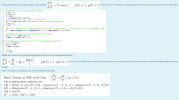 Please provide me the maximum computed y vector for the given
domain
The colde provided solbe)() 1, y(5).nthe ntred aproimation o 100 no y value prob 1) -1. บู(5) -2, on the interval-rousing a centred approximation of the derivative term and N-100 nodes. dr2 Matlab code for the solution of Module 2 3 xright-5; 4 N 188: 5 x=linspace(xleft , X right ,N); 6 x-x"; %this just turns x into a column vector 7 dx = (xright-xleft)/(N-1); %1f theres N...
Please provide me the maximum computed y vector for the given
domain
The colde provided solbe)() 1, y(5).nthe ntred aproimation o 100 no y value prob 1) -1. บู(5) -2, on the interval-rousing a centred approximation of the derivative term and N-100 nodes. dr2 Matlab code for the solution of Module 2 3 xright-5; 4 N 188: 5 x=linspace(xleft , X right ,N); 6 x-x"; %this just turns x into a column vector 7 dx = (xright-xleft)/(N-1); %1f theres N...
Need help with this MatLab exercise. Please show all commands in MatLab. Enter the following matrices...
 Need help with this MatLab exercise. Please show all commands in
MatLab.
Enter the following matrices and vectors in MATLAB [ 2 -6 3 ] [ 5 ] -3 A= 2 -7 -2 , B= 2 -2 -3 , b= -13 , c= 3 -1 4], d= 0 [ 7 -2 7 [1 -8 -1 ] [ 10 (a) Perform the following operations: AB, BA, CA and Bd (use standard linear algebra multiplication). - 3 (b) Construct a 6 x...
Need help with this MatLab exercise. Please show all commands in
MatLab.
Enter the following matrices and vectors in MATLAB [ 2 -6 3 ] [ 5 ] -3 A= 2 -7 -2 , B= 2 -2 -3 , b= -13 , c= 3 -1 4], d= 0 [ 7 -2 7 [1 -8 -1 ] [ 10 (a) Perform the following operations: AB, BA, CA and Bd (use standard linear algebra multiplication). - 3 (b) Construct a 6 x...
1. Write a MATLAB function that takes a matrix, a row number and a scalar as...
 1. Write a MATLAB function that takes a matrix, a row number and
a scalar as
arguments and multiplies each element of the row of the matrix by
the scalar returning the
updated matrix.
2. Write a MATLAB function that takes a matrix, two row numbers and
a scalar as
arguments and returns a matrix with a linear combination of the
rows. For example, if the rows
passed to the function were i and j and the scalar was m,...
1. Write a MATLAB function that takes a matrix, a row number and
a scalar as
arguments and multiplies each element of the row of the matrix by
the scalar returning the
updated matrix.
2. Write a MATLAB function that takes a matrix, two row numbers and
a scalar as
arguments and returns a matrix with a linear combination of the
rows. For example, if the rows
passed to the function were i and j and the scalar was m,...
*** Write a function called reverse_diag that creates a square matrix whose elements are 0 except...
*** Write a function called reverse_diag that creates a square matrix whose elements are 0 except for 1s on the reverse diagonal from top right to bottom left. The reverse diagonal of an nby- n matrix consists of the elements at the following indexes: (1, n), (2, n-1), (3, n-2), … (n, 1). The function takes one positive integer input argument named n, which is the size of the matrix, and returns the matrix itself as an output argument. Note...
Write a program to find product of a row vector, U having dimension 1 x 2...
Write a program to find product of a row vector, U having dimension 1 x 2 with a 2 x 2 matrix, A. The input to the program includes initialized row vector, U and matrix, A. The expected output is a transformed row vector. You can test your program using following example: A = 2 4 5 1 4 5 1 and U = [3 2] The result of product U.A is a transformed row vector: [16 14] Q2. Write...
The code provided solves the boundary value problem 2 dr2 cos(a), J(1) , y(5)2.on the interval To...
 Please provide code and final answer.
The code provided solves the boundary value problem 2 dr2 cos(a), J(1) , y(5)2.on the interval Toxksusing a Centred approximation of the derivative term and N= 100 nodes 1 we% Matlab code for the solution of Module 2 3 xright=5; 4 N 100; 5 x-linspace(xleft,xright,N); x x'; %this just turns x into a column vector dx- 7 (xright-xleft)/(N-1); %If theres N nodes, theres N-1 separations . 9 yright 2; 10 here is the matrix...
Please provide code and final answer.
The code provided solves the boundary value problem 2 dr2 cos(a), J(1) , y(5)2.on the interval Toxksusing a Centred approximation of the derivative term and N= 100 nodes 1 we% Matlab code for the solution of Module 2 3 xright=5; 4 N 100; 5 x-linspace(xleft,xright,N); x x'; %this just turns x into a column vector dx- 7 (xright-xleft)/(N-1); %If theres N nodes, theres N-1 separations . 9 yright 2; 10 here is the matrix...
Matlab answer only Form 1 6) [10 pts] Consider the following two matrices B=[S A 3...
 Matlab answer only
Form 1 6) [10 pts] Consider the following two matrices B=[S A 3 1 5 -7 4 6-3] a) Obtain the sum of each row of matrix A. b) Use the size function to create a magic matrix P which has the same size as matrix A. c) Create a matrix called Q from the second column of matrix A d) Extract the four numbers in the lower left-hand corner of matrix A and create matrix R....
Matlab answer only
Form 1 6) [10 pts] Consider the following two matrices B=[S A 3 1 5 -7 4 6-3] a) Obtain the sum of each row of matrix A. b) Use the size function to create a magic matrix P which has the same size as matrix A. c) Create a matrix called Q from the second column of matrix A d) Extract the four numbers in the lower left-hand corner of matrix A and create matrix R....
3. Random matrices are matrix generalization of random variables. To examine the distribution of eigenvalues of...
 3. Random matrices are matrix generalization of random variables. To examine the distribution of eigenvalues of such matrices, first generate a 100x100 random matrix with elements selected from a random distribution of ones and zeros (to do this you can start with the function rand( ) together with round( ) or alternatively randi( )) and then find the absolute value (the norm) of each the eigenvalues of this matrix with the routine eig。 Repeat this 100 times storing all the...
 Which of the following is an INCORRECT statement: 1) MATLAB command eye(n) makes an nxn identity matrix 2) Identity matrix is square matrix with ones on main diagonal and zeros elsewhere 0 3) Matrix multiplication on any array with the identity matrix changes the array 4) Matrix B is the inverse of matrix A if matrix product of A and B is the identity matrix
 in matlab
6. Create a big matrix with submatrices: The following matrix G is created by inserting the matrices A, B, and C from Exercise 3, together with zero matrices and 2 x 2 identity AY NOT llr SIIAIut. UMOADIT, SOLD Og1 DISTIunUTII》 THIS CONTENT IS PROTECTED AND M 019 2 CopprightQ Schoall of Mathercatical and Statistical Sceom Ariaona State Cniseesity matrices in the appropriate position. Create the matrix using submatrioes A, B, C, zeros and eye (that is, you...
in matlab
6. Create a big matrix with submatrices: The following matrix G is created by inserting the matrices A, B, and C from Exercise 3, together with zero matrices and 2 x 2 identity AY NOT llr SIIAIut. UMOADIT, SOLD Og1 DISTIunUTII》 THIS CONTENT IS PROTECTED AND M 019 2 CopprightQ Schoall of Mathercatical and Statistical Sceom Ariaona State Cniseesity matrices in the appropriate position. Create the matrix using submatrioes A, B, C, zeros and eye (that is, you...
 Please provide me the maximum computed y vector for the given
domain
The colde provided solbe)() 1, y(5).nthe ntred aproimation o 100 no y value prob 1) -1. บู(5) -2, on the interval-rousing a centred approximation of the derivative term and N-100 nodes. dr2 Matlab code for the solution of Module 2 3 xright-5; 4 N 188: 5 x=linspace(xleft , X right ,N); 6 x-x"; %this just turns x into a column vector 7 dx = (xright-xleft)/(N-1); %1f theres N...
Please provide me the maximum computed y vector for the given
domain
The colde provided solbe)() 1, y(5).nthe ntred aproimation o 100 no y value prob 1) -1. บู(5) -2, on the interval-rousing a centred approximation of the derivative term and N-100 nodes. dr2 Matlab code for the solution of Module 2 3 xright-5; 4 N 188: 5 x=linspace(xleft , X right ,N); 6 x-x"; %this just turns x into a column vector 7 dx = (xright-xleft)/(N-1); %1f theres N...
 Need help with this MatLab exercise. Please show all commands in
MatLab.
Enter the following matrices and vectors in MATLAB [ 2 -6 3 ] [ 5 ] -3 A= 2 -7 -2 , B= 2 -2 -3 , b= -13 , c= 3 -1 4], d= 0 [ 7 -2 7 [1 -8 -1 ] [ 10 (a) Perform the following operations: AB, BA, CA and Bd (use standard linear algebra multiplication). - 3 (b) Construct a 6 x...
Need help with this MatLab exercise. Please show all commands in
MatLab.
Enter the following matrices and vectors in MATLAB [ 2 -6 3 ] [ 5 ] -3 A= 2 -7 -2 , B= 2 -2 -3 , b= -13 , c= 3 -1 4], d= 0 [ 7 -2 7 [1 -8 -1 ] [ 10 (a) Perform the following operations: AB, BA, CA and Bd (use standard linear algebra multiplication). - 3 (b) Construct a 6 x...
 1. Write a MATLAB function that takes a matrix, a row number and
a scalar as
arguments and multiplies each element of the row of the matrix by
the scalar returning the
updated matrix.
2. Write a MATLAB function that takes a matrix, two row numbers and
a scalar as
arguments and returns a matrix with a linear combination of the
rows. For example, if the rows
passed to the function were i and j and the scalar was m,...
1. Write a MATLAB function that takes a matrix, a row number and
a scalar as
arguments and multiplies each element of the row of the matrix by
the scalar returning the
updated matrix.
2. Write a MATLAB function that takes a matrix, two row numbers and
a scalar as
arguments and returns a matrix with a linear combination of the
rows. For example, if the rows
passed to the function were i and j and the scalar was m,...
 Please provide code and final answer.
The code provided solves the boundary value problem 2 dr2 cos(a), J(1) , y(5)2.on the interval Toxksusing a Centred approximation of the derivative term and N= 100 nodes 1 we% Matlab code for the solution of Module 2 3 xright=5; 4 N 100; 5 x-linspace(xleft,xright,N); x x'; %this just turns x into a column vector dx- 7 (xright-xleft)/(N-1); %If theres N nodes, theres N-1 separations . 9 yright 2; 10 here is the matrix...
Please provide code and final answer.
The code provided solves the boundary value problem 2 dr2 cos(a), J(1) , y(5)2.on the interval Toxksusing a Centred approximation of the derivative term and N= 100 nodes 1 we% Matlab code for the solution of Module 2 3 xright=5; 4 N 100; 5 x-linspace(xleft,xright,N); x x'; %this just turns x into a column vector dx- 7 (xright-xleft)/(N-1); %If theres N nodes, theres N-1 separations . 9 yright 2; 10 here is the matrix...
 Matlab answer only
Form 1 6) [10 pts] Consider the following two matrices B=[S A 3 1 5 -7 4 6-3] a) Obtain the sum of each row of matrix A. b) Use the size function to create a magic matrix P which has the same size as matrix A. c) Create a matrix called Q from the second column of matrix A d) Extract the four numbers in the lower left-hand corner of matrix A and create matrix R....
Matlab answer only
Form 1 6) [10 pts] Consider the following two matrices B=[S A 3 1 5 -7 4 6-3] a) Obtain the sum of each row of matrix A. b) Use the size function to create a magic matrix P which has the same size as matrix A. c) Create a matrix called Q from the second column of matrix A d) Extract the four numbers in the lower left-hand corner of matrix A and create matrix R....
 3. Random matrices are matrix generalization of random variables. To examine the distribution of eigenvalues of such matrices, first generate a 100x100 random matrix with elements selected from a random distribution of ones and zeros (to do this you can start with the function rand( ) together with round( ) or alternatively randi( )) and then find the absolute value (the norm) of each the eigenvalues of this matrix with the routine eig。 Repeat this 100 times storing all the...
Most questions answered within 3 hours.
-
Where is the error in this code sequence?
String s1 = "Hello";
String s2 = "ello";...
asked 10 months ago -
Financial data for Joel de Paris, Inc., for last year
follow:
Joel de Paris, Inc.
Balance...
asked 10 months ago -
Consider this reaction:
Al2(SO4)3 (aq)+ BaCl3
(aq) Al2Cl6 (aq)- +
3BaSO4(s) . What is the...
asked 10 months ago -
Suppose that Savneet is considering increasing her
recent random sample from 20 car rentals to 40...
asked 10 months ago -
Trucks arrive at an unloading terminal at an average rate of 120
per hour.
Trucks arrive...
asked 10 months ago -
Why are methanol and ethanol completely soluble in water while
octanol is not very little soluble....
asked 10 months ago -
A facilities manager at a university reads in a research report
that the mean amount of...
asked 10 months ago -
When the CuSO4 is rehydrated by adding water to the anhydrous
compound, is this an endothermic...
asked 10 months ago -
A ray of sunlight is passing from diamond into crown glass; the
angle of incidence is...
asked 10 months ago -
A block of mass 0.249 kg is placed on top of a light, vertical
spring of...
asked 10 months ago -
how do the kidneys compensate in the presences of acidosis
a) trigger hyperventilate
b) reserve acid...
asked 10 months ago -
Question 501 pts
The rental rate of capital to the firm increases. Which of the
following...
asked 10 months ago