Please provide me the maximum computed y vector for the given domain

Homework Answers
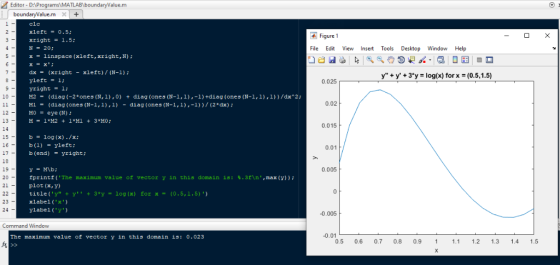
I have implemented the code as required. I have attached the code as well as the screenshot with output.
Code:
clc
xleft = 0.5;
xright = 1.5;
N = 20;
x = linspace(xleft,xright,N);
x = x';
dx = (xright - xleft)/(N-1);
yleft = 1;
yright = 1;
M2 = (diag(-2*ones(N,1),0) +
diag(ones(N-1,1),-1)+diag(ones(N-1,1),1))/dx^2;
M1 = (diag(ones(N-1,1),1) - diag(ones(N-1,1),-1))/(2*dx);
M0 = eye(N);
M = 1*M2 + 1*M1 + 3*M0;
b = log(x)./x;
b(1) = yleft;
b(end) = yright;
y = M\b;
fprintf('The maximum value of vector y in this domain is:
%.3f\n',max(y));
plot(x,y)
title('y" + y'' + 3*y = log(x) for x = (0.5,1.5)')
xlabel('x')
ylabel('y')
Screenshot:
Add Answer to:
The colde provided solbe)() 1, y(5).nthe ntred aproimation o 100 no y value prob 1) -1. บู(5) -2,...
The code provided solves the boundary value problem 2 dr2 cos(a), J(1) , y(5)2.on the interval To...
 Please provide code and final answer.
The code provided solves the boundary value problem 2 dr2 cos(a), J(1) , y(5)2.on the interval Toxksusing a Centred approximation of the derivative term and N= 100 nodes 1 we% Matlab code for the solution of Module 2 3 xright=5; 4 N 100; 5 x-linspace(xleft,xright,N); x x'; %this just turns x into a column vector dx- 7 (xright-xleft)/(N-1); %If theres N nodes, theres N-1 separations . 9 yright 2; 10 here is the matrix...
Please provide code and final answer.
The code provided solves the boundary value problem 2 dr2 cos(a), J(1) , y(5)2.on the interval Toxksusing a Centred approximation of the derivative term and N= 100 nodes 1 we% Matlab code for the solution of Module 2 3 xright=5; 4 N 100; 5 x-linspace(xleft,xright,N); x x'; %this just turns x into a column vector dx- 7 (xright-xleft)/(N-1); %If theres N nodes, theres N-1 separations . 9 yright 2; 10 here is the matrix...
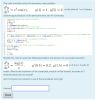
I know the solution is 0.2, but it says incorrect for my quiz. I think there...
 I
know the solution is 0.2, but it says incorrect for my quiz. I
think there is a problem when writing log(x). Can someone help
me?
The code provided solves the boundary value problem dạy %= r- cos(x), y(1) = 1, y(5) = 2 , on the interval 1<x<5 using a d.x2 centred approximation of the derivative term and N=100 nodes. 1 4 x Matlab code for the solution of Module 2 xleft = 1; xright = 5; N =...
I
know the solution is 0.2, but it says incorrect for my quiz. I
think there is a problem when writing log(x). Can someone help
me?
The code provided solves the boundary value problem dạy %= r- cos(x), y(1) = 1, y(5) = 2 , on the interval 1<x<5 using a d.x2 centred approximation of the derivative term and N=100 nodes. 1 4 x Matlab code for the solution of Module 2 xleft = 1; xright = 5; N =...
Use the attached Matlab code as a basis to solve the following ordinary differential equation usi...
 Question 1
QUESTION 2
Use the attached Matlab code as a basis to solve the following ordinary differential equation using Euler's method, with timestep of 0.1, from t-0to t-100. d)0) -0 - sin (5vt cos(у Plot y versus t from t=0 to t=100. How many local maxima are on this interval(do not include end points). Be careful to count them all! Answer should be an integer 1 w% Matlab code for the solution of Module 2 3 dt-9.1; %dt is...
Question 1
QUESTION 2
Use the attached Matlab code as a basis to solve the following ordinary differential equation using Euler's method, with timestep of 0.1, from t-0to t-100. d)0) -0 - sin (5vt cos(у Plot y versus t from t=0 to t=100. How many local maxima are on this interval(do not include end points). Be careful to count them all! Answer should be an integer 1 w% Matlab code for the solution of Module 2 3 dt-9.1; %dt is...
on matlab (1) Matrices are entered row-wise. Row commas. Enter 1 2 3 (2) Element A,...
 on matlab
(1) Matrices are entered row-wise. Row commas. Enter 1 2 3 (2) Element A, of matrix A is accesser (3) Correcting an entry is easy to (4) Any submatrix of Ais obtained by d row wise. Rows are separated by semicolons and columns are separated by spaces ner A l 23:45 6. B and hit the return/enter kry matrix A is accessed as A Enter and hit the returnerter key an entry is easy through indesine Enter 19...
on matlab
(1) Matrices are entered row-wise. Row commas. Enter 1 2 3 (2) Element A, of matrix A is accesser (3) Correcting an entry is easy to (4) Any submatrix of Ais obtained by d row wise. Rows are separated by semicolons and columns are separated by spaces ner A l 23:45 6. B and hit the return/enter kry matrix A is accessed as A Enter and hit the returnerter key an entry is easy through indesine Enter 19...
QUESTION: Show= (y − y0* )(y − y1*) . .(y − yn* ) = 5 it...
 QUESTION: Show= (y − y0* )(y −
y1*) . .(y − yn* ) = 5
it is Part 1 at the bottom
We were unable to transcribe this image(7+17) Problem 1: Recall that the Chebyshev nodes x7, x1,...,x* are determined on the interval (-1,1] [-1, 1) as the zeros of Tn+1(x) = cos((n + 1) arccos(x)) and are given by 2j +12 X; - cos j = 0,1, ... n. n+1 2 Consider now interpolating the function f(x) = 1/(1+x2)...
QUESTION: Show= (y − y0* )(y −
y1*) . .(y − yn* ) = 5
it is Part 1 at the bottom
We were unable to transcribe this image(7+17) Problem 1: Recall that the Chebyshev nodes x7, x1,...,x* are determined on the interval (-1,1] [-1, 1) as the zeros of Tn+1(x) = cos((n + 1) arccos(x)) and are given by 2j +12 X; - cos j = 0,1, ... n. n+1 2 Consider now interpolating the function f(x) = 1/(1+x2)...
Function LUfac_solver.m is provided here: function [x] = LUfac_solver(LU,b,piv) % % function [x] = LUfac_solver(lu,b) %...
 Function LUfac_solver.m is provided here:
function [x] = LUfac_solver(LU,b,piv)
%
% function [x] = LUfac_solver(lu,b)
%
% This program employs the LU factorization to solve the linear
system Ax=b.
%
% Input
% LU: lu matrix from GEpivot_new function
% b: right side column vector (ordered corresponding to original
vector
% sent to GEpivot_new)
% piv: vector indicating the pivoting (row interchanges that
took place
% during GE
%
% Output
% x: solution vector
%
% Written by Steve...
Function LUfac_solver.m is provided here:
function [x] = LUfac_solver(LU,b,piv)
%
% function [x] = LUfac_solver(lu,b)
%
% This program employs the LU factorization to solve the linear
system Ax=b.
%
% Input
% LU: lu matrix from GEpivot_new function
% b: right side column vector (ordered corresponding to original
vector
% sent to GEpivot_new)
% piv: vector indicating the pivoting (row interchanges that
took place
% during GE
%
% Output
% x: solution vector
%
% Written by Steve...
I need to create a MATLAB function, bvp_solve.m, to approximate the solution y(x). The function takes...
 I need to create a MATLAB function, bvp_solve.m, to approximate
the solution y(x). The function takes the number of grid points n
as an input. The outputs are grid vector x and the solution vector
y
%% This is the function i have so far:
function [xi, yi] = bvp_solve(n)
% BVP_SOLVE computes the solution y(x) of a two-point boundary
value problem
% using finite difference method (FDM).
% The governing equation is
% y''' = -y + (x -...
I need to create a MATLAB function, bvp_solve.m, to approximate
the solution y(x). The function takes the number of grid points n
as an input. The outputs are grid vector x and the solution vector
y
%% This is the function i have so far:
function [xi, yi] = bvp_solve(n)
% BVP_SOLVE computes the solution y(x) of a two-point boundary
value problem
% using finite difference method (FDM).
% The governing equation is
% y''' = -y + (x -...
MATLAB %% T = 1; N = 11; np = 2; dt = 0.001; tmax =...
MATLAB %% T = 1; N = 11; np = 2; dt = 0.001; tmax = np*T; t = -tmax:dt:tmax; %% Function 1 %the following code was used to create the x(t) function xrange = floor((T/dt)/15); x1 = linspace(0,1,xrange); x2 = x1(end-1:-1:1); x3 = linspace(0,2,2*xrange); x4 = x3(end-1:-1:1); x5 = zeros(1,xrange); x6 = x1; x7 = 2*ones(1,xrange); x8 = 1+x2; x9 = -0.5*ones(1,xrange); x10 = x1/2-0.5; xtemp = [x1 x2 x3 x4 x5 x6 x7 x8 x9 x10]; ztemp =...
Part I: Show that (y − y ∗ 0 )(y − y ∗ 1 ). ....
 Part I: Show that (y − y ∗ 0 )(y − y ∗ 1 ). . .(y − y ∗ n ) = 5
n+1 2 n Tn+1(x), where x = y/5
Part II: It can be shown that there exists R > 0 such that |f
(n) (y)| ≤ Rn for all y ∈ [−5, 5]. Assuming this, show that limn→∞
max{|f(y) − Pn(y)|, y ∈ [−5, 5]} = 0
Ij = COS Problem 1: Recall that the Chebyshev...
Part I: Show that (y − y ∗ 0 )(y − y ∗ 1 ). . .(y − y ∗ n ) = 5
n+1 2 n Tn+1(x), where x = y/5
Part II: It can be shown that there exists R > 0 such that |f
(n) (y)| ≤ Rn for all y ∈ [−5, 5]. Assuming this, show that limn→∞
max{|f(y) − Pn(y)|, y ∈ [−5, 5]} = 0
Ij = COS Problem 1: Recall that the Chebyshev...
numerical methods 2+17), j = 0,1...... Problem 1: Recall that the Chebyshev nodes x0, 71,..., are...
 numerical methods
2+17), j = 0,1...... Problem 1: Recall that the Chebyshev nodes x0, 71,..., are determined on the interval (-1,1) as the zeros of Tn+1(x) = cos((n +1) arccos(x)) and are given by 2j +17 X; = cos in +12 Consider now interpolating the function f(x) = 1/(1+22) on the interval (-5,5). We have seen in lecture that if equispaced nodes are used, the error grows unbound- edly as more points are used. The purpose of this problem is...
numerical methods
2+17), j = 0,1...... Problem 1: Recall that the Chebyshev nodes x0, 71,..., are determined on the interval (-1,1) as the zeros of Tn+1(x) = cos((n +1) arccos(x)) and are given by 2j +17 X; = cos in +12 Consider now interpolating the function f(x) = 1/(1+22) on the interval (-5,5). We have seen in lecture that if equispaced nodes are used, the error grows unbound- edly as more points are used. The purpose of this problem is...
 Please provide code and final answer.
The code provided solves the boundary value problem 2 dr2 cos(a), J(1) , y(5)2.on the interval Toxksusing a Centred approximation of the derivative term and N= 100 nodes 1 we% Matlab code for the solution of Module 2 3 xright=5; 4 N 100; 5 x-linspace(xleft,xright,N); x x'; %this just turns x into a column vector dx- 7 (xright-xleft)/(N-1); %If theres N nodes, theres N-1 separations . 9 yright 2; 10 here is the matrix...
Please provide code and final answer.
The code provided solves the boundary value problem 2 dr2 cos(a), J(1) , y(5)2.on the interval Toxksusing a Centred approximation of the derivative term and N= 100 nodes 1 we% Matlab code for the solution of Module 2 3 xright=5; 4 N 100; 5 x-linspace(xleft,xright,N); x x'; %this just turns x into a column vector dx- 7 (xright-xleft)/(N-1); %If theres N nodes, theres N-1 separations . 9 yright 2; 10 here is the matrix...
 I
know the solution is 0.2, but it says incorrect for my quiz. I
think there is a problem when writing log(x). Can someone help
me?
The code provided solves the boundary value problem dạy %= r- cos(x), y(1) = 1, y(5) = 2 , on the interval 1<x<5 using a d.x2 centred approximation of the derivative term and N=100 nodes. 1 4 x Matlab code for the solution of Module 2 xleft = 1; xright = 5; N =...
I
know the solution is 0.2, but it says incorrect for my quiz. I
think there is a problem when writing log(x). Can someone help
me?
The code provided solves the boundary value problem dạy %= r- cos(x), y(1) = 1, y(5) = 2 , on the interval 1<x<5 using a d.x2 centred approximation of the derivative term and N=100 nodes. 1 4 x Matlab code for the solution of Module 2 xleft = 1; xright = 5; N =...
 Question 1
QUESTION 2
Use the attached Matlab code as a basis to solve the following ordinary differential equation using Euler's method, with timestep of 0.1, from t-0to t-100. d)0) -0 - sin (5vt cos(у Plot y versus t from t=0 to t=100. How many local maxima are on this interval(do not include end points). Be careful to count them all! Answer should be an integer 1 w% Matlab code for the solution of Module 2 3 dt-9.1; %dt is...
Question 1
QUESTION 2
Use the attached Matlab code as a basis to solve the following ordinary differential equation using Euler's method, with timestep of 0.1, from t-0to t-100. d)0) -0 - sin (5vt cos(у Plot y versus t from t=0 to t=100. How many local maxima are on this interval(do not include end points). Be careful to count them all! Answer should be an integer 1 w% Matlab code for the solution of Module 2 3 dt-9.1; %dt is...
 on matlab
(1) Matrices are entered row-wise. Row commas. Enter 1 2 3 (2) Element A, of matrix A is accesser (3) Correcting an entry is easy to (4) Any submatrix of Ais obtained by d row wise. Rows are separated by semicolons and columns are separated by spaces ner A l 23:45 6. B and hit the return/enter kry matrix A is accessed as A Enter and hit the returnerter key an entry is easy through indesine Enter 19...
on matlab
(1) Matrices are entered row-wise. Row commas. Enter 1 2 3 (2) Element A, of matrix A is accesser (3) Correcting an entry is easy to (4) Any submatrix of Ais obtained by d row wise. Rows are separated by semicolons and columns are separated by spaces ner A l 23:45 6. B and hit the return/enter kry matrix A is accessed as A Enter and hit the returnerter key an entry is easy through indesine Enter 19...
 QUESTION: Show= (y − y0* )(y −
y1*) . .(y − yn* ) = 5
it is Part 1 at the bottom
We were unable to transcribe this image(7+17) Problem 1: Recall that the Chebyshev nodes x7, x1,...,x* are determined on the interval (-1,1] [-1, 1) as the zeros of Tn+1(x) = cos((n + 1) arccos(x)) and are given by 2j +12 X; - cos j = 0,1, ... n. n+1 2 Consider now interpolating the function f(x) = 1/(1+x2)...
QUESTION: Show= (y − y0* )(y −
y1*) . .(y − yn* ) = 5
it is Part 1 at the bottom
We were unable to transcribe this image(7+17) Problem 1: Recall that the Chebyshev nodes x7, x1,...,x* are determined on the interval (-1,1] [-1, 1) as the zeros of Tn+1(x) = cos((n + 1) arccos(x)) and are given by 2j +12 X; - cos j = 0,1, ... n. n+1 2 Consider now interpolating the function f(x) = 1/(1+x2)...
 Function LUfac_solver.m is provided here:
function [x] = LUfac_solver(LU,b,piv)
%
% function [x] = LUfac_solver(lu,b)
%
% This program employs the LU factorization to solve the linear
system Ax=b.
%
% Input
% LU: lu matrix from GEpivot_new function
% b: right side column vector (ordered corresponding to original
vector
% sent to GEpivot_new)
% piv: vector indicating the pivoting (row interchanges that
took place
% during GE
%
% Output
% x: solution vector
%
% Written by Steve...
Function LUfac_solver.m is provided here:
function [x] = LUfac_solver(LU,b,piv)
%
% function [x] = LUfac_solver(lu,b)
%
% This program employs the LU factorization to solve the linear
system Ax=b.
%
% Input
% LU: lu matrix from GEpivot_new function
% b: right side column vector (ordered corresponding to original
vector
% sent to GEpivot_new)
% piv: vector indicating the pivoting (row interchanges that
took place
% during GE
%
% Output
% x: solution vector
%
% Written by Steve...
 I need to create a MATLAB function, bvp_solve.m, to approximate
the solution y(x). The function takes the number of grid points n
as an input. The outputs are grid vector x and the solution vector
y
%% This is the function i have so far:
function [xi, yi] = bvp_solve(n)
% BVP_SOLVE computes the solution y(x) of a two-point boundary
value problem
% using finite difference method (FDM).
% The governing equation is
% y''' = -y + (x -...
I need to create a MATLAB function, bvp_solve.m, to approximate
the solution y(x). The function takes the number of grid points n
as an input. The outputs are grid vector x and the solution vector
y
%% This is the function i have so far:
function [xi, yi] = bvp_solve(n)
% BVP_SOLVE computes the solution y(x) of a two-point boundary
value problem
% using finite difference method (FDM).
% The governing equation is
% y''' = -y + (x -...
 Part I: Show that (y − y ∗ 0 )(y − y ∗ 1 ). . .(y − y ∗ n ) = 5
n+1 2 n Tn+1(x), where x = y/5
Part II: It can be shown that there exists R > 0 such that |f
(n) (y)| ≤ Rn for all y ∈ [−5, 5]. Assuming this, show that limn→∞
max{|f(y) − Pn(y)|, y ∈ [−5, 5]} = 0
Ij = COS Problem 1: Recall that the Chebyshev...
Part I: Show that (y − y ∗ 0 )(y − y ∗ 1 ). . .(y − y ∗ n ) = 5
n+1 2 n Tn+1(x), where x = y/5
Part II: It can be shown that there exists R > 0 such that |f
(n) (y)| ≤ Rn for all y ∈ [−5, 5]. Assuming this, show that limn→∞
max{|f(y) − Pn(y)|, y ∈ [−5, 5]} = 0
Ij = COS Problem 1: Recall that the Chebyshev...
 numerical methods
2+17), j = 0,1...... Problem 1: Recall that the Chebyshev nodes x0, 71,..., are determined on the interval (-1,1) as the zeros of Tn+1(x) = cos((n +1) arccos(x)) and are given by 2j +17 X; = cos in +12 Consider now interpolating the function f(x) = 1/(1+22) on the interval (-5,5). We have seen in lecture that if equispaced nodes are used, the error grows unbound- edly as more points are used. The purpose of this problem is...
numerical methods
2+17), j = 0,1...... Problem 1: Recall that the Chebyshev nodes x0, 71,..., are determined on the interval (-1,1) as the zeros of Tn+1(x) = cos((n +1) arccos(x)) and are given by 2j +17 X; = cos in +12 Consider now interpolating the function f(x) = 1/(1+22) on the interval (-5,5). We have seen in lecture that if equispaced nodes are used, the error grows unbound- edly as more points are used. The purpose of this problem is...
Most questions answered within 3 hours.
-
Where is the error in this code sequence?
String s1 = "Hello";
String s2 = "ello";...
asked 10 months ago -
Financial data for Joel de Paris, Inc., for last year
follow:
Joel de Paris, Inc.
Balance...
asked 10 months ago -
Consider this reaction:
Al2(SO4)3 (aq)+ BaCl3
(aq) Al2Cl6 (aq)- +
3BaSO4(s) . What is the...
asked 10 months ago -
Suppose that Savneet is considering increasing her
recent random sample from 20 car rentals to 40...
asked 10 months ago -
Trucks arrive at an unloading terminal at an average rate of 120
per hour.
Trucks arrive...
asked 10 months ago -
Why are methanol and ethanol completely soluble in water while
octanol is not very little soluble....
asked 10 months ago -
A facilities manager at a university reads in a research report
that the mean amount of...
asked 10 months ago -
When the CuSO4 is rehydrated by adding water to the anhydrous
compound, is this an endothermic...
asked 10 months ago -
A ray of sunlight is passing from diamond into crown glass; the
angle of incidence is...
asked 10 months ago -
A block of mass 0.249 kg is placed on top of a light, vertical
spring of...
asked 10 months ago -
how do the kidneys compensate in the presences of acidosis
a) trigger hyperventilate
b) reserve acid...
asked 10 months ago -
Question 501 pts
The rental rate of capital to the firm increases. Which of the
following...
asked 10 months ago