Does manipulating the controls of the oscilloscope change the characteristics of the input signal being evaluates?...
Does manipulating the controls of the oscilloscope change the characteristics of the input signal being evaluates? Explain.
Homework Answers
An oscilloscope is a tool for examining the signal. The electron beam in the oscilloscope's cathode ray
tube is deflected by the varying electrical charges on the plates situated around the beam. These varying
electrical charges are supplied by the signal. So the oscilloscope simply displays the effect of the input
signal on the electron beam (as seen in the trace on the screen). It does not change the signal.
Add Answer to:
Does manipulating the controls of the oscilloscope change the
characteristics of the input signal being evaluates?...
V1 D1 1N4001GP 1.5V R1 2.2㏀ 0.5ms 1ms 1.5 Use the oscilloscope to visualize the input...
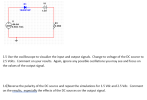 V1 D1 1N4001GP 1.5V R1 2.2㏀ 0.5ms 1ms 1.5 Use the oscilloscope to visualize the input and output signals. Change to voltage of the DC source to 2.5 Volts. Comment on your results. Again, ignore any possible oscillations you may see and focus on the values of the output signal. 1.6 Reverse the polarity of the DC source and repeat the simulations for 1.5 Vdc and 2.5 Vdc. Comment on the results, especially the effects of the DC sources on...
Part I: Black Box A Design your first black box adhering to the following specifications A. Input Signal to Black Box A 1. A 1 kHz cosine wave with amplitude of 1V. B. Output Signal from Black Box A...
 Part I: Black Box A Design your first black box adhering to the following specifications A. Input Signal to Black Box A 1. A 1 kHz cosine wave with amplitude of 1V. B. Output Signal from Black Box A 1. A 1 kHz sine wave with amplitude of Hint: Use an ideal op-amp C. Explain your design process. What type of circuit did you design? Discuss D. Why did vou use an op-amp? Could another component be used instead? Why...
An AM signal is being produced with the following characteristics: fc = 560 kHz, Ec =...
An AM signal is being produced with the following characteristics: fc = 560 kHz, Ec = 1000 V, fm = 3 kHz, Em = 300 V. Calculate the following and show your work: fusb[Upper Sideband Frequency] flsb [Upper Sideband Frequency] m [Modulation Index] %m [Percentage of Modulation] Eusb [Upper Sideband Voltage] Elsb [Lower Sideband voltage] Bandwidth [BW]
3. Let Vi is AC input signal which has following properties: Voffset: 1 Volt Vpp: 0.5 Volt Wavefo...
 3. Let Vi is AC input signal which has following properties: Voffset: 1 Volt Vpp: 0.5 Volt Waveform: Sinus Frequency: 1 KHz a) Why we chose 1 Volt for offset voltage? b) If the waveform is Square, what would happens in terms of circuit characteristics? How do you make AC Analysis of the circuit to calculate expected output signal? Please explain as step by step. R2-820 0 c) (NPN) R1-100 Figure 1. A transistor circuit
3. Let Vi is AC...
3. Let Vi is AC input signal which has following properties: Voffset: 1 Volt Vpp: 0.5 Volt Waveform: Sinus Frequency: 1 KHz a) Why we chose 1 Volt for offset voltage? b) If the waveform is Square, what would happens in terms of circuit characteristics? How do you make AC Analysis of the circuit to calculate expected output signal? Please explain as step by step. R2-820 0 c) (NPN) R1-100 Figure 1. A transistor circuit
3. Let Vi is AC...
Input costs being slow to change is a factor of: a. short-run aggregate demand curve b....
Input costs being slow to change is a factor of: a. short-run aggregate demand curve b. long-run aggregate demand curve c. short-run aggregate supply curve d. long-run aggregate supply curve
Why does the Net Present Value change depending on discount rate being used?
Why does the Net Present Value change depending on discount rate being used?
Remember that the only absrobed power that does not change is real power being 500 KW....
Remember that the only absrobed power that does not change is real power being 500 KW. Provide a Matlab code that shows the following: 1. If the power anhle is changed, what happens to the capacitor, capacitance reactance, apparent power and reactive power? The value of the power angle is 10 degrees. 2. If the capacitor size is changed, what happens to the capacitance reactance, apparent power, reactive power and the power angle? The value of the capacitor is 46...
Let’s look at a simple state machine with the input signal, w, represents a toggle switch for a flashlight that has two modes: blink once or stay on. And the output, z, represents the light being on....
Let’s look at a simple state machine with the input signal, w, represents a toggle switch for a flashlight that has two modes: blink once or stay on. And the output, z, represents the light being on. To get the light to blink once (i.e, have z assert for one cycle), w needs to assert for just one cycle. To get the light to stay on (i.e., have z stay asserted), w needs to assert for two consecutive cycles. After...
hy I need answers of these questions according to data sheet. thank you DATA SHEET PARTI...
 hy I need answers of these questions according to data
sheet. thank you
DATA SHEET PARTI TIME/DIV ims VOLTS/DIV=_IV PEAK VOLTAGE V_47 toms TIME/DIV=_ms VOLTS/DIV-5V PEAK VOLTAGE V_42 PERIOD TO_loms PERIOD T- PART 1 SINEWAVE Vrms (VOLTS) VP (VOLTS) (Voltmeter) (oscilloscope) 7:07 10 3.57 5 2: 78 4 2.10 3 2 Slope=0.707V TIME/DIV=_ams VOLTS/DIVE PEAK VOLTAGE V=_41_ PERIOD T=_toms PART III SQUAREWAVE VAMS (VOLTS) VP (VOLTS) (Voltmeter) (oscilloscope) 10.9 do 542 S 4.4 4 3:3 고 2-2 Slope 0-92-1v PART...
hy I need answers of these questions according to data
sheet. thank you
DATA SHEET PARTI TIME/DIV ims VOLTS/DIV=_IV PEAK VOLTAGE V_47 toms TIME/DIV=_ms VOLTS/DIV-5V PEAK VOLTAGE V_42 PERIOD TO_loms PERIOD T- PART 1 SINEWAVE Vrms (VOLTS) VP (VOLTS) (Voltmeter) (oscilloscope) 7:07 10 3.57 5 2: 78 4 2.10 3 2 Slope=0.707V TIME/DIV=_ams VOLTS/DIVE PEAK VOLTAGE V=_41_ PERIOD T=_toms PART III SQUAREWAVE VAMS (VOLTS) VP (VOLTS) (Voltmeter) (oscilloscope) 10.9 do 542 S 4.4 4 3:3 고 2-2 Slope 0-92-1v PART...
need help with this two questions Analysis A 21. Predict how the voltage across the Explain...
 need help with this two questions
Analysis A 21. Predict how the voltage across the Explain your reasoning for your prediction le voltage across the inductor will change at high and low frequencies 2. Now verify your predic verity your prediction Vary the frequency between 20 to 400 H As you vary requency and everything is working properly. then you should observe a signal similar to the one shown below. BIGOL TO Coupling DC EWL Probe CM 500m Screenshot of...
need help with this two questions
Analysis A 21. Predict how the voltage across the Explain your reasoning for your prediction le voltage across the inductor will change at high and low frequencies 2. Now verify your predic verity your prediction Vary the frequency between 20 to 400 H As you vary requency and everything is working properly. then you should observe a signal similar to the one shown below. BIGOL TO Coupling DC EWL Probe CM 500m Screenshot of...
 V1 D1 1N4001GP 1.5V R1 2.2㏀ 0.5ms 1ms 1.5 Use the oscilloscope to visualize the input and output signals. Change to voltage of the DC source to 2.5 Volts. Comment on your results. Again, ignore any possible oscillations you may see and focus on the values of the output signal. 1.6 Reverse the polarity of the DC source and repeat the simulations for 1.5 Vdc and 2.5 Vdc. Comment on the results, especially the effects of the DC sources on...
 Part I: Black Box A Design your first black box adhering to the following specifications A. Input Signal to Black Box A 1. A 1 kHz cosine wave with amplitude of 1V. B. Output Signal from Black Box A 1. A 1 kHz sine wave with amplitude of Hint: Use an ideal op-amp C. Explain your design process. What type of circuit did you design? Discuss D. Why did vou use an op-amp? Could another component be used instead? Why...
 3. Let Vi is AC input signal which has following properties: Voffset: 1 Volt Vpp: 0.5 Volt Waveform: Sinus Frequency: 1 KHz a) Why we chose 1 Volt for offset voltage? b) If the waveform is Square, what would happens in terms of circuit characteristics? How do you make AC Analysis of the circuit to calculate expected output signal? Please explain as step by step. R2-820 0 c) (NPN) R1-100 Figure 1. A transistor circuit
3. Let Vi is AC...
3. Let Vi is AC input signal which has following properties: Voffset: 1 Volt Vpp: 0.5 Volt Waveform: Sinus Frequency: 1 KHz a) Why we chose 1 Volt for offset voltage? b) If the waveform is Square, what would happens in terms of circuit characteristics? How do you make AC Analysis of the circuit to calculate expected output signal? Please explain as step by step. R2-820 0 c) (NPN) R1-100 Figure 1. A transistor circuit
3. Let Vi is AC...
 hy I need answers of these questions according to data
sheet. thank you
DATA SHEET PARTI TIME/DIV ims VOLTS/DIV=_IV PEAK VOLTAGE V_47 toms TIME/DIV=_ms VOLTS/DIV-5V PEAK VOLTAGE V_42 PERIOD TO_loms PERIOD T- PART 1 SINEWAVE Vrms (VOLTS) VP (VOLTS) (Voltmeter) (oscilloscope) 7:07 10 3.57 5 2: 78 4 2.10 3 2 Slope=0.707V TIME/DIV=_ams VOLTS/DIVE PEAK VOLTAGE V=_41_ PERIOD T=_toms PART III SQUAREWAVE VAMS (VOLTS) VP (VOLTS) (Voltmeter) (oscilloscope) 10.9 do 542 S 4.4 4 3:3 고 2-2 Slope 0-92-1v PART...
hy I need answers of these questions according to data
sheet. thank you
DATA SHEET PARTI TIME/DIV ims VOLTS/DIV=_IV PEAK VOLTAGE V_47 toms TIME/DIV=_ms VOLTS/DIV-5V PEAK VOLTAGE V_42 PERIOD TO_loms PERIOD T- PART 1 SINEWAVE Vrms (VOLTS) VP (VOLTS) (Voltmeter) (oscilloscope) 7:07 10 3.57 5 2: 78 4 2.10 3 2 Slope=0.707V TIME/DIV=_ams VOLTS/DIVE PEAK VOLTAGE V=_41_ PERIOD T=_toms PART III SQUAREWAVE VAMS (VOLTS) VP (VOLTS) (Voltmeter) (oscilloscope) 10.9 do 542 S 4.4 4 3:3 고 2-2 Slope 0-92-1v PART...
 need help with this two questions
Analysis A 21. Predict how the voltage across the Explain your reasoning for your prediction le voltage across the inductor will change at high and low frequencies 2. Now verify your predic verity your prediction Vary the frequency between 20 to 400 H As you vary requency and everything is working properly. then you should observe a signal similar to the one shown below. BIGOL TO Coupling DC EWL Probe CM 500m Screenshot of...
need help with this two questions
Analysis A 21. Predict how the voltage across the Explain your reasoning for your prediction le voltage across the inductor will change at high and low frequencies 2. Now verify your predic verity your prediction Vary the frequency between 20 to 400 H As you vary requency and everything is working properly. then you should observe a signal similar to the one shown below. BIGOL TO Coupling DC EWL Probe CM 500m Screenshot of...
Most questions answered within 3 hours.
-
Where is the error in this code sequence?
String s1 = "Hello";
String s2 = "ello";...
asked 10 months ago -
Financial data for Joel de Paris, Inc., for last year
follow:
Joel de Paris, Inc.
Balance...
asked 10 months ago -
Consider this reaction:
Al2(SO4)3 (aq)+ BaCl3
(aq) Al2Cl6 (aq)- +
3BaSO4(s) . What is the...
asked 10 months ago -
Suppose that Savneet is considering increasing her
recent random sample from 20 car rentals to 40...
asked 10 months ago -
Trucks arrive at an unloading terminal at an average rate of 120
per hour.
Trucks arrive...
asked 10 months ago -
Why are methanol and ethanol completely soluble in water while
octanol is not very little soluble....
asked 10 months ago -
A facilities manager at a university reads in a research report
that the mean amount of...
asked 10 months ago -
When the CuSO4 is rehydrated by adding water to the anhydrous
compound, is this an endothermic...
asked 10 months ago -
A ray of sunlight is passing from diamond into crown glass; the
angle of incidence is...
asked 10 months ago -
A block of mass 0.249 kg is placed on top of a light, vertical
spring of...
asked 10 months ago -
how do the kidneys compensate in the presences of acidosis
a) trigger hyperventilate
b) reserve acid...
asked 10 months ago -
Question 501 pts
The rental rate of capital to the firm increases. Which of the
following...
asked 10 months ago